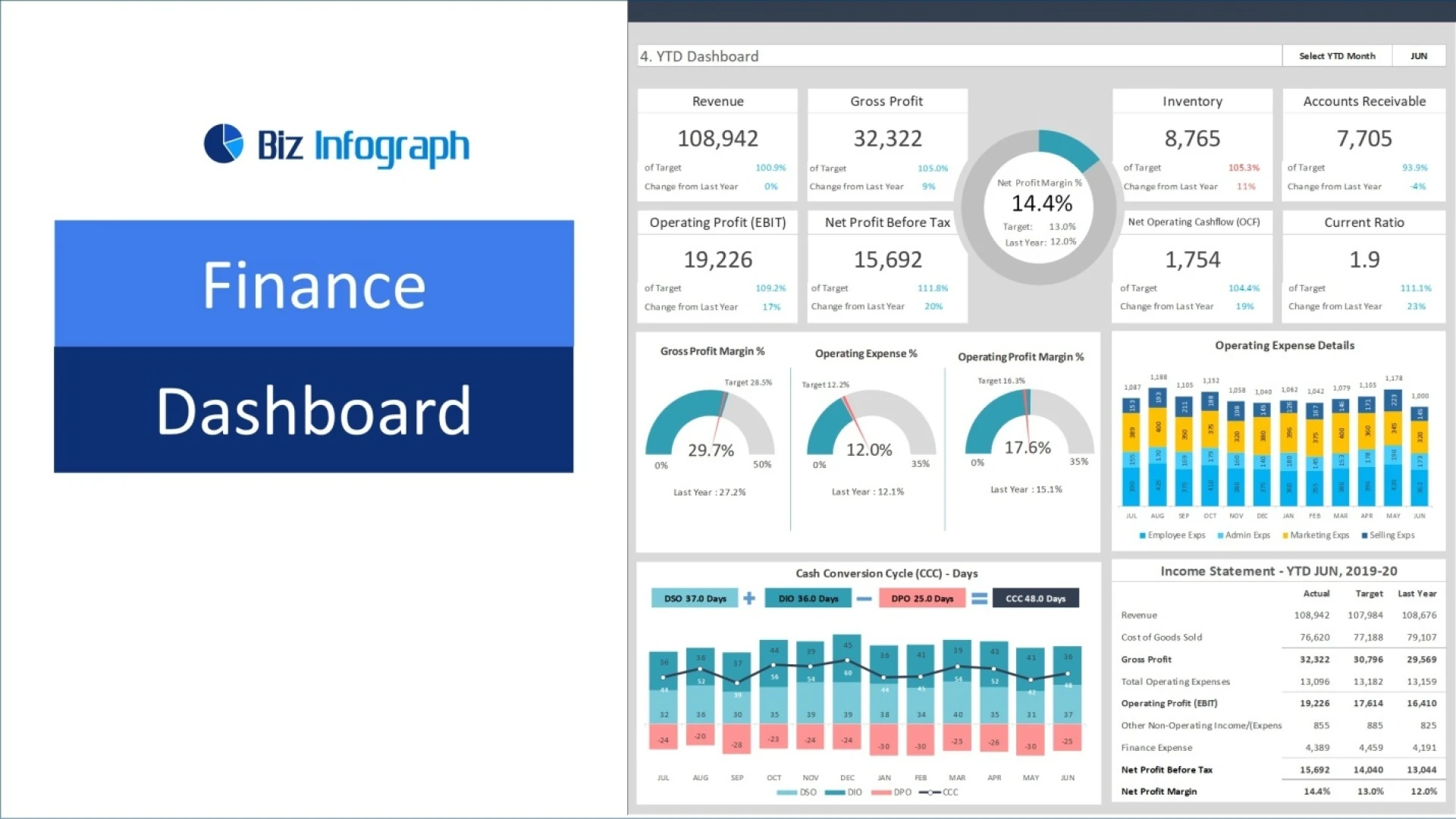

Basic financial modeling skills are necessary for every business manager, whether you’re just starting out or have years of experience. The good news? Even without previous experience, you can learn how to work with these nine most common financial models using this introductory guide.
With these tips under your belt, you’ll be able to confidently create and interpret any financial model in a financial dashboard!
Model #1: Break-Even Analysis
Break-Even Analysis is a calculation determining the point at which your product or service will be self-sustaining. It tells you how much money you will have to make before the business starts making a profit. For example, if you need to make $5,000 per month to break even and start turning a profit, your break-even point is $5,000/per month. You can calculate your break-even point by taking the cost of each unit (or what it costs to produce one of your products) times 12 months (the number of months in a year).
You can also use this formula: Total Fixed Costs ÷ Number of Units Sold = Break-Even Point. Total Fixed Costs are all the expenses associated with running your business, whether fixed monthly or one-time start-up costs. An excellent way to think about Fixed Costs is everything that doesn't change daily. For example, rent on office space, wages for a full-time employee, insurance premiums, etc.
Model #2: Business Valuation
This is the process of estimating the value of a company. It is done by comparing what a company might be worth with its tangible assets, looking at comparable companies in similar industries, and then making adjustments for intangible assets. The most common way to do this is by using discounted cash flow analysis, which values a company based on how much cash it will produce in the future.
Model #3: Capital Budgeting
Capital Budgeting is a process that helps businesses determine the most profitable investment opportunities. These investments are made to raise a company's productivity, which leads to an increase in profit.
Model #4: Cash Flow
Cash flow is the cash generated from your operations minus what you spend. For example, if you spend $1,000 and generate $500 in revenue, your cash flow is -$500. Cash flow can be positive or negative depending on how much cash is coming in versus how much cash is going out of your business.
Model #5: DCF (Discounted Cash Flow)
This is a financial model that calculates the value of an investment by taking the net present value (NPV) of all the expected future cash flows. This calculation estimates how much an investor should be willing to pay for a given asset based on how much profit it is expected to generate in the future. The DCF model uses a discount rate to determine what amount should be invested today to have a certain amount available at some point in the future.
For example, if you invest $100 and your annual interest rate is 5%, your total balance after one year will be $105 ($100 + 5% interest). To calculate the NPV of $100 after 20 years, you need to divide the total cost ($100) by the percentage (5%). You will then get $2000 as your answer because you would have made five times your initial investment over 20 years.
Model #6: Economic Value Added (EVA)
EVA is a financial model on your financial dashboard that measures profit by determining the difference between the economic value of a company's output and its cost. The higher a company's EVA, the more it is worth. A company with an EVA of 15% performs better than an EVA of 5%. EVA is similar to ROI in that both measure what you get for your investment.
Model #7: Financing Options
You can finance that growth by raising money through debt or equity when you need capital to grow. Debt financing involves borrowing money, typically paid back with interest over a set period. Equity financing is when the company sells shares of its ownership to investors in return for capital.
The most common type of equity financing is an initial public offering (IPO), which is when a business offers its shares on the stock market for the first time.
Model #8: NPV (Present Net Value)
NPV is a financial model used to determine an investment's profitability. It calculates the present value of future cash flows and discounts them to a present value. You can calculate the NPV by multiplying the cash flow for each period by its respective weight, summing these products, and then dividing by 1 minus the cost of capital or discount rate. This can help you decide if an investment is worth it or not. For example, say that Project A costs $10,000 but will bring in $5,000 per year over the next 3 years. If the cost of capital is 10%, then the project's net present value would be:
$5,000*3 + $10,000*(1-0.1) = $24,000.
Model #9: ROI (Return On Investment)
ROI, or return on investment, is a business model that calculates the profits an investor receives in proportion to their initial capital input. For example, if you invest $1,000 and make $1,200 in profits over a year, your ROI is 20%. This means that for every dollar invested by the investor, they receive an additional 20 cents back. This is one of the most important models to know because it quantifies any project's profitability based on what has been initially put in.
ROI can also be considered a ratio between profit margin and total assets employed, often used interchangeably. For example, if a company invests $10 million but only net earnings worth $2 million, then it has an ROI of 20%.
Sign Up For A Professionally Designed Financial Dashboard
If you want to streamline your financial process and get better insight into your business, Biz Infograph can help you. They offer numerous dashboard templates, including financial and excel dashboard templates. These dashboards will focus on all finance-related KPIs and help you focus on important metrics.
Sign up today and learn about all that they have to offer.
About The Author
Kayla M. is a financial expert affiliated with Biz Infograph and writes blogs to offer her insights into the financial world to business owners. She also conducts seminars and technical trainings to help individuals make the most of professionally designed financial keyboards.
0
























Sign in to leave a comment.