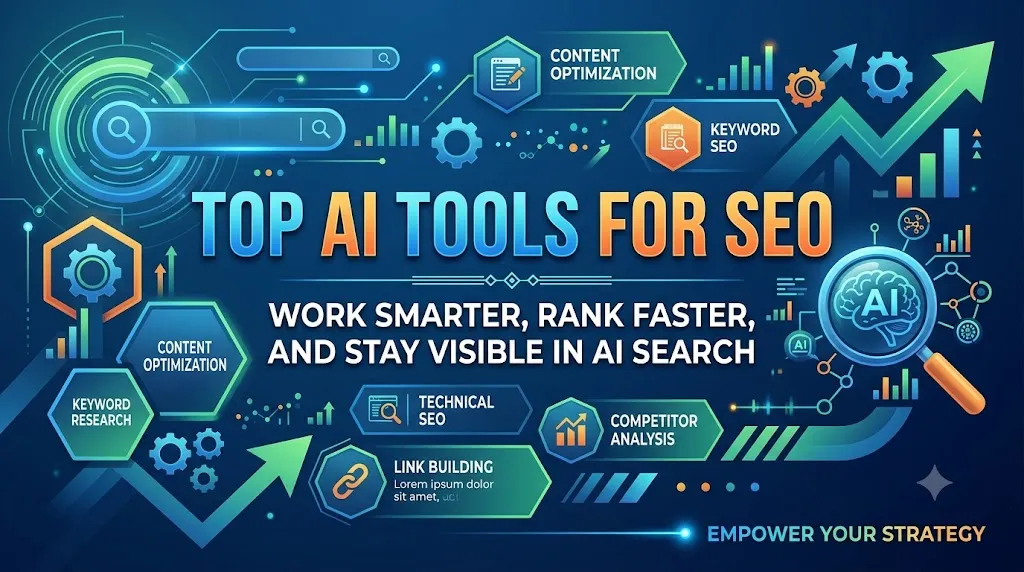

SEO has always involved repetitive work: researching keywords, auditing pages, optimizing content, building reports, and tracking results. AI tools now handle much of that heavy lifting, freeing you to focus on strategy, creativity, and quality.
But not every tool lives up to its marketing. This guide covers what AI can realistically do for SEO, the tools worth considering, how to build an efficient workflow, and how to avoid the mistakes that cost teams time and rankings. If you want a shorter shortlist to compare against, this roundup of the top AI SEO tools in 2026 is a useful companion.
How AI Helps With SEO
AI is most useful where work is repetitive, data-heavy, or pattern-based. Common uses include:
- Keyword research and clustering: grouping thousands of keywords by topic and intent
- Content briefs and outlines: summarizing what top-ranking pages cover
- On-page optimization: suggesting headings, related terms, and missing subtopics
- Technical audits: spotting broken links, duplicate content, and crawl issues faster
- Meta tags and schema: drafting titles, descriptions, and structured data at scale
- Internal linking: suggesting relevant pages to connect
- Reporting and analysis: summarizing performance trends and anomalies
- AI search visibility: tracking whether your brand is mentioned in AI-generated answers
What AI cannot do is replace experience, original insight, or editorial judgment. Treat it as a fast assistant, not an autopilot.
Why AI Matters More Than Ever for SEO
Search is changing in two ways at once. First, the workload is growing: sites are larger, competition is tighter, and manual processes struggle to keep up. Second, the way people find information is shifting. AI-generated answers, chat-based search, and summaries now sit alongside traditional blue links.
That means SEO is no longer only about ranking a page. It's also about being a source that search engines and AI assistants can understand, trust, and cite. Clear structure, accurate information, strong expertise signals, and consistent brand mentions all help. AI tools can speed up both sides of the job: the classic optimization work and the newer task of monitoring how your brand appears in AI answers.
Top AI Tools for SEO
General AI Assistants: ChatGPT, Claude, and Gemini
These are flexible starting points for brainstorming topics, drafting outlines, rewriting meta descriptions, generating FAQ ideas, clustering keywords from a pasted list, and writing formulas or scripts for spreadsheets. They work best with detailed prompts and your own data. Always verify any facts, statistics, or claims they produce.
Semrush
A long-established SEO suite that has added AI features alongside keyword research, competitor analysis, site audits, and rank tracking. It suits teams that want research, content, and reporting in one platform.
Ahrefs
Known for backlink and keyword data, Ahrefs has also expanded into AI-related features, including tools aimed at understanding brand visibility in AI-driven search. A good fit for experienced SEOs who value data depth.
Surfer SEO
Focused on content optimization. It analyzes top-ranking pages and guides you on structure, length, and related terms so your content covers a topic thoroughly. It's popular with content teams and bloggers.
Clearscope
A content optimization tool built around relevance and topic coverage. It's often favored by editorial teams that want clean, readable recommendations rather than a heavy scoring system.
Frase
Helps with research and briefs by pulling together what searchers ask and what competing pages cover. Useful for producing outlines and answering questions directly.
MarketMuse
Emphasizes topic authority and content planning. It helps larger sites find content gaps and decide what to publish or update next.
NeuronWriter
A budget-conscious content optimization option offering keyword suggestions, competitor analysis, and writing guidance. It works well for small teams and freelancers.
Screaming Frog SEO Spider
A crawler for technical audits that finds broken links, redirects, missing tags, and duplicate content. Newer versions can connect with AI models for tasks like generating alt text or classifying pages, though you should check the current feature set.
Rank Math and Yoast
WordPress plugins that assist with on-page SEO, schema, and meta tag suggestions. Both have AI-assisted features, though availability depends on the plan you choose.
Google Search Console and Google Trends
Not AI tools in the strict sense, but essential free sources of real performance and demand data. Pair them with an AI assistant to summarize trends and spot opportunities.
Features, plans, and pricing change frequently, so confirm what's currently included before subscribing.
Tools by Task: A Quick Reference
| SEO task | Tools to consider |
| Keyword research and clustering | Semrush, Ahrefs, ChatGPT, Claude, Gemini |
| Content briefs and optimization | Surfer SEO, Clearscope, Frase, NeuronWriter |
| Content strategy and gap analysis | MarketMuse, Semrush, Ahrefs |
| Technical audits | Screaming Frog, Semrush, Ahrefs |
| On-page and schema (WordPress) | Rank Math, Yoast |
| Performance data | Google Search Console, Google Trends |
| AI search visibility | Ahrefs and other emerging AI visibility trackers |
How to Evaluate an AI SEO Tool Before You Buy
Flashy demos are easy. Real value is harder to spot. Before subscribing, ask:
- Does it solve a problem you actually have? A shiny feature you won't use is wasted budget.
- Where does the data come from? Keyword and competitor data should be current and clearly sourced.
- Can you export and integrate? Look for spreadsheet exports, API access, or links to your CMS and analytics.
- How good is the output without editing? Test it on a real page, not the sample provided.
- Is there a trial or free plan? Run it on one live project before committing.
- What does support look like? Documentation and responsive help matter when something breaks.
- What is the total cost? Account for seats, usage limits, and add-ons, not just the headline price.
How to Choose the Right Tool
- Solo bloggers and beginners: Start with a general AI assistant plus free Google tools, then add a content optimizer like Surfer or NeuronWriter.
- Content teams: Combine a research and brief tool such as Frase or Clearscope with an editorial review process.
- Agencies and larger sites: Choose an all-in-one platform like Semrush or Ahrefs, supported by a crawler and a content planning tool.
- WordPress sites: Use Rank Math or Yoast for day-to-day on-page tasks.
Avoid paying for overlapping tools. Most teams need one research platform, one content optimizer, and one crawler at most.
A Practical AI-Assisted SEO Workflow
- Research keywords and questions with an SEO platform and Search Console.
- Cluster keywords by topic and intent, using AI to speed up grouping.
- Build a brief from top-ranking pages, noting gaps you can fill.
- Draft or outline with an AI assistant, then add original insight, examples, and expertise.
- Optimize with a content tool, focusing on clarity rather than chasing a perfect score.
- Edit and fact-check everything before publishing.
- Add structure such as clear headings, FAQs, and schema where appropriate.
- Measure and refresh content regularly based on real performance data.
Tools handle the speed, but strategy is what turns activity into rankings. If you'd rather hand the planning and execution to specialists, professional SEO services can combine technical, content, and link-building work into one plan.
Example Prompts That Work Well
Good prompts give context, constraints, and a clear format. A few examples you can adapt:
- "Group these 200 keywords into topic clusters and label the search intent of each cluster."
- "Write five meta description options under 155 characters for a page about [topic], aimed at [audience]."
- "List the questions a first-time buyer of [product] would ask, ordered by search intent."
- "Review this outline and point out subtopics a searcher would expect that are missing."
Replace the brackets with real details, paste in your own data, and always review the results.
Optimizing for AI Search
AI-driven search is becoming a real traffic and visibility channel. A few practices help your content get understood and cited:
- Answer questions directly. Lead sections with a clear, concise answer, then add detail.
- Use clean structure. Descriptive headings, short paragraphs, lists, and tables make content easier to parse.
- Demonstrate expertise. Include author bios, original data, real examples, and cited sources.
- Keep facts accurate and current. Outdated or contradictory information reduces trust.
- Build consistent brand signals. Mentions, reviews, and a coherent presence across the web strengthen credibility.
- Monitor your visibility. Check how your brand and content appear in AI-generated answers, and adjust accordingly.
This is a fast-moving area, and many businesses benefit from specialist help. Dedicated AI SEO services focus on exactly this blend of traditional optimization and visibility in AI-powered search.
Mistakes to Avoid
- Publishing raw AI output. Unedited content tends to be generic, repetitive, and sometimes inaccurate.
- Chasing optimization scores. A tool's score is a guide, not a ranking guarantee.
- Trusting facts blindly. AI can state wrong information confidently, so verify names, figures, and sources.
- Ignoring search intent. Content must answer what the searcher actually wants.
- Using too many tools. More subscriptions rarely mean better results.
- Skipping originality. Search engines and readers reward first-hand experience, expert input, and unique perspective.
- Neglecting technical basics. Fast pages, clean crawling, and proper indexing still matter, no matter how good the content is.
Frequently Asked Questions
Can AI replace an SEO professional?
No. AI speeds up research and production, but strategy, judgment, and quality control still need a human.
Is AI-generated content bad for SEO?
Not inherently. Search engines focus on whether content is helpful, accurate, and original. Low-quality, mass-produced content is the problem, whoever or whatever wrote it.
Which AI SEO tool is best for beginners?
A general AI assistant combined with free Google tools is a low-cost way to start. Add a paid content optimizer once you're publishing regularly.
How many AI SEO tools do I need?
Usually one research platform, one content optimizer, and one crawler. More often adds cost than value.
How long does it take to see results?
SEO is gradual. Tools can speed up your workflow, but rankings typically take weeks to months to move.
Final Thoughts
AI tools can speed up research, tighten content, and uncover technical issues, but results still depend on the person using them. Pick a small, well-matched toolkit, keep humans in charge of quality and accuracy, and use AI to take on the repetitive work so you can focus on strategy and creativity. As search expands into AI-generated answers, the brands that combine solid fundamentals with clear, trustworthy content will be the ones that stay visible.

























Sign in to leave a comment.