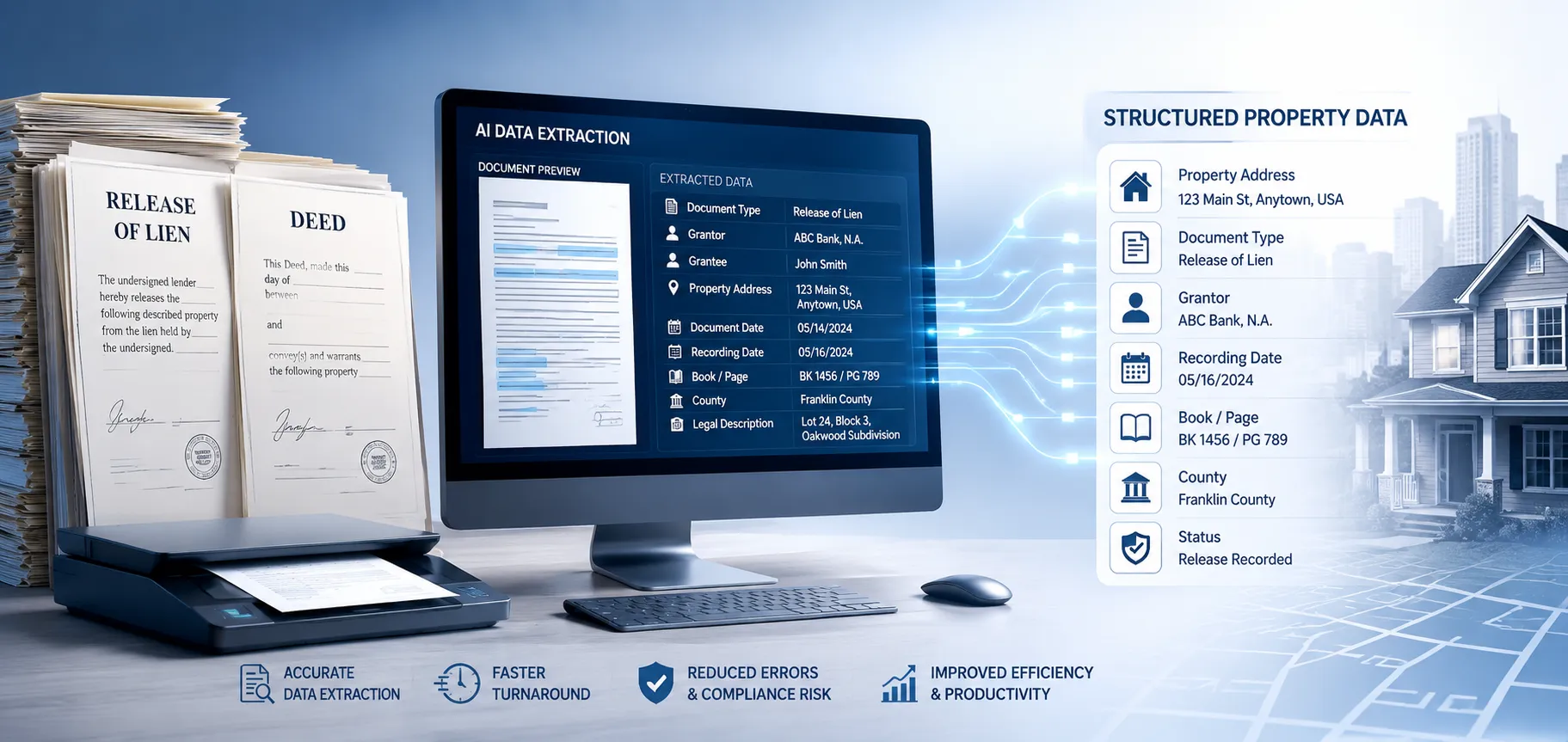

Real estate data has become one of the most valuable decision making resources in 2026. Investors, lenders, insurance firms, and PropTech platforms all depend on accurate property records to evaluate risk, identify opportunities, and track ownership changes.
The scale of this data is massive. In the United States alone there are more than 160 million property parcels, and each one can generate multiple updates across its lifecycle including ownership transfers, tax updates, mortgage filings, and legal releases. These updates happen continuously at the county and state level, which makes manual tracking almost impossible.
At the same time, this information is spread across thousands of fragmented systems. Some records exist in modern databases while others are still stored as scanned PDFs or outdated government portals. This creates a strong need for automated solutions like data extraction companies that can unify everything into structured, usable formats.
Data extraction companies solve this problem by collecting raw information from public sources, cleaning it, and converting it into structured datasets or APIs that businesses can use instantly.
What Data Extraction Companies Actually Do
Data extraction companies specialize in turning unstructured or semi structured data into organized and usable formats. In the context of property records and releases, this includes information such as ownership details, deed transfers, tax assessments, liens, foreclosure records, and legal filings.
These companies typically deliver data in formats like JSON, CSV, Excel files, or through APIs that connect directly to business systems. Some also provide fully managed databases hosted on cloud platforms.
Their work usually involves three key stages. First, they collect raw data from multiple sources including government websites, real estate portals, and legal repositories. Second, they clean and normalize the data so it follows a consistent structure. Third, they validate and enrich the data to ensure accuracy and completeness.
This process helps businesses avoid the complexity of dealing with inconsistent formats and unreliable sources.
Why Property Records and Release Data Are Difficult to Extract
Property data extraction is more complex than most people realize. One major challenge is fragmentation. In the United States alone there are over 3000 county level jurisdictions, and each one maintains its own system for recording property information. There is no single standardized database.
Another challenge is the format of the data itself. Many records are stored in scanned documents or PDFs that require optical character recognition before they can be processed. Even when digital systems exist, they often use outdated structures that are not easy to parse.
Anti scraping technologies also create barriers. Many websites use CAPTCHA systems, IP blocking, or dynamic content loading to prevent automated access. This makes large scale extraction technically challenging.
Finally, compliance requirements add another layer of complexity. Companies must ensure that data collection practices comply with regional privacy and data usage regulations. All of these challenges make specialized providers essential for reliable property data extraction.
Key Features to Look for in a Data Extraction Company
When choosing a data extraction provider for property records and releases, there are several important factors to consider.
The first is accuracy. Property data is often used for financial and legal decisions, so even small errors can lead to significant risks.
The second is coverage. A strong provider should be able to access multiple jurisdictions and handle different types of property records including ownership history, tax information, and legal filings.
The third is scalability. Businesses often need millions of records processed regularly, so the infrastructure must support high volume extraction without delays.
The fourth is delivery flexibility. Good providers offer multiple formats such as APIs, bulk downloads, and cloud integrations.
The fifth is compliance. Data must be collected and delivered in a way that respects legal and regulatory requirements.
Top 10 Data Extraction Companies for Property Records and Releases
1. HabileData
HabileData specializes in data processing, document-heavy extraction, and property data solutions for businesses handling complex real estate records. It is particularly strong in handling complex property related documents such as deeds, mortgage records, and legal filings.
The company uses a combination of automation and human validation to ensure high accuracy. This hybrid approach is especially useful when dealing with unstructured or scanned documents.
HabileData is commonly used by title companies, legal organizations, and real estate analytics firms that require precise and validated property records. Its strength lies in accuracy and attention to detail rather than raw speed.
2. Hitech BPO
Hitech BPO focuses on large scale data digitization and geospatial processing. It has strong capabilities in GIS mapping, land records digitization, and cadastral data management.
The company operates large offshore teams that can handle high volume data extraction projects at scale. This makes it suitable for government programs and enterprise level transformation initiatives.
Hitech BPO is often used for infrastructure mapping and land record modernization projects. It is especially strong in cost efficient large scale operations.
3. ATTOM Data Solutions
ATTOM is one of the most established property data providers in the United States. Unlike scraping platforms, it offers structured and licensed property datasets.
It covers more than 160 million property parcels across the country. The data includes ownership history, tax records, mortgage information, and foreclosure details.
ATTOM is widely used in lending, insurance, and real estate analytics. It is especially valuable for companies that need reliable and pre structured property intelligence. Its datasets are considered highly trusted in the industry.
4. CoreLogic
CoreLogic is one of the most established real estate data and analytics providers globally. Unlike scraping platforms, it delivers licensed and structured property datasets.
It provides detailed coverage of property ownership, valuation, mortgage, and tax records across multiple regions.
CoreLogic is widely used in lending, insurance, and risk assessment industries. It is especially valuable for organizations that require verified and compliant property intelligence. Its data is widely trusted for financial and underwriting decisions.
5. Black Knight (ICE Mortgage Technology)
Black Knight, now part of ICE Mortgage Technology, is a leading provider of mortgage and property data solutions for the financial services industry.
It specializes in end to end mortgage lifecycle data, including foreclosure tracking, loan servicing, and property valuation insights.
The company is widely used by banks, mortgage lenders, and financial institutions that require deep integration between property records and lending workflows. Its strength lies in combining property data with financial risk analytics.
6. Quantarium
Quantarium is a real estate data and analytics company focused on AI driven property intelligence.
It enhances property records using machine learning models to generate valuation estimates, risk scores, and market insights.
The company is widely used by PropTech platforms, lenders, and insurance providers that need predictive property analytics. Its strength lies in transforming raw property data into intelligent insights.
7. Reonomy (CoStar Group)
Reonomy, part of CoStar Group, is a commercial real estate data platform specializing in property ownership intelligence.
It provides detailed insights into commercial buildings, ownership structures, tenant data, and transaction history.
Reonomy is widely used by commercial real estate investors, brokers, and asset managers. Its focus is deep commercial property intelligence and network level ownership insights.
8. Grepsr
Grepsr is a managed data extraction service that delivers clean and structured datasets. It focuses on long term data pipelines rather than one time scraping tasks.
The company handles everything from extraction to cleaning and delivery, which reduces operational burden for clients.
Grepsr is commonly used by businesses that need consistent property data feeds over time.
9. DataFlirt
DataFlirt specializes in real estate data extraction in the Indian market. It has strong expertise in extracting data from platforms such as 99acres and MagicBricks.
The company is known for handling anti scraping challenges effectively in regional property portals.
DataFlirt is widely used by brokers, aggregators, and PropTech platforms operating in India.
10. Thordata
Thordata is a niche provider focused on structured real estate datasets. It emphasizes clean and normalized outputs that are ready for analysis.
The company is often used by startups and analytics platforms that need simplified and structured property information. Its focus is more on usability and clarity rather than raw extraction volume.
Use Cases of Property Data Extraction
Property data extraction supports several industries.
Real estate investors use it to identify undervalued properties and track market trends. Lending institutions rely on it for risk analysis and loan approvals. Legal firms use it for title verification and ownership history. PropTech companies use it to build property search and valuation platforms.
In every case, structured data improves decision making speed and accuracy.
Why Companies Prefer Outsourcing Data Extraction
Building internal data extraction systems is expensive and complex. Companies often spend between 50,000 and 200,000 dollars annually maintaining scraping infrastructure.
They also need to constantly update systems to handle website changes and anti bot technologies. Compliance risks add further complexity. Outsourcing to specialized providers allows businesses to focus on analysis rather than data collection.
Future Trends in Property Data Extraction
The future of property data extraction is moving toward automation and intelligence.
Artificial intelligence is being used to interpret unstructured documents like scanned deeds and legal filings. Real time data pipelines are replacing static datasets. Cloud based systems are becoming standard for delivery and storage.
Over time, property data will become more unified, structured, and instantly accessible.
Conclusion
Choosing the right data extraction company depends on your specific needs. Enterprise platforms are best for scale and automation. Mid sized providers are ideal for document heavy and validated workflows. Niche companies are useful for specialized or regional data requirements.
In a data driven real estate market, having accurate and structured property information is no longer optional. It is a core advantage that directly impacts speed, efficiency, and decision making quality.
Frequently Asked Questions
What are data extraction companies and how do they work?
Data extraction companies specialize in collecting unstructured or semi-structured data from various sources, cleaning it, and converting it into organized formats like JSON or CSV. They typically follow a three-stage process: collecting raw data, normalizing it to ensure consistency, and validating its accuracy for reliable use in business applications.
Why is property data extraction considered complex?
Property data extraction is complex due to fragmentation across over 3,000 county jurisdictions, each with its own recording systems. Additionally, many records are stored in outdated formats like scanned PDFs, and anti-scraping technologies can hinder large-scale automated access, making specialized providers essential for effective data extraction.
What features should I look for in a data extraction provider?
When choosing a data extraction provider, prioritize accuracy to prevent costly errors, coverage of multiple jurisdictions, scalability for high-volume needs, delivery flexibility in various formats, and compliance with legal regulations. These features ensure you receive reliable and usable property data.
How do data extraction companies ensure data accuracy?
Data extraction companies ensure accuracy through a combination of automated processes and human validation. This hybrid approach is particularly effective for handling complex or unstructured documents, allowing them to provide precise and reliable property records essential for financial and legal decisions.
What industries benefit from property data extraction?
Various industries benefit from property data extraction, including real estate investors who analyze market trends, lending institutions that conduct risk assessments, legal firms needing title verification, and PropTech companies developing property platforms. Structured data enhances decision-making speed and accuracy across these sectors.
Why should companies outsource property data extraction instead of managing it in-house?
Outsourcing property data extraction allows companies to avoid the high costs and complexities of maintaining their own systems. By partnering with specialized providers, businesses can focus on data analysis rather than data collection, while also mitigating compliance risks and adapting to website changes more efficiently.
What future trends are expected in property data extraction?
The future of property data extraction is leaning towards increased automation and the use of artificial intelligence to interpret unstructured documents. Real-time data pipelines will replace static datasets, and cloud-based systems will become standard for data delivery and storage, resulting in more unified and accessible property information.




























Sign in to leave a comment.