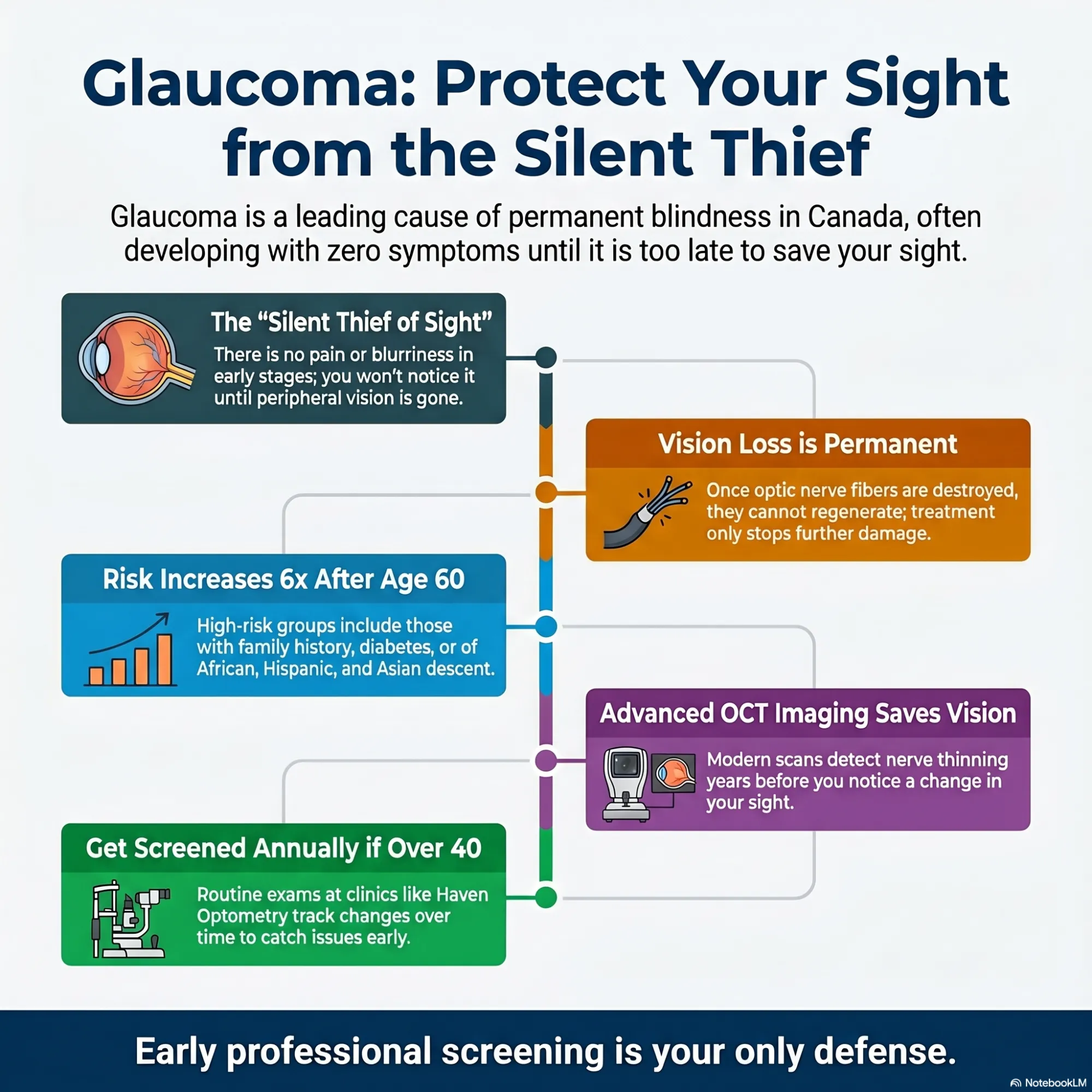

If you’re set on postponing your next Port Coquitlam eye exam and live in Port Coquitlam, you should definitely reconsider. The reason? Glaucoma is one of the top causes of permanent loss of vision in Canada. The most troubling part of this condition is that the vast majority of the population doesn’t notice problems with their vision until it is too late and the damage has already been done. The bright side of this is that early stages are still very easy to manage after being discovered. Only a simple screening done by a Port Coquitlam optometrist can bring this condition to light.
This guide will cover just about everything to do with Glaucoma. After reading this, you will not only understand the condition but also how it will affect your vision, the process of screening, and the importance of selecting the eye care provider of your choice in Port Coquitlam.
What Is Glaucoma?
Glaucoma is a group of diseases that involve damage to the optic nerve, which serves the function of delivering visual data from the eyes to the brain. For the majority of cases, this is caused by the gradual development of optic nerve compression as a result of increased pressure within the eye, which is classified as Intraocular Pressure. This causes a number of nerve fibers to die. This results in a progressive constriction of the field of vision, which starts from the sides.
The most dangerous characteristic of glaucoma is the discreteness of its development. In early stages, there are virtually no symptoms. No pain, visual acuity remains clear, and there are no physical manifestations. The disease has usually already progressed beyond the point of no return by the time an individual becomes aware of the disease through their loss of peripheral vision. Because of this, glaucoma is most often called the "silent thief of sight."
There are many forms of glaucoma, each with its own characteristic behavior.
- The most common form, which accounts for the majority of cases, is Open-Angle Glaucoma. This is a slowly developing, insidious form of glaucoma with almost no symptoms until late stages.
- The less common form, but more insidious, is Angle-Closure Glaucoma. This form of glaucoma is classified as a medical emergency, and may result in the development of acute episodes which are characterized by severe eye pain, nausea, headaches, and rapidly developing blurriness of vision.
- The most elusive form of glaucoma is classified as Normal-Tension Glaucoma. Despite eye pressure being classified as normal, the optic nerve is still being damaged, and therefore is particularly difficult to identify without extensive investigative procedures.
- Lastly, there is Pigmentary Glaucoma which results when pigment granules from the iris clog the drainage canals of the eye, and Secondary Glaucoma which occurs as the result of an eye injury, inflammation, or the administration of steroids.
Another reason to consult a skilled Port Coquitlam optometrist instead of practicing self-assessment is that each condition requires its own specific testing and management.
Who Is at Risk for Glaucoma?
While anyone can develop glaucoma, a few groups have a higher probability. Knowing your risk factors is the first step towards prevention.
The following characteristics denote higher risk of developing glaucoma.
Older than 60 — The older a person is, the greater their risk of developing glaucoma. Once a person is older than 60, the risk becomes 6 fold.
Family History — Glaucoma tends to run in families. The greater the proximity to the family member with the disease (i.e. parent vs. cousin) the more likely the person is to develop glaucoma.
Intraocular Pressure (IOP) — High eye pressure is the most commonly known reason for developing open angle glaucoma.
Certain Ethnicities — Glaucoma tends to affect people of African, Hispanic, or Asian descent more often.
Diabetes or Hypertension — Both diseases can result in poor blood flow and can impact glaucoma.
very severe Myopia — Glaucoma is more likely to develop with higher optical prescriptions.
Eye trauma — Injuring the eye can cause glaucoma by lowering the drainage for eye fluid.
Corticosteroid use — Long term use of oral or Steroid eye drops can cause glaucoma.
If any of these are true for you, you need to have your eyes checked for glaucoma.
How Glaucoma Affects Your Vision Over Time
Understanding the progression of untreated glaucoma helps illustrate why early detection is so critical.
Stage 1 - Pre-Perimetric: At this level, optic nerve displays early, minor, and detectable structural damage. Routine vision tests will show no significant loss. Identification of the damage will require the use of novel imaging modalities.
Stage 2 - Early Vision Loss: Loss of wider vision begins and is generally unperceived by the individual, as the loss is compensated by the brain filling in the missing portions of the field.
Stage 3 - Moderate Vision Loss: At this stage, the loss is perceivable and will significantly impact a person’s ability to drive and make navigating unfamiliar spaces considerably difficult.
Stage 4 — Advanced Vision Loss: Tunnel vision sets in, where only a small central area of sight remains functional.
Stage 5 — Blindness: Without treatment, glaucoma can result in total, permanent blindness. This damage cannot be reversed.
The key word throughout all of these stages is "permanent." Once optic nerve fibres are destroyed, they do not regenerate. That is why no treatment can restore vision already lost to glaucoma — it can only slow or stop further damage.
Glaucoma Screening: What to Expect at Your Eye Exam
When you visit a Port Coquitlam optometrist for a comprehensive eye exam, a thorough glaucoma screening involves several diagnostic tests. Each one provides a different piece of the picture, and together they allow your optometrist to assess your risk accurately.
1.Tonometry—Measuring Intraocular Pressure (IOP)
Tonometry is a common intraocular pressure (IOP) test for glaucoma. IOP is generally in the 10–21 mmHg range. While higher measured pressure is a significant risk factor for glaucoma, it is not an automatic diagnosis.
There are a couple of methods. These include non-contact tonometry (the “air puff” test) and Goldmann applanation tonometry, which is actually the most accurate.
2.Ophthalmoscopy—Viewing the Nerve
This test involves dilation of the pupil and the use of specialized equipment to view the optic nerve. Shape, color, and the cup-to-disc ratios of the nerve can provide glaucoma-related information.
3.Perimetry—Field of Vision Testing
This test is designed to evaluate the boundary of your nervous system's field of vision. Spots of light are presented to your vision field, and you press a button when you see the light. Reduced field vision is indicative of damage to the nervous system and will be investigated further.
4.Pachymetry—Measuring Cornea Thickness
Pachymetry is done to account for the thickness of the cornea. A thin cornea can cause an underestimate of IOP. A thick cornea can be the opposite.
5.Gonioscopy—Viewing the Drainage Angle
This test is helpful to the optometrist to view the drainage angle of the eye where fluid exits. This is helpful to decipher open-angle and angle-closure glaucoma.
6.OCT (Optical Coherence Tomography) — Advanced Retinal Imaging
OCT employs light waves to generate high-resolution, cross-sectional scans of the optic nerve and retinal nerve fibre layer. Because OCT can analyze the nerve fibre layer and determine whether nerve fibre thinning occurs prior to any visual field loss, it is invaluable as an early-detection tool. Advanced OCT imaging is used during assessments of eye health at clinics like Haven Optometry in Port Coquitlam.
Treatment and Management of Glaucoma
There is no cure for glaucoma and no way to regain lost vision. However, if detected early, glaucoma is manageable. The goal of treatment is to lower the pressure of the fluid in the eye to reduce the risk of further damage to the optic nerve.
Eye Drops
Eye drops are the most commonly prescribed treatment. Medicated eye drops lower eye fluid pressure by either (1) improving the drainage of the fluid or (2) decreasing fluid production. The classes of drops include, but are not limited to, prostaglandin analogues, beta-blockers, and alpha-agonists. To be effective, daily administration of the drops is required.
Oral Medications
In some cases, oral carbonic anhydrase inhibitors are prescribed to reduce fluid production. These are typically used short-term or when drops are not sufficient on their own.
Laser Therapy
Selective Laser Trabeculoplasty (SLT) is a low-risk, outpatient, minimally invasive procedure that improves eye drainage. This procedure is often recommended when eye drops are not adequately controlling eye pressure, or when patients wish to be less dependent on daily medication.
For angle-closure glaucoma, Laser Peripheral Iridotomy (LPI) is performed to create a small opening in the iris to allow free flow of the fluid.
Surgical Options
Your optometrist will refer you to an ophthalmologist if you need a treatment like trabeculectomy or the implantation of micro-stents (MIGS) as these are more advanced treatment options.
MIGS and trabeculectomy are recommended when other treatment options are not enough to control your glaucoma.
Your Port Coquitlam optometrist is your first line of defense against the progression of glaucoma. The treatment options for glaucoma are far less complicated if the condition is caught sooner rather than later.
Why Glaucoma Screening Should Be Part of Your Routine Eye Care
Most people only visit an optometrist when their vision has issues. While this is a common approach, it is dangerous for the health of your eyes when it comes to glaucoma.
The early stages of glaucoma do not manifest any symptoms; therefore, to catch it before major damage occurs, you must be proactive. The Canadian Association of Optometrists recommends that the eye exams of adults aged 20-39 should be conducted every 2- 3 years. Adults 40 and older should have annual exams. Those in the high-risk category should have exams annually, and even more frequently, if recommended.
Seeing a Port Coquitlam optometrist on a regular basis should be done every year. These exams make a record of your eye health which allows the optometrist to track both your health history and any changes to your vision over time. This changes the value of the vision records from a snapshot to a historical comparison that allows the optometrist to assess your eye health over the years.
Haven Optometry: Comprehensive Glaucoma Screening in Port Coquitlam
When it comes to glaucoma screening and comprehensive eye care in Port Coquitlam, Haven Optometry stands out as a trusted destination for families and individuals across the Tri-Cities area. The clinic combines modern diagnostic technology with a patient-centred approach, ensuring every visit is thorough, unhurried, and genuinely informative.
At Haven Optometry, glaucoma screening is not treated as a checkbox at the end of an eye exam — it is integrated into every comprehensive assessment. The team uses advanced tools including OCT imaging and visual field analysis to evaluate optic nerve health and detect early signs of damage before any symptoms arise.
Why patients choose Haven Optometry for glaucoma care:
- Advanced diagnostic technology — Including OCT imaging that can identify pre-symptomatic nerve fibre changes.
- Thorough, unhurried exams — Sufficient time is allocated for proper glaucoma assessment, not just a quick pressure check.
- Clear communication — Results are explained in plain language so you understand exactly what was found and what it means.
- Continuity of care — Returning to the same clinic allows your optometrist to track changes over time, which is especially critical for glaucoma monitoring.
- Referral network — If treatment beyond the scope of optometry is needed, Haven Optometry can connect you with trusted ophthalmology specialists.
- Welcoming environment — The clinic is designed to feel comfortable and approachable, particularly for those who feel anxious about medical appointments.
Whether you are coming in for a routine Poco Eye exam, concerned about a family history of glaucoma, or following up after a previous diagnosis, Haven Optometry provides the level of care that Port Coquitlam residents deserve.
How Often Should You Be Screened for Glaucoma?
The right frequency depends on your personal risk profile. As a general guide:
| Risk Level | Recommended Frequency |
| Low risk, under 40 | Every 2–3 years |
| Low risk, 40–64 | Every 1–2 years |
| Low risk, 65+ | Annually |
| Family history of glaucoma | Annually from age 35 |
| Elevated IOP or other risk factors | As directed by your optometrist |
| Existing glaucoma diagnosis | Every 3–6 months |
Your Port Coquitlam optometrist will provide a personalised recommendation based on your individual health profile and the results of your examination.
What to Do Before Your Glaucoma Screening Appointment
To make the most of your visit, a little preparation goes a long way.
Bring a list of all medications you currently take, including any eye drops, as some medications can influence eye pressure readings or interact with prescribed treatments.
Know your family eye health history. If a parent or sibling has glaucoma, let your optometrist know at the start of your appointment. This directly influences which tests are prioritised.
Arrange for someone to drive you if your eyes will be dilated, as dilation can temporarily blur your vision and make you sensitive to bright light.
Ask questions freely. If you do not understand what a test involves or what a result means, ask. A good optometrist will always take the time to explain.
Frequently Asked Questions About Glaucoma Screening in Port Coquitlam
1.Is there any pain involved in glaucoma tests?
There’s no pain in the tests themselves — tonometry, OCT imaging, etc. — and visual field tests. There’s a tiny puff of air for non-contact tonometry that may cause a split-second discomfort at worst.
2.Is glaucoma screening covered by BC MSP?
In BC, eye exams covered by MSP include those for kids under 19, seniors 65+, and those with certain chronic illnesses and eye-related conditions. Those 19 to 64, without qualifying illnesses, pay for the exams themselves but extended health plans often include partial coverage. Contact Haven Optometry for more information.
3.Is it possible to get glaucoma if my eyesight is good?
Yes. Glaucoma can be diagnosed with good or even great central vision. Glaucoma tends to effect peripheral vision first, which is left undistorted until the end stages. And many with great vision for reading have also been diagnosed with advanced glaucoma.
4.Is there a way to make glaucoma go away?
There is no way to cure it, but treatment can be started to slow or stop the progression. It is better to start treatment sooner in order to be able to keep more of your vision longer.
5.What are the next steps after glaucoma is diagnosed?
Your condition and its severity will be explained by your optometrist and a management plan will be provided. This can include a lot of different things from prescribing eye drops to a referral for laser treatment or just more regular appointments for monitoring your condition. You will know what the next step will be for your condition.


























Sign in to leave a comment.