
Introduction
In our modern corporate ecosystem, data assets are equivalent to financial capital. As systems grow increasingly complex, the threat vectors targeting them expand exponentially. Organizations frequently assume that their standard perimeter controls, such as traditional firewalls and consumer-grade antivirus suites, are sufficient to deter malicious entities. However, real-world breach data paints a drastically different picture. Threat actors bypass rigid defenses by systematically hunting for trivial human mistakes, software oversights, and systemic architectural gaps.
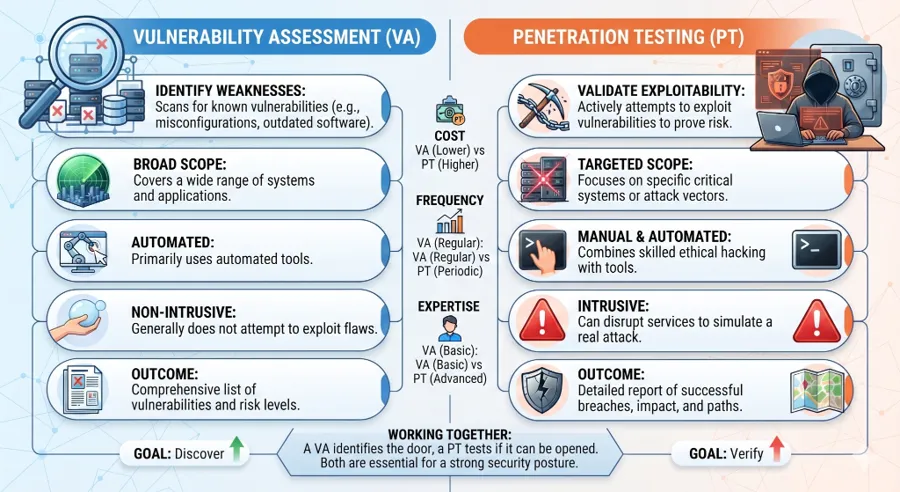
To combat this, businesses look toward Vulnerability Assessment and Penetration Testing (VAPT). Rather than guessing where security gaps exist, a proactive audit simulates the precise strategies used by hostile groups. When companies undergo deep technical evaluations, certified ethical hackers discover that while networks differ, the underlying security flaws are remarkably consistent.
Understanding these prevalent vulnerabilities allows leadership teams to move away from chaotic, reactive patching routines. Instead, it empowers them to implement strategic engineering principles that secure core infrastructure. This detailed analysis examines the top security vulnerabilities routinely discovered during comprehensive corporate evaluations, exploring how they function, why they occur, and how to permanently mitigate their impact.
The Value of Proactive Identification
Many corporate leadership teams view cybersecurity as an insurance policy—an operational expense that offers protection only after a crisis occurs. This mindset is fundamentally flawed in a digital economy. A reactive security model means an organization discovers its technical weaknesses only when a data breach is already in progress. At that stage, the damages include severe operational downtime, massive regulatory fines, legal liabilities, and a devastating loss of market reputation.
Proactive identification through VAPT flips this equation entirely. By commissioning certified engineers to safely attack an environment, an enterprise gains complete visibility into its operational weak points without enduring actual operational harm. It provides IT departments with an objective, evidence-based blueprint of their network. This blueprint separates theoretical worries from validated, actionable hazards, allowing businesses to spend their security budgets efficiently where they matter most.
1. Broken Access Control and Privilege Escalation
Understanding the Vulnerability
Broken access control occurs when an information system fails to properly enforce policies that restrict users from acting outside their intended permissions. In a well-designed application, access control mechanisms ensure that users can only view or modify data directly required for their roles. When these parameters are flawed, users can access functions or data belonging to other accounts, or worse, administrative controls.
Privilege escalation is the direct consequence of this structural failure. It is generally split into two categories:
- Horizontal Privilege Escalation: This happens when a user with standard access rights manipulates web requests or parameters to view data belonging to another user with identical permissions (e.g., a customer viewing another customer’s private invoices).
- Vertical Privilege Escalation: This occurs when a regular user successfully elevates their access tier to an administrative level, gaining unauthorized capability to modify system configurations, delete logs, or create new backend users.
Real-World Implications and Exploitation
During manual testing, security engineers frequently target parameter values within application URLs or API requests. For instance, if an invoice download link looks like example.com/view?id=1001, a tester will simply alter the identifier to 1001 or 1002. If the web server returns the corresponding user's data without validating that the requesting account owns that document, access control is broken.
Malicious actors exploit this gap to scrape entire databases of customer personal information (PII), corporate financial records, and proprietary operational secrets.
2. Unpatched Software and Legacy Systems
Understanding the Vulnerability
Every modern enterprise relies on a massive stack of software, including operating systems, network protocols, third-party content management systems, and specialized plugins. As engineers uncover software bugs over time, vendors release security updates to patch those vulnerabilities. Unpatched software refers to any system component running out-of-date code that contains publicly known security vulnerabilities.
Legacy systems represent an even larger corporate risk. These are aging pieces of hardware or software that are no longer actively maintained or supported by their original manufacturer. Because they receive zero security updates, any newly discovered flaw remains a permanent open door into the enterprise network.
Real-World Implications and Exploitation
When automated scanning tools map an organization's network perimeter, they analyze the software banners returned by active services. If a scanner detects that an external web server is running an obsolete version of Apache or an unpatched version of a popular framework, it matches that version against global vulnerability indices like the Common Vulnerabilities and Exposures (CVE) list.
Modifying or utilizing available code templates allows attackers to achieve direct remote code execution (RCE) on the target server, completely bypassing standard authentication blocks.
3. Misconfigured Cloud and Network Environments
Understanding the Vulnerability
Security tools are only as effective as their implementation. Security misconfiguration occurs when infrastructure is deployed with improper security settings, default configurations, or overly permissive access rights. This issue has grown significantly with the corporate transition to multi-cloud ecosystems like AWS, Microsoft Azure, and Google Cloud Platform.
Common misconfigurations include:
- Retaining default manufacturer administrative usernames and passwords (e.g., admin/admin).
- Leaving unnecessary network communication ports open to the public internet (such as SSH, RDP, or SMB).
- Enabling verbose error messaging that leaks database structures, directory pathways, and software versions to external visitors.
Real-World Implications and Exploitation
Cloud storage misconfigurations are a leading cause of massive corporate data exposures. Ethical hackers regularly locate cloud storage units (such as AWS S3 buckets) configured with public read access. Because these storage repositories lack authentication requirements, anyone who guesses or scans the URL can download sensitive backups, database dumps, and intellectual property.
Similarly, leaving remote desktop ports (RDP) exposed to the public internet allows automated botnets to bombard the login screen with brute-force scripts until they compromise an internal corporate user profile.
4. Flawed Authentication and Weak Credentials
Understanding the Vulnerability
Authentication mechanisms are the digital checkpoints responsible for verifying a user's identity before granting network entry. Flawed authentication encompasses any design weakness that allows an adversary to compromise sessions, bypass login screens, or masquerade as a legitimate corporate employee.
This structural risk multiplies when organizations fail to enforce strict credential hygiene. Weak credentials include easily guessable passwords, reused passwords across multiple platforms, and the complete absence of multi-factor authentication (MFA) on external corporate access portals.
Real-World Implications and Exploitation
During a simulated assault, testers leverage automated credential stuffing techniques. They take massive dumps of leaked credentials from historical public breaches and run them against the client’s corporate login interfaces. Because employees frequently reuse identical passwords across personal social media and professional profiles, attackers often gain entry without triggering technical alerts.
Furthermore, if an application fails to implement rate-limiting, an attacker can execute hundreds of thousands of password guesses against a single corporate email account without being locked out. Once inside, they use the compromised email account to launch highly convincing internal phishing campaigns.
5. Insecure Data Input and Injection Flaws
Understanding the Vulnerability
Applications must constantly process input provided by users, whether through login forms, search bars, file uploads, or API payloads. Injection flaws happen when an application accepts untrusted data input and passes it directly to an interpreter without performing strict validation, sanitization, or filtering.
The most dangerous variants include:
- SQL Injection (SQLi): Malicious database commands are injected into input forms, forcing the database backend to execute unauthorized data queries.
- Cross-Site Scripting (XSS): Malicious browser scripts are injected into web pages viewed by other users, allowing attackers to hijack active user sessions.
- Command Injection: Arbitrary operating system commands are passed to the host server, giving the attacker control over the underlying computer.
Real-World Implications and Exploitation
In a classic SQL injection scenario, an attacker enters a command string like ' OR '1'='1 into a standard username box. If the application is poorly written, this input alters the logic of the SQL query running on the database server.
Instead of checking for a valid password, the database evaluates the statement as true and grants full administrative access. Through this single entry point, an intruder can extract the entire corporate database, modify financial data, or erase critical operational logs.
Comprehensive Vulnerability Mapping
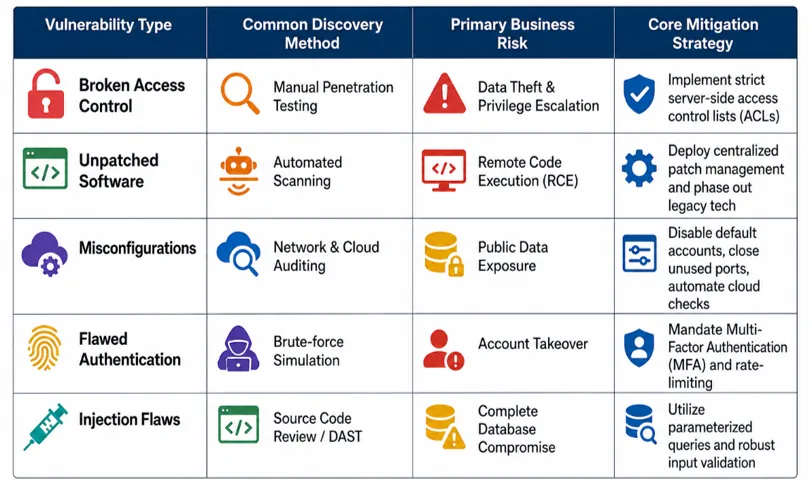
Mitigating Your Exposure
Addressing these structural flaws requires a balanced, continuous approach to corporate defense. Utilizing a comprehensive penetration testing guide ensures your development teams follow secure design principles from day one. Additionally, companies must complement manual deep-dives with routine vulnerability management routines to prevent configuration drifts across expanding cloud environments.
Auditing assets against recognized CISA Cybersecurity Standards eliminates baseline exposure stemming from lax security permissions. Initiating a regular network security audit allows your IT teams to address unpatched endpoints long before external threat groups spot them. Ultimately, establishing continuous VAPT for businesses establishes a robust, validated safety barrier over high-value data parameters, keeping your organization fully protected against evolving cyber threats.
Safeguarding a modern enterprise requires moving past the illusion of absolute security. Every software update, cloud migration, and new employee profile introduces new potential points of exposure. As our analysis shows, the most devastating cyberattacks rarely rely on highly complex, futuristic techniques. Instead, they exploit simple, preventable oversights like unpatched servers, weak passwords, and misconfigured access permissions.
By committing to regular, structured evaluations, businesses strip away the element of surprise from cyber adversaries. VAPT transforms security from an abstract, stressful guessing game into an organized, manageable engineering discipline. Take control of your company's digital perimeter today, patch your architectural weaknesses, and ensure your data remains resilient against unauthorized intrusion.
Secure Your Business Infrastructure Today
Do not wait for a security incident to uncover weaknesses in your network perimeter. Contact our certified technical experts now to schedule a detailed, custom security evaluation that meets your specific operational needs.



























Sign in to leave a comment.