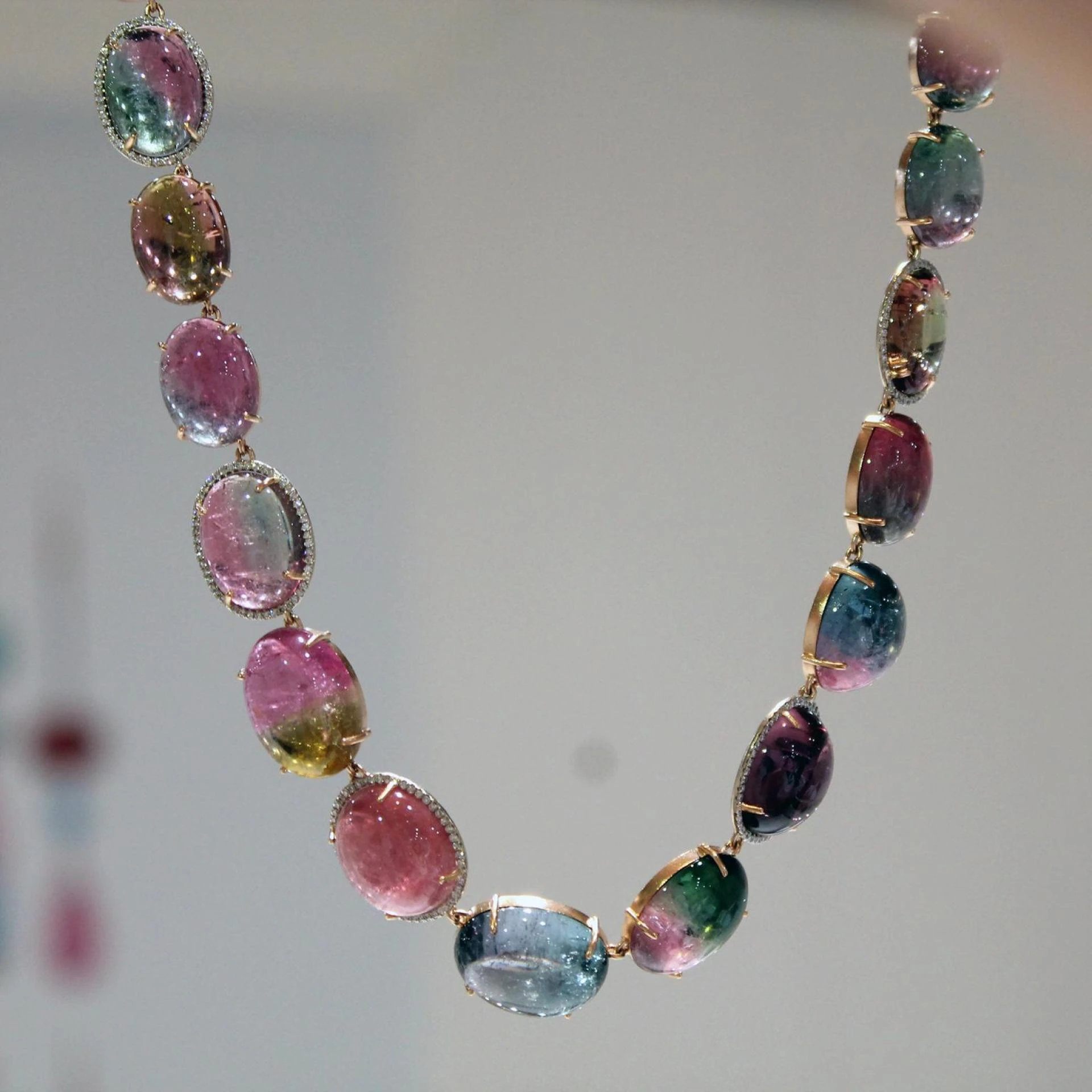

Tourmaline jewelry
When we talk about tourmaline, we are talking about a unique universe in the world of precious stones due to its enormous variety of colors. Let's not forget that it is a gem that is shown in an enormous diversity of shades, one more beautiful and exciting than the other!
It is found in pegmatite or metamorphic rocks. We are talking about a mineral that contains an extremely complex structure, which has sodium, magnesium, aluminum, lithium, iron ions which give it a diversity of tones that have positioned it among the most loved gems in jewelry since ancient times. Indeed, it is believed that its name comes from the Sinhalese Turamali, which means Stone of Mixed Colors.
And not only beauty!
Tourmaline is the only crystal capable of maintaining constant electricity, which has made it ideal for use in ionic technology. And what is ionic technology? – You may ask – because it is a technology that we have access to very often!
For example: it is a system used in dryers or hair straighteners. Many times, our hair looks dull and “lifts” due to static electricity after brushing or towel drying. The flow of hot air produced with ionic technology neutralizes static electricity, generating negative ions that soften the hair. Tourmaline, in particular black tourmaline, is used for this.
But not only, is it also used industrially in radio, microphones and instruments to measure changes in pressure.
Tourmaline in history
The Greeks, about 2000 years ago, spoke of a rock that had the property of attracting ashes and pieces of straw and wood when exposed to heat. In turn, in ancient Rome Pliny the Elder, who is one of the most emblematic figures in the history of natural sciences, mentions it by calling it "lincurum".
The truth is that due to the similarity with other gems, it was widely used in jewels of different crowns of the world, in which it was taken for ruby.
It was introduced to Europe by the Dutch in the 16th century, who brought it from Ceylon (now Sri Lanka). After the conquest of the American continent, a good part of the tourmalines came from Brazil.
Tourmaline colors
It is said that there is no other gem that shows more diversity of colors, shades and nuances than tourmaline. I leave you a list of the best known and loved in jewelry:
Rubellite: is a red tourmaline that is very similar to ruby. It is a very rare and much-loved variety. At the same time, due to its inclusions, clear specimens suitable for use in jewelry are scarce and therefore very expensive. The color of rubellite is due to manganese and partially to lithium. Its fundamental characteristic is that its color does not change in tone even if it is observed under different light sources. Other red or pink tourmalines show a shade towards brown under artificial light.
The most fanatical admirer of rubellites was the last Chinese empress Tzu Hsi, who ruled between 1860 and 1908. Her remains rest. On a cushion made of rubellite.
Green Tourmaline: The colors displayed by this type of tourmaline range from dark bottle green to bluish green. It will depend on the amount of iron that is added to its magnesium coloring agent that the green tourmalines will show shades of yellow.
Chrome tourmaline: this type of tourmaline is an intense green due to its chrome component, an agent that is not found in other tourmalines of this color. In general chrome tourmalines are found only in small dimensions
Indigolite: is the blue variety of tourmaline. It is a truly exotic type of tourmaline, with a deep blue color and due to its rarity and beauty, it is highly coveted in the world of high-end international jewelry. Its coloring agents are manganese and iron.
Paraiba Tourmaline: It is the newest specimen of tourmaline, discovered in the 80s of the last centuries, in the region of Paraiba, Brazil (hence its name). From one day to the next, Paraiba tourmaline conquered the gemological market, becoming a of the gems most loved by the great high jewelry designers. Indeed, Paraiba tourmaline is in every worthy jewelry collection. Its color is defined as a light blue pool, neon tonality. A true wonder! The unusual presence of copper makes this captivating color possible.
Pink tourmaline: it has an old pink color that falls in love at first sight. This color is due to traces of manganese, which curiously is responsible for the most feminine colors in the world of gems (among others, Cunzite and Morganite are colored with this agent).
Watermelon Tourmaline: It is a tourmaline that combines several colors in the same crystal. Cut crosswise, it shows a green border (due to chromium and lithium), a white border and inside it is pink, which, as we said, gets this color due to manganese. Hence its name due to its similarity to a slice of watermelon.
There are more variations of tourmalines that are less commonly used in jewelry. Today I wanted to bring you closer to this fascinating gemstone that can be found in the windows of large jewelry stores since tourmaline jewelry is always in fashion, a precious stone with tradition.
Looking for New age metaphysical products?










Sign in to leave a comment.