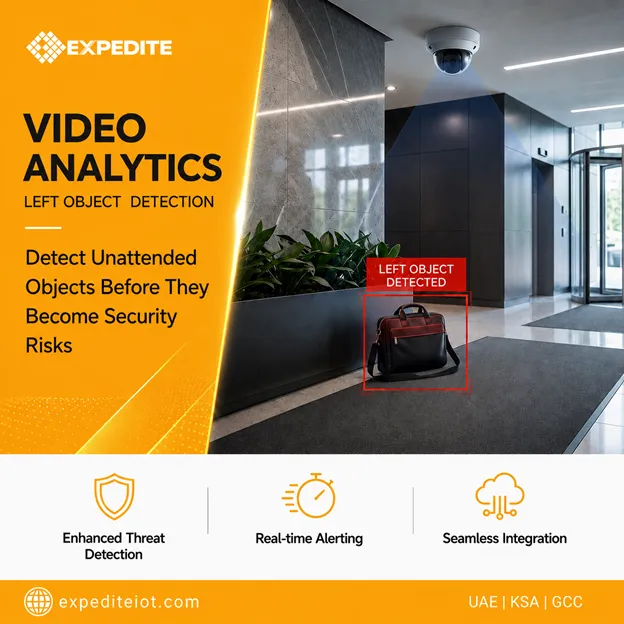

Video Analytics is reshaping how organizations across Saudi Arabia and the wider Gulf Cooperation Council (GCC) approach security, safety, and operational intelligence. As smart cities, giga-projects, and critical infrastructure scale rapidly across the region, traditional CCTV monitoring can no longer keep pace with today's surveillance demands.

Forward-looking enterprises are moving from passive recording to intelligent, self-analysing camera networks. Expedite IoT's video analytics system in Saudi, Qatar, and Oman brings this shift to life, combining computer vision, deep learning, and edge processing into a single, deployable platform built for the region's unique regulatory and operational environment.
The Rising Demand for AI-Powered Video Analytics in the GCC
Saudi Arabia's Vision 2030 and parallel national strategies in Qatar and Oman are driving unprecedented investment in smart cities, transportation networks, and industrial zones. This growth has created an urgent need for AI-Powered Video Analytics that can monitor thousands of camera feeds simultaneously, flag risks instantly, and reduce dependence on manual human oversight.
Security teams are no longer judged only by how many cameras they deploy, but by how intelligently those cameras interpret what they see. This is where modern, AI-driven surveillance intelligence — often described using terms like smart CCTV analytics, computer vision security, and predictive threat detection — has moved from a competitive advantage to a baseline expectation.
Why Traditional CCTV Falls Short
Conventional CCTV systems record footage but rarely interpret it in real time. Control room operators are expected to watch dozens of screens at once, a task where fatigue, distraction, and human error are inevitable. Incidents such as unauthorized access, fire outbreaks, or equipment malfunctions are frequently discovered only after reviewing footage retrospectively — long after the damage is done.
The Technology Stack Behind AI-Powered Video Analytics
Under the hood, a modern deployment blends edge computing, cloud orchestration, and trained neural networks. Edge processing units attached to cameras run lightweight inference models so that basic detection — a person entering a restricted zone, a vehicle overstaying in a loading bay — happens locally, in milliseconds, without waiting on network bandwidth. Heavier analysis, historical trend reporting, and multi-site correlation are then handled in the cloud or on a central on-premise server.
This hybrid architecture matters in the GCC context specifically: remote industrial sites in the Eastern Province or desert logistics corridors in Oman may have inconsistent connectivity, so edge-first processing ensures Real-Time Hazard Detection keeps working even when a link to the central server briefly drops. Cybersecurity is built into the same stack, with encrypted video streams, role-based dashboard access, and audit logs that satisfy enterprise IT governance requirements alongside physical security goals.
What Makes a Modern Video Analytics Solution?
A true Video Analytics Solution goes beyond motion detection. It applies trained AI models directly to live video streams — at the edge or in the cloud — to recognize objects, behaviours, and anomalies with human-level accuracy, and often faster. This turns a simple camera network into a proactive intelligence layer for the entire facility.
Core Capabilities to Look For
- Object and behaviour recognition, including loitering, intrusion, and abandoned-object detection
- License plate recognition (ANPR) for gated communities, ports, and logistics hubs
- PPE and safety-compliance monitoring on industrial and construction sites
- Crowd density and queue analytics for malls, transit hubs, and religious sites
- Seamless integration with existing VMS, access control, and alarm infrastructure
Real-Time Hazard Detection: Stopping Incidents Before They Escalate
One of the most valuable outcomes of a well-implemented Video Analytics Software deployment is Real-Time Hazard Detection. Instead of waiting for a human operator to notice smoke on a screen, the system identifies fire, spills, restricted-zone breaches, falls, or equipment anomalies within seconds and triggers an alert automatically. In high-risk environments such as refineries, warehouses, and construction sites, this speed can be the difference between a contained incident and a major loss.
Hazard models are typically trained on thousands of labelled clips covering exactly the scenarios a given site cares about — smoke density at different distances, liquid spread patterns on warehouse flooring, or a worker crossing a taped-off zone on a construction site. Because the model is purpose-trained rather than generic, detection accuracy improves considerably compared with older motion-only sensors, and safety officers gain a live heat-map view of where incidents cluster over time.
Automated Emergency Response for Faster Action
Detection alone is not enough — response speed matters just as much. A mature platform pairs Real-Time Hazard Detection with Automated Emergency Response: triggering sirens, locking down access points, notifying the nearest security personnel by SMS or app, and even initiating public-address announcements, all without waiting for manual intervention. This orchestration compresses response times from minutes to seconds, which is critical in fire, intrusion, or medical-emergency scenarios.
Automated Emergency Response workflows can also be tiered by severity. A low-confidence alert might simply flag an operator's dashboard for review, while a high-confidence fire or intrusion event can simultaneously lock doors, dispatch the nearest patrol unit, and open a live video feed on a supervisor's mobile device — all within the same automated sequence, removing the delay of a human relaying instructions between systems.
Reduced False Alarms — Smarter Alerts, Fewer Distractions
Nuisance alerts triggered by shadows, rain, wind-blown debris, or stray animals are one of the biggest reasons security teams lose trust in automated systems. Deep learning models trained on regional environmental conditions deliver Reduced False Alarms by distinguishing genuine threats from harmless movement. The result is a security team that responds to alerts with confidence instead of alarm fatigue, and a meaningful reduction in unnecessary manned-guarding costs.
Detailed Incident Reporting for Compliance and Accountability
Every flagged event is automatically logged, time-stamped, and archived with the associated video clip, giving facility managers Detailed Incident Reporting that supports audits, insurance claims, and regulatory compliance. For organizations operating under Saudi civil defence codes, SASO requirements, or sector-specific safety standards, having a searchable, evidence-backed incident history simplifies compliance reviews and strengthens accountability across shifts and sites.
Video Analytics KSA: Localized Deployment Across Saudi Arabia
Deploying Video Analytics KSA-wide requires more than translating a global product — it demands local engineering. Saudi giga-projects, industrial cities, and government facilities operate under specific data-residency, Arabic-language interface, and regulatory requirements. Expedite IoT builds its platform around these realities, offering on-premise or in-Kingdom cloud hosting, Arabic dashboards, and support teams familiar with Saudi civil defence and safety codes.
Video Analytics Riyadh — Securing the Capital's Critical Infrastructure
As the political and commercial heart of the Kingdom, Riyadh presents some of the region's most complex security environments — government buildings, metro stations, malls, and commercial towers, all operating at scale. Video Analytics Riyadh deployments are engineered to integrate with existing city infrastructure, giving control rooms a unified, real-time view across dispersed sites rather than isolated camera feeds.
Multi-site operators headquartered in Riyadh also benefit from centralized reporting: a single dashboard can aggregate Detailed Incident Reporting from branch offices in Jeddah, Dammam, and Khobar, giving regional security directors one consistent picture instead of stitching together separate systems from different vendors at each location.
Extending Coverage to Qatar and Oman
The same intelligence layer extends naturally beyond the Kingdom. Ports, logistics corridors, and hospitality developments in Qatar and Oman face comparable challenges — high foot traffic, valuable assets, and strict safety expectations. Expedite IoT's AI-powered surveillance platform for Saudi Arabia, Qatar, and Oman is designed as one scalable deployment model, so multinational operators can standardize security intelligence across every GCC site from a single dashboard.
Industries Benefiting from Modern Video Analytics Solutions
- Oil, gas, and petrochemical facilities — perimeter security and hazard monitoring
- Retail and shopping malls — loss prevention and crowd analytics
- Ports and logistics — vehicle recognition and yard management
- Healthcare — restricted-area monitoring and patient safety
- Education and hospitality — access control and occupancy management
- Banking and finance — perimeter intrusion and asset protection
Across each of these sectors, the underlying value proposition is consistent: fewer blind spots, faster response, and measurable operational insight drawn directly from existing camera infrastructure. A refinery gains continuous perimeter awareness without adding guard headcount; a mall operator gains queue and footfall data alongside loss-prevention alerts; a hospital gains restricted-area assurance without disrupting patient flow. The common thread is that Video Analytics Solutions are configured around each industry's specific risk profile rather than applied as a one-size-fits-all layer.
The Future of Video Analytics Across the GCC
As 5G connectivity, edge AI chips, and smart-city platforms mature across Saudi Arabia, Qatar, and Oman, camera networks are increasingly expected to act as sensors for far more than security alone — feeding traffic management, occupancy planning, and environmental monitoring systems. The next generation of Video Analytics Solutions will likely blend seamlessly with digital-twin city models, allowing planners to simulate crowd flow or emergency evacuation routes using the same data streams that already protect a site today.
For organizations building their security roadmap now, choosing a platform with open integration standards ensures today's investment in AI-Powered Video Analytics continues to pay dividends as these broader smart-city ecosystems come online, rather than becoming a closed system that needs replacing in a few years.
Why Choose Expedite IoT for Your Video Analytics Software
Expedite IoT has spent years designing and deploying IoT and AI-driven security systems across Saudi Arabia, Qatar, and Oman, working directly with facility operators, integrators, and government stakeholders. That hands-on regional experience — combined with certified engineering teams, established partnerships with leading camera and VMS manufacturers, and a track record of live deployments across industrial, commercial, and public-sector sites — underpins every project delivered.
Data security, transparent service-level agreements, and responsive local support are treated as core deliverables, not add-ons, because a security platform is only as trustworthy as the team standing behind it after installation.
Organizations evaluating vendors can review real deployment details on Expedite IoT's video analytics system page for Saudi Arabia, Qatar, and Oman to see how the platform is architected end-to-end.
The Business Case: Return on Investment from Video Analytics Solutions
Security leaders increasingly need to justify surveillance spend in financial terms, not just risk-mitigation terms. Video Analytics Solutions typically pay for themselves through a combination of reduced manned-guarding hours, fewer false-alarm callouts, lower insurance premiums tied to demonstrable safety controls, and avoided downtime from incidents caught early. A facility that once needed several operators watching screens around the clock can often reallocate that headcount to higher-value tasks once AI handles first-pass monitoring.
Detailed Incident Reporting adds a second, less obvious financial benefit: faster and better-documented insurance claims. When every flagged event already has a time-stamped clip, an automatically generated report, and a clear chain of custody, claims that once took weeks of manual footage review can be substantiated in a fraction of the time.
Implementation Roadmap: Deploying Video Analytics Software in Four Stages
A structured rollout reduces disruption and gets a site to full protection faster. Most Expedite IoT deployments follow a similar four-stage path, adapted to the client's existing camera infrastructure and site complexity:
- Site assessment — auditing existing cameras, network bandwidth, and priority risk zones
- Model configuration — tuning detection models (hazard, intrusion, PPE, ANPR) to the specific site
- Integration and testing — connecting to VMS, access control, alarms, and notification channels
- Go-live and optimization — monitoring real-world alert accuracy and refining thresholds to sustain Reduced False Alarms over time
This phased approach also gives facility teams time to adjust operating procedures around Automated Emergency Response before it is fully relied upon, rather than switching from manual monitoring to automation overnight.
How to Choose the Right Video Analytics Vendor
- Scalability — can the platform grow from one site to hundreds without a redesign?
- Integration — does it work with your existing cameras, VMS, and access control?
- Accuracy — what is the vendor's documented false-positive rate in similar environments?
- Local presence — is there in-region support, Arabic-language capability, and compliance knowledge?
- Reporting — does the platform generate audit-ready documentation automatically?
Conclusion
Video Analytics has moved from an optional upgrade to an operational necessity for organizations across Saudi Arabia and the GCC. By combining AI-Powered Video Analytics with Real-Time Hazard Detection and Automated Emergency Response, facilities gain the ability to act in seconds rather than minutes. Reduced False Alarms and Detailed Incident Reporting further ensure that every alert is meaningful and every incident is documented for compliance and insurance purposes. For teams evaluating Video Analytics Software or Video Analytics Solutions, purpose-built regional deployments such as Video Analytics KSA and Video Analytics Riyadh offer the local engineering and support that global platform often lack. Choosing the right partner today defines how resilient, efficient, and future-ready a security operation will be tomorrow.
FAQs
1. What is Video Analytics and how is it different from regular CCTV?
Video Analytics uses AI to interpret live camera footage in real time — recognizing objects, behaviours, and anomalies — rather than simply recording video for later review, which is all standard CCTV does.
2. How does Real-Time Hazard Detection improve workplace safety?
Real-Time Hazard Detection identifies risks such as fire, spills, or restricted-zone breaches the moment they occur, allowing teams to respond within seconds instead of discovering incidents after the fact.
3. Can Video Analytics Software reduce false alarms from weather or animals?
Yes. Deep learning models trained on local conditions deliver Reduced False Alarms by filtering out rain, shadows, and wildlife, so security teams only act on genuine threats.
4. Is Video Analytics KSA deployment compliant with Saudi regulations?
Video Analytics KSA deployments from Expedite IoT are built around in-Kingdom data hosting, Arabic-language interfaces, and alignment with Saudi civil defence and safety requirements.
5. What industries benefit most from Video Analytics Solutions in Riyadh?
Video Analytics Riyadh deployments support government buildings, malls, transit hubs, and commercial towers, with Detailed Incident Reporting that simplifies audits and regulatory compliance across sectors.
For more information contact us on:
Expedite IT
+966 502104086
Office No 01, Conference Building (Kirnaf Finance), Abi Tahir Al Dhahabi Street,
Al Mutamarat, Riyadh 12711, Saudi Arabia






























Sign in to leave a comment.