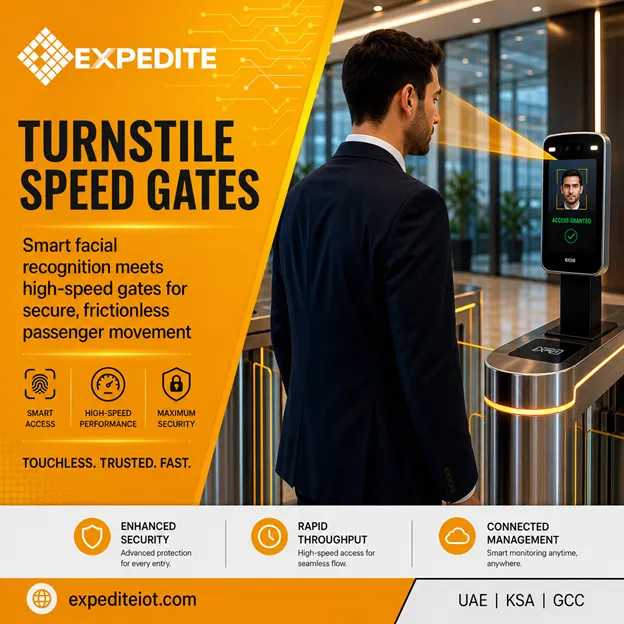

Turnstile Speed Gates are reshaping how Saudi Arabian offices, transit hubs, stadiums, and industrial sites manage the flow of people through a secure entrance. Instead of a single guard checking every badge by hand, today's lanes verify identity in a fraction of a second and glide open only for authorized individuals, moving crowds quickly while keeping unauthorized entry out entirely.
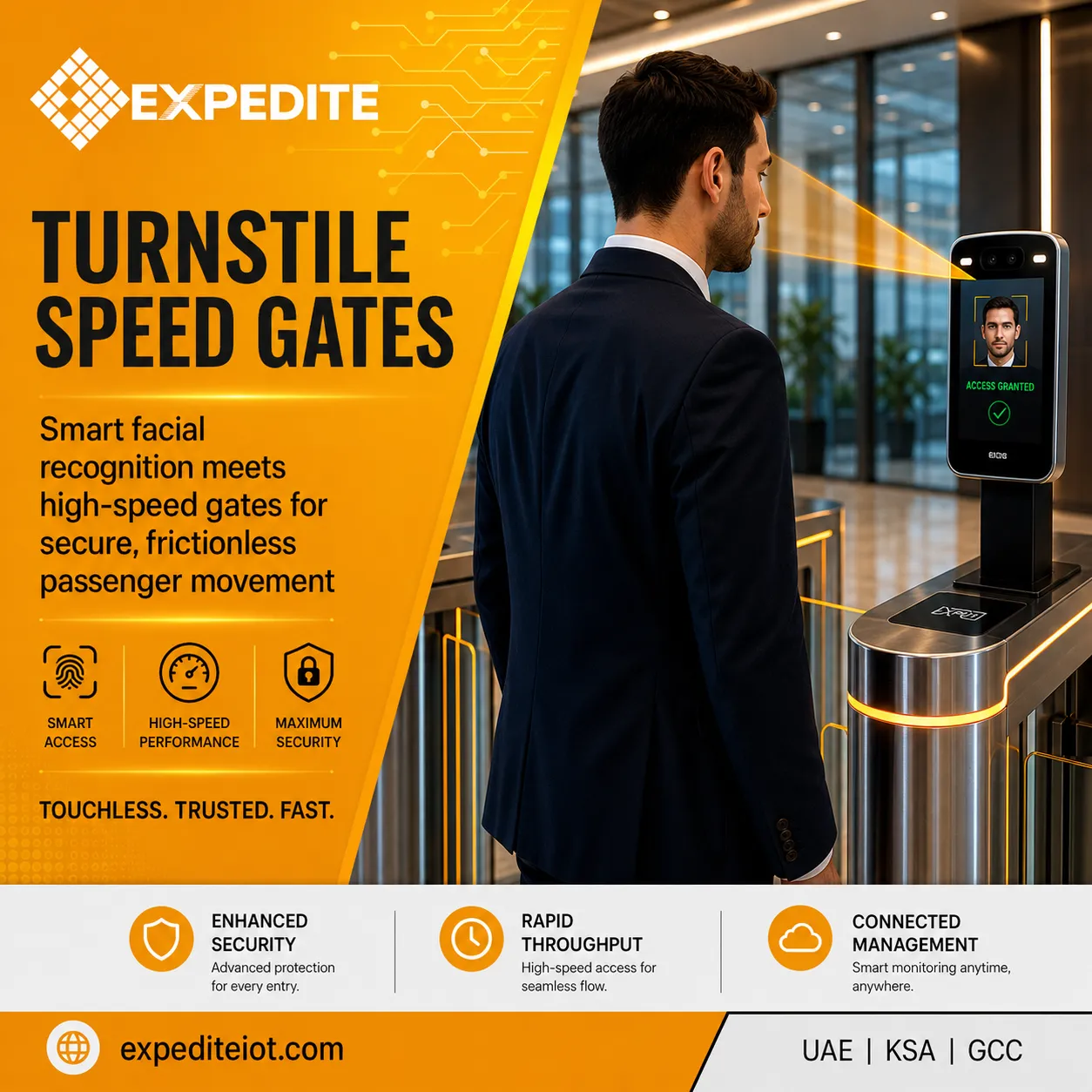
This guide explains how modern lane-based entry systems work, what separates a basic mechanical barrier from a genuinely intelligent gate, and how facility managers across the Kingdom can choose and deploy the right configuration for their site.
Why Saudi Facilities Are Moving to Speed Gate Technology
A staffed reception desk checking badges one at a time simply cannot keep pace with the entry volumes at a modern Saudi corporate tower, metro station, or stadium. Long queues at peak hours frustrate employees and visitors, and manual checks are inconsistent — a distracted guard on a busy morning is far more likely to wave someone through without a proper check than an automated lane that verifies every single credential without exception.
Vision 2030's push toward smart-city infrastructure and giga-project developments has accelerated demand for automated lane security that can scale to thousands of daily entries while still producing a complete, auditable record of every person who passed through — something a logbook or a guard's memory can never reliably provide.
Turnstile Access Control: How Lane-Based Security Works
At its core, Turnstile Access Control pairs a physical barrier — arms, panels, or glass wings — with a credential reader and a decision engine that only releases the barrier once a valid card, mobile credential, or biometric scan is confirmed. Every event is logged automatically, creating a real-time, searchable record of who entered which lane and when, without requiring a staff member to manually note anything down.
Because the barrier itself enforces the decision, this approach removes the human inconsistency of manual checks entirely — the lane simply will not open for an invalid credential, regardless of how confident or familiar the person attempting to pass through appears to security staff.
Tripod Turnstile Gates: A Practical Entry-Level Solution
For lower-security areas such as gyms, office lobbies, or staff cafeterias, Tripod Turnstile Gates offer a compact, cost-effective way to control pedestrian flow. Three rotating arms allow one person to pass per authorized credential, providing a visible deterrent and a simple mechanical checkpoint without the footprint or cost of a taller, more elaborate barrier. They remain a popular choice where budget matters more than deterring a determined intruder willing to climb over.
Swing Barrier Turnstile Gates: Balancing Accessibility and Security
Swing Barrier Turnstile Gates use glass or metal panels that swing open horizontally once a credential is verified, offering a sleeker aesthetic that suits corporate lobbies, hospitals, and hotels where appearance matters alongside function. Their wider lane opening also makes them a natural fit for accessibility requirements, easily accommodating wheelchairs, strollers, and luggage without requiring a separate, segregated accessible gate.
Full Height Turnstile Gates: Maximum Perimeter Protection
Where security requirements are highest — perimeter fencing at industrial sites, stadium entrances, or unattended after-hours access points — Full Height Turnstile Gates provide floor-to-ceiling rotating barriers that make climbing over or ducking under practically impossible. Resembling a revolving door crossed with a security cage, this format is specifically chosen for locations where the barrier itself must physically stop an unauthorized person, not merely discourage one.
Flap Barrier Turnstile Gates: Fast, Elegant Throughput
Flap Barrier Turnstile Gates use retracting glass or acrylic flaps that open vertically or slide away in a fraction of a second, delivering some of the fastest pedestrian throughput available in a compact lane footprint. Their quiet, quick operation and modern appearance have made them a preferred choice for corporate headquarters and metro stations across the Gulf that need to move large volumes of verified people quickly without sacrificing a polished entrance aesthetic.
- Tripod gates: cost-effective, compact, suited to lower-security staff or gym entrances.
- Swing barriers: accessible, wheelchair and luggage friendly, common in hospitals and hotels.
- Full height gates: maximum physical deterrence for perimeter and after-hours access points.
- Flap barriers: fastest throughput with a sleek, modern profile for corporate lobbies.
Intelligent Facial Recognition Turnstiles: Credential-Free Entry
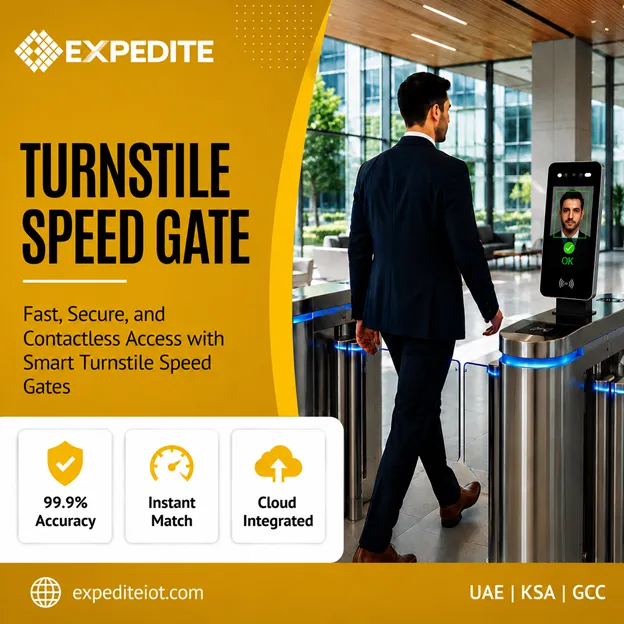
The newest generation of lane security removes the credential entirely. Intelligent Facial Recognition Turnstiles verify identity through a camera built into or mounted beside the gate, releasing the barrier the instant a match is confirmed — no card to badge, no phone to tap, no pause at all for a legitimate, enrolled user. Built-in anti-spoofing and liveness checks ensure the system cannot be fooled by a printed photo or video replay, maintaining security even as the credential itself disappears from the process.
This format has become especially popular for Saudi corporate campuses and government facilities seeking both a frictionless employee experience and a stronger security posture than card-based systems alone can provide, since a face cannot be lost, shared, or lent to a colleague the way a badge can.
Biometric Turnstiles: Verifying the Person, Not Just the Credential
Beyond facial recognition, Biometric Turnstiles can incorporate fingerprint or iris verification for environments requiring the highest possible assurance that the person passing through matches the enrolled identity precisely. Multi-factor configurations — combining a card with a fingerprint, for example — add a second verification layer for especially sensitive zones such as data centers, cash-handling areas, or restricted government facilities where a single point of failure is unacceptable.
Turnstile Speed Gates KSA: Compliance and Deployment Factors
Rolling out Turnstile Speed Gates KSA -wide involves more than selecting a gate style. Saudi facilities must ensure lanes comply with civil defense fire-egress codes, which typically require gates to fail open or provide an adjacent unobstructed exit during an emergency evacuation. Biometric enrollment must align with the Kingdom's Personal Data Protection Law, and gender-segregated lane configurations are often required at schools, government buildings, and certain public venues.
Turnstile Speed Gates Riyadh: Local Deployment Considerations
As the Kingdom's capital and home to a dense concentration of corporate headquarters, metro stations, and government facilities, Turnstile Speed Gates Riyadh installations often face higher daily throughput demands than smaller regional sites. Local installation partners familiar with Riyadh's high-rise office towers, network infrastructure, and municipal safety codes can configure lane count, gate style, and integration details to match real building conditions rather than a generic specification sheet.
How Expedite IoT Deploys Smart Turnstile Systems Across the Region
Expedite IoT has spent years engineering IoT-driven security infrastructure for corporate, transit, education, and government clients across Saudi Arabia, Qatar, and Oman. Our engineering team combines hands-on installation experience with a deep understanding of regional compliance requirements, giving facility managers a partner who can specify the right gate format for the right entrance rather than a one-size-fits-all package.
Facility managers evaluating lane security can review our full smart turnstile system for Saudi Arabia, Qatar, and Oman to see supported gate formats, integration options, and deployment case studies from clients across the region.
Our deployments integrate turnstile lanes with existing access control, visitor management, and CCTV infrastructure, so facilities gain a unified entry-security layer without discarding equipment that already works well. Every project includes local onboarding, staff training, and ongoing technical maintenance — the hands-on service that distinguishes a trusted regional integrator from an offshore hardware supplier.
For a closer look at how our facial recognition and biometric lane security platform handles high-volume throughput and emergency fail-safe behaviour, explore the dedicated solution page linked above.
Feedback from facility managers who have deployed our systems consistently highlights three benefits: dramatically reduced queuing during peak entry hours, cleaner audit trails during civil defense inspections, and a sharp drop in tailgating incidents compared to manually staffed checkpoints.
Why Vendor Experience Matters for Lane Security Projects
Lane security sits at the entrance to every secure facility, so vendor selection deserves the same scrutiny as the gates themselves. Facility managers should ask prospective integrators how long they have deployed turnstile systems specifically in the Saudi and Gulf markets, request references from comparable sites, and confirm how firmware updates, spare-parts availability, and after-hours emergency support are handled once installation is complete.
A provider that documents real project history, holds relevant certifications, and maintains a locally based support team is far more likely to deliver lanes that keep performing reliably years after installation, rather than hardware that only impresses during the initial demonstration.
Integrating Turnstile Lanes with Broader Facility Security
A turnstile lane delivers the greatest value when connected to the rest of a facility's security infrastructure rather than operating as an isolated checkpoint. Integration with visitor management systems ensures a guest badge issued at reception is the only credential that opens the lane, closing the loop between front-desk registration and physical entry. Integration with CCTV analytics allows security teams to visually confirm that the person passing through matches the credential presented, while integration with fire alarm panels ensures lanes release automatically during an evacuation rather than becoming a bottleneck when speed matters most.
This kind of interoperability is particularly valuable for large Saudi campuses, transit hubs, and stadiums operating multiple lanes across several entrances, where a single unified security dashboard replaces what would otherwise be a collection of disconnected point solutions each requiring separate monitoring.
Return on Investment: What Facilities Gain from Automated Lanes
Facility managers evaluating the cost of a lane upgrade often ask how quickly the investment pays for itself. In practice, value accumulates across several areas: reduced staffing costs from automating first-line credential checks, faster peak-hour throughput that shortens queues and improves the daily experience for employees and visitors, stronger audit trails that speed up civil defense and security inspections, and measurably fewer tailgating or unauthorized entry incidents compared to a manually staffed checkpoint relying on human vigilance alone.
Because pricing varies significantly between gate format, lane count, and biometric versus card-only configurations, facilities should request a detailed proposal that maps costs directly to expected daily volume and desired integrations before committing to a specific vendor or hardware package.
Best Practices for Rolling Out Turnstile Speed Gates
- Map peak entry and exit volumes before selecting lane count and gate style.
- Confirm fire-egress and civil defense compliance before finalizing hardware specifications.
- Pair biometric lanes with a fallback credential option for enrollment or verification failures.
- Integrate lane events with existing visitor management and CCTV systems for a unified view.
- Schedule periodic maintenance checks to keep sensors and mechanical components performing reliably.
Facilities that treat lane security as an ongoing program — reviewed alongside emergency planning and visitor policy — consistently report smoother daily operations than those that install gates once and never revisit the configuration.
Conclusion
Turnstile Speed Gates are transforming entry security across Saudi Arabia, giving facilities fast, auditable Turnstile Access Control at every lane. From compact Tripod Turnstile Gates and accessible Swing Barrier Turnstile Gates to high-security Full Height Turnstile Gates and fast-throughput Flap Barrier Turnstile Gates, every format has its place. Intelligent Facial Recognition Turnstiles and Biometric Turnstiles push accuracy further still. Facilities pursuing Turnstile Speed Gates KSA compliance or a Turnstile Speed Gates Riyadh deployment achieve the strongest results with an experienced regional integration partner.
FAQs
1. What are Turnstile Speed Gates and how do they improve entry security?
Turnstile Speed Gates are automated lane barriers that verify a credential before releasing, moving people through an entrance quickly while producing a complete, auditable record of every entry event.
2. How does Turnstile Access Control differ from a manually staffed checkpoint?
Turnstile Access Control enforces every credential check automatically and consistently, removing the human inconsistency of a guard occasionally waving a familiar face through without a proper verification.
3. What is the difference between Swing Barrier and Full Height Turnstile Gates?
Swing Barrier Turnstile Gates prioritize accessibility with wider, waist-height panels, while Full Height Turnstile Gates provide floor-to-ceiling barriers for maximum physical deterrence at high-security perimeters.
4. Can Intelligent Facial Recognition Turnstiles work without any physical credential at all?
Yes. Intelligent Facial Recognition Turnstiles verify identity through a built-in camera and release the barrier automatically for enrolled users, eliminating the need to carry or present a card at all.
5. Are Biometric Turnstiles compliant with Saudi Arabia's data protection requirements?
Reputable Biometric Turnstiles platforms build encryption, consent capture, and configurable data-retention policies into enrollment, allowing facilities to align with Saudi PDPL and National Cybersecurity Authority guidance.
For more information contact us on:
Expedite IT
+966 502104086
Office No 01, Conference Building (Kirnaf Finance), Abi Tahir Al Dhahabi Street, Al Mutamarat,
Riyadh 12711, Saudi Arabia






























Sign in to leave a comment.