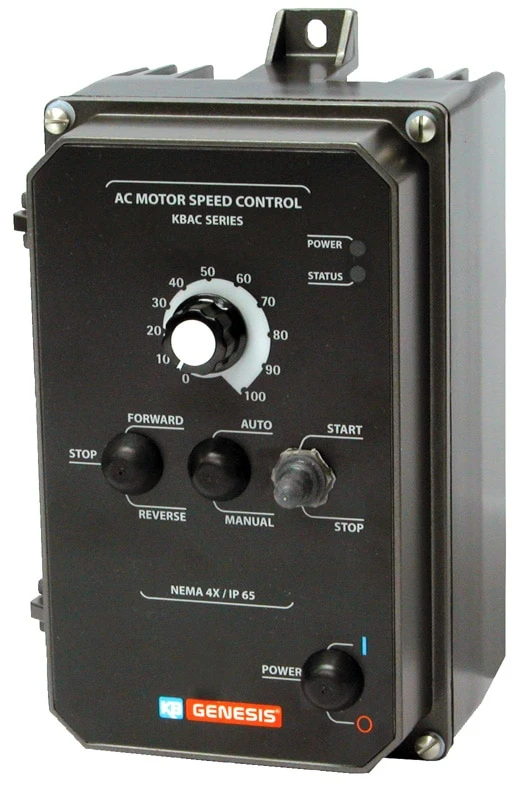

When you need to power AC motors, its electrical supply can be at full power to operate at full speed or at variable power to operate at variable speed. Applications with unstable loads take advantage of the variable speed offered by an AC drive, since less power is utilized at lower loads and speeds.
CM Industry Supply Automation ultimate guide explains how AC drives achieve this.
An AC drive is also called VFD i.e. variable frequency drive. It is a power supply control and conditioning device used for AC motors as these motors need frequency to spin. The drive has to offer the necessary energy waveform with sufficient voltage to supply the required current to create magnetic flux within the motor.
To produce the required frequency waveform, AC drives gets an AC voltage supply and correct it to DC voltage, usually via a diode bridge. This corrected power is stocked up in a capacitor bank as part of a DC bus. This is called the converting part of the drive.
The DC power stocked up in the capacitor bank is then delivered to switching devices to form the necessary frequency. This AC power is delivered to the motor, makes it to spin at a required speed, which is usually measured in revolutions/minute.
The drive creates a set of pulse-width modulated signals, which are positively or negatively oriented to make the required waveform.
The power devices switching ensure control of the amount or voltage level, which that passes via the switches, and the frequency at which the waveform is form, offering the essential energy to control motor speed.
The AC drive ensures control of the working trait of an AC motor that can decrease energy used by the motor. This energy savings is possible via adjusting or restricting the applied voltage and current throughout controlled acceleration or deceleration and throughout usual operation.
Basics of AC drive application
Conveyor, Pumps, and fans, alone can make numerous applications. Even the conditions within applications can be identical. Bulk conveying can be executed with conveyors, pumps, or fans, for example. Application examples comprises tons of flour blown via pipes for a bagging process, pumps managing gallons of soda via a bottling line, conveyors shifting coal or rock, or a shifting bulk of cookies via a baking oven.
From the plain air fan in the warehouse to the difficulty of energy storage systems, wastewater management systems or water supply AC motors operating at variable speeds play a vital role. Since AC motors use much of the electricity formed worldwide, utilizing AC drives to restrict energy utilization can make important savings.
Conclusion
The advantages of using AC drives are:
AC drives offer the most energy efficient ways of capacity control.
AC drives require the lowest initial current of any starter type.
AC drives decrease thermal and mechanical pressure on motors and belts.
Installation of AC drives are simple, just connect the power supply to the AC drive.
AC drives based on AFE technology can match even the most severe harmonic standards and decrease backup producer sizing.
AC drives offer high power factor, reducing the requirement for external power factor correction capacitors.
AC drives offer lower KVA, helping lessen power outages and voltage sags.
0







Sign in to leave a comment.