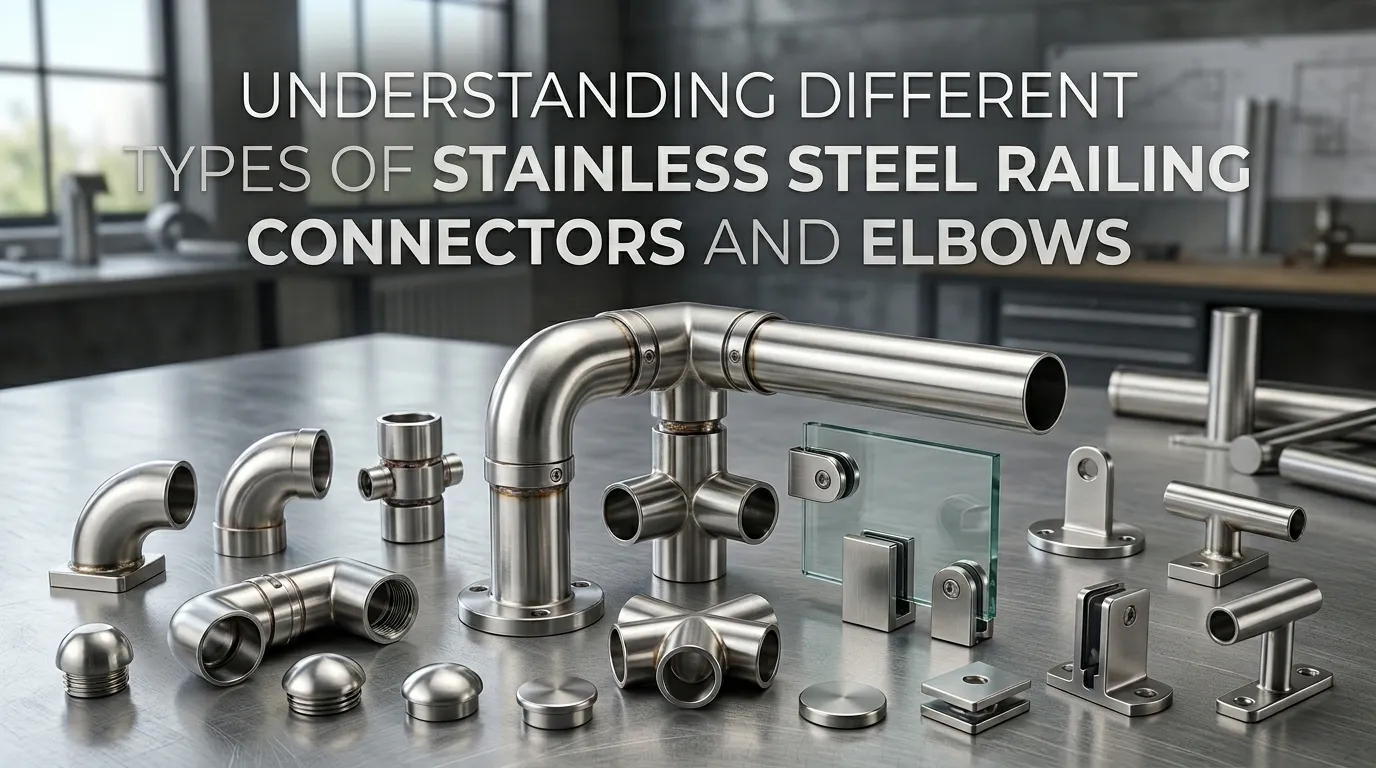

Railing systems most often degrade at connections far earlier than at any other point. A well-cut tube means nothing if the fitting joining it to the next section corrodes, loosens, or misaligns under load. Stainless steel railing fittings, connectors, elbows, brackets, and tube holders determine structural integrity, finish quality, and long-term serviceability across residential staircases and commercial balcony installations alike. Wrong type, wrong grade, or wrong angle creates problems that surface months after handover.
Understanding Stainless Steel Railing Connectors and Their Role
Connectors join individual tube sections into a continuous, structurally sound system. Each fitting transmits load between tube sections, transfers forces to wall anchors or floor posts, and maintains the alignment that keeps a railing safe and visually consistent. In handrail applications, fitting failures create immediate safety hazards and liability exposure. Grade, wall thickness, and mechanical fixing method set screw, weld, or clamp, determine how well a connector holds under repeated dynamic loads.
Common Types of Stainless Steel Railing Connectors
Straight Connectors
Straight connectors join two tube sections along a single axis for flat runs, corridor handrails, horizontal deck rails, and long balcony sections. They accept standard tube diameters of 38.1mm or 50.8mm. No angular adjustment means any deviation from level requires a different fitting type.
Adjustable Connectors
Adjustable connectors handle angle changes in one plane, typically ±15° from horizontal. Staircases rising at 32°–38° use these where the railing pitch falls outside standard fixed-angle increments, avoiding custom fabrication costs on site.
Swivel Connectors
Swivel connectors move in two planes simultaneously, handling compound vertical and horizontal angle changes within one fitting. Curved balconies and spiral staircases rely on swivel types because fixed and adjustable connectors physically cannot achieve the required geometry.
Tube Connectors
Tube connectors join two tube ends inside a single sleeve, maintaining external diameter through the joint. Exposed in glass railing systems, they rely on internal set screws or compression to grip the tube; torquing to manufacturer's specification is critical.
Multi-Directional Connectors
Multi-directional connectors branch one tube into two, three, or four directions simultaneously. Post-top fittings joining side rails to vertical posts, and T-fittings at landing returns fall into this category. Each arm typically adjusts independently.
Types of Stainless Steel Elbow Fittings Used in Railing Systems
45-Degree Elbows
45° elbows redirect tube runs at shallow angles the bottom of staircase handrails where the rail transitions to a horizontal wall return, or top landings where the rail angles outward to a post. They suit staircases with steeper-than-average pitches.
90-Degree Elbows
90° elbows make sharp directional changes and are the most common elbow type across balcony corners, wall-return terminations, and post-top installations. Available in internal and external socket configurations.
Adjustable Elbows
Adjustable elbows lock at any angle between 0° and 180° via set screw. Unlike fixed-angle elbows that require pre-measurement, adjustable types set on site are useful when the staircase or ramp pitch isn't confirmed until installation day.
Swivel Elbows
Swivel elbows handle compound angle changes in three dimensions. Curved staircases and spiral ramp guardrails use them at transition points where neither fixed nor adjustable elbows achieve the required geometry.
Corner Elbows
Corner elbows join two tube sections at building corners internal or external. External types handle open balcony edges; internal types suit enclosed corridor corners where railings run continuously around a 90° room turn.
How to Select the Right Stainless Steel Railing Fittings
Material Grade Selection
Grade 304 handles indoor and low-exposure outdoor environments. Grade 316 adds 2–3% molybdenum, resisting chloride pitting the primary failure mode in coastal, pool-side, and marine settings. Specifying 304 in sea-facing balcony installations produces visible pitting within 2–4 years.
Indoor vs Outdoor Applications
Outdoor fittings need grade 316 and a brushed or satin finish. Mirror-polished finishes show weather marks faster and demand more maintenance in exposed locations. Indoor connectors face higher cleaning chemical exposure in commercial settings but lower atmospheric corrosion risk.
Corrosion Resistance Requirements
Chloride concentration, humidity, and temperature together determine actual corrosion risk. Pool enclosures within 10 metres of water need 316 minimum. Installations directly adjacent to pool water benefit from 316L or duplex-grade fittings where chlorine contact is continuous.
Design Compatibility
Fitting bore and tube OD must match exactly 0.1–0.3mm differences between manufacturers prevent proper seating. Confirm tube OD, wall thickness, and connection method across every component before ordering.
Maintenance Expectations
Brushed 316 fittings in outdoor settings need cleaning every 3–6 months with mild detergent. Pool-adjacent fittings need monthly rinsing to remove chloride deposits before pitting initiates.
Applications of Railing Connectors and Elbows
Staircases use the highest variety of fitting types, straight connectors on flat runs, adjustable or swivel elbows at pitch transitions, and 90° elbows at top and bottom returns. Balcony railings run primarily straight connectors with corner elbows. Glass railing systems use tube holder fittings in flush side-mounted configurations. Commercial buildings specify 316 throughout, regardless of location, since maintenance access is harder to guarantee at height. Outdoor public spaces, parks, transit stations, waterfront promenades face the harshest combination of weather, chloride, and heavy daily contact loads that make grade selection critical.
Common Mistakes to Avoid When Choosing Railing Fittings
Wrong grade selection causes most premature corrosion failures 304 in coastal environments produces pitting within 3 years. Ignoring environmental exposure means indoor-rated fittings end up outdoors when project specifications change mid-build. Improper angle selection creates visible gaps or forced tube bends where the fitting angle doesn't match the actual geometry and always verifies staircase pitch before specifying fixed-angle elbows. Compatibility issues between tube OD and fitting bore cause loose connections and visible movement under load.
Conclusion
Connector and elbow selection shapes structural performance, visual quality, and service life more than any other component decision in a railing project. Specify 316 for any outdoor or chloride-adjacent installation, confirm tube OD compatibility before ordering, match the fitting angle precisely to the actual installation geometry, and verify the connection method suits the load condition. Getting these four factors right before procurement removes most of the post-installation problems that railing projects encounter.
























Sign in to leave a comment.