
Understanding Goods and Services Tax in India is essential for businesses, professionals, students, and consumers alike. Since its introduction, GST has transformed India’s indirect tax system by replacing multiple taxes with a single, unified structure. This reform has simplified taxation, improved transparency, and strengthened the Indian economy.
What Is Goods and Services Tax (GST)?
Goods and Services Tax (GST) is an indirect tax levied on the supply of goods and services in India. It is a destination-based tax, meaning the tax is collected at the point of consumption rather than production. GST replaced earlier taxes such as VAT, service tax, excise duty, and octroi, creating a single national market.
Why Was GST Introduced in India?
Before GST, India had a complex tax system with multiple layers of indirect taxes, leading to cascading taxation (tax on tax). GST was introduced to:
- Eliminate multiple indirect taxes
- Reduce tax evasion
- Improve ease of doing business
- Ensure uniform taxation across states
- Increase transparency and compliance
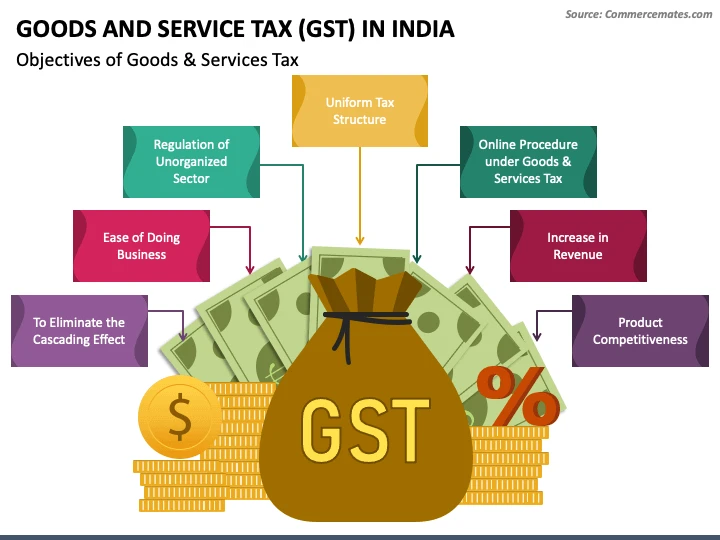
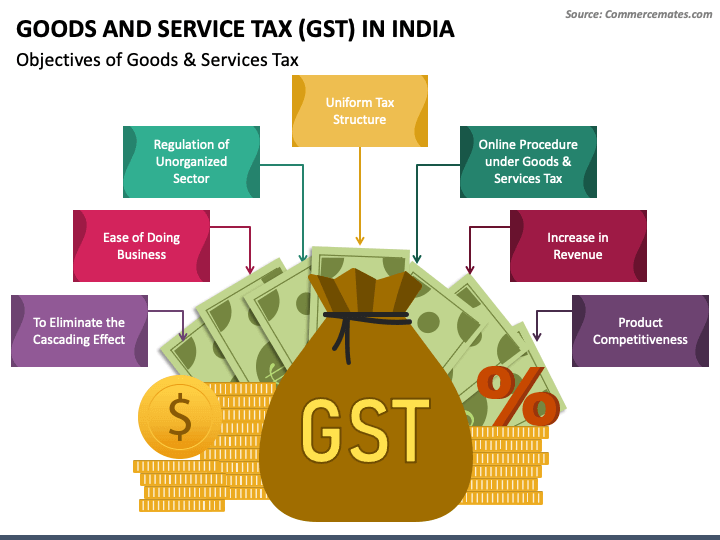
Objectives of Goods and Services Tax in India
The main objectives of GST include:
- Creating a unified national tax system
- Reducing the overall tax burden
- Promoting economic growth
- Simplifying compliance for businesses
- Enhancing government revenue
Types of GST in India
GST in India is divided into four main types:
- CGST (Central GST): Collected by the Central Government on intra-state supplies
- SGST (State GST): Collected by State Governments on intra-state supplies
- IGST (Integrated GST): Applied to inter-state transactions and imports
- UTGST (Union Territory GST): Applicable in Union Territories without legislatures
GST Slab Rates Explained
India follows a multi-slab GST rate structure:
- 0% – Essential goods
- 5% – Basic necessities
- 12% and 18% – Standard goods and services
- 28% – Luxury and sin goods
This structure ensures affordability while maintaining revenue balance.
How Does GST Work?
- The seller charges GST on the invoice
- The buyer pays GST to the seller
- The seller deposits GST with the government
- Input Tax Credit (ITC) is adjusted
- The final tax burden lies with the consumer
GST Registration Process in India
Businesses must register under GST if their annual turnover exceeds the prescribed limit or if they are involved in inter-state trade. GST registration is completed online through the GST portal, making the process quick and transparent.
Input Tax Credit (ITC) Under GST
Input Tax Credit allows businesses to reduce their tax liability by claiming credit for GST paid on purchases. This prevents double taxation and reduces operational costs.
Advantages of GST in India
- Simplified tax system
- Reduced cascading effect of taxes
- Transparent pricing for consumers
- Boost to startups and MSMEs
- Improved tax compliance
Challenges of GST
Despite its benefits, GST faces challenges such as frequent rule changes, compliance burden for small businesses, and technical issues with return filing.
Impact of GST on Businesses and Consumers
For businesses, GST enables smoother interstate trade and easier expansion. Consumers benefit from uniform pricing across states, though prices of some goods have increased while others have become cheaper.
GST Compliance and Return Filing
Businesses must file GST returns regularly, such as GSTR-1 and GSTR-3B, either monthly or quarterly depending on turnover. Timely compliance helps avoid penalties and interest.
Conclusion
Understanding Goods and Services Tax in India is crucial in today’s tax environment. While GST has its challenges, its long-term benefits include economic growth, transparency, and simplification of the tax system. With proper awareness and compliance, GST continues to strengthen India’s financial framework.




























Sign in to leave a comment.