
Artificial intelligence has grown so much in the past few years that most of us are relying on it for our data needs. The data these LLMs provide is near perfect, that said, the reliability of access of real-time and quality still remains questionable.
2024-2025 were the years Modular AI gained traction. What is Modular AI you ask? Think of it like LEGO bricks, you have different shapes built for different purposes, using which you build your whole structure. Likewise modular AI breaks the system down into smaller specialized components or “modules”. Each module is excellent at one specific task, and you know the drill, you can mix, match, and plug these pieces together to build exactly what you need.
Coming back to Data reliability, this is where Modular AI becomes particularly relevant. Let’s say we have the bricks or the models ready but you still need to snap them together. If one brick uses a different socket size than the rest, your structure falls apart. In the software world, this is exactly where MCP (Model Context Protocol) steps in.
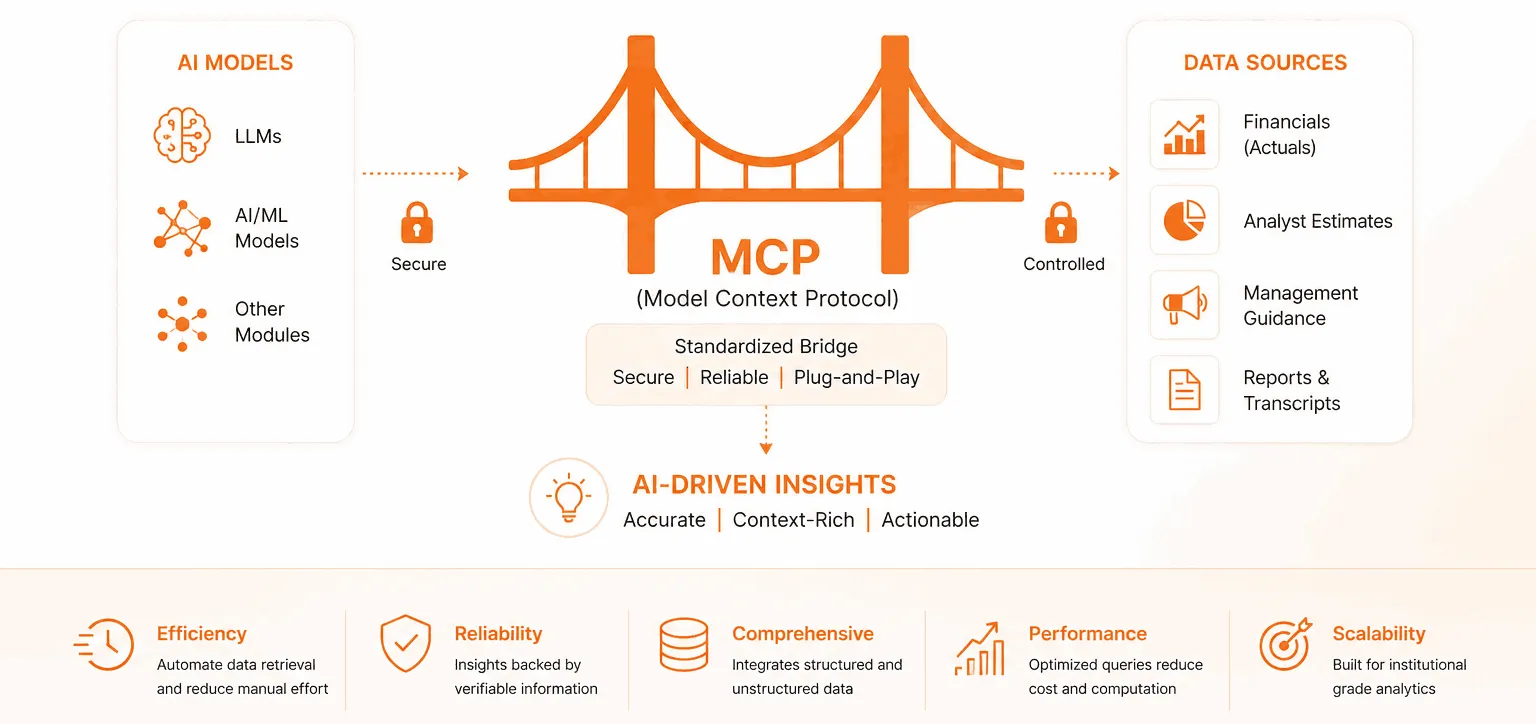
MCP can be understood as a standardized bridge, or a universal plug-and-play standard. It practically allows AI systems to securely connect with external, structured datasets. Instead of relying only on the pre-trained knowledge, AI tools can query live data sources and deliver more accurate, context-rich insights.
Now speaking of reliable and secure data, working in the finance industry, I’ve realized that this is simply needed. A system which primarily focuses on enabling AI-Driven fundamental analysis. Our organization InSync Analytics built just that, ‘InSync MCP’, an AI system that can directly access a unified dataset comprising actual financials, analyst estimates, and management guidance. This framework makes sure that every insight is backed by verifiable information rather than probabilistic outputs.
One of the major advantages of such systems is efficiency. Traditional workflows usually take more time as a major chunk of it involves manual data extraction, spreadsheet manipulation, and cross-referencing multiple sources. MCP simplifies this by allowing users to ask questions in plain and simple language, while the system handles data requests, its processing and formatting as well, increasing efficiency while also reducing the risk of human error.
Another important feature of MCP is the integration of both structured and unstructured data. Financial decision making needs more than just numbers. It also depends on qualitative information from earnings call transcripts and management commentary or guidance. MCP-based platforms bring these elements together, helping make better informed decisions by enabling deeper analysis.
Performance optimization is another core area of focus. This is achieved by only retrieving relevant data and using intelligent query planning, MCP systems can significantly reduce computational load and associated costs. This makes AI-Dirven analytics more scalable and practical for institutional use.
For those interested in exploring how such systems are implemented in practice, the architecture and use cases are outlined in a detailed overview available at
InSync MCP overview
From a broader perspective, MCP represents a shift in how AI interacts with data. It moves AI from being a static knowledge system to a dynamic interface capable of real-time reasoning. As adoption grows, especially in domains like finance, research, and analytics, MCP could become a foundational layer for building more reliable and context-aware AI applications.
Disclaimer: This article is for informational purposes only and does not constitute professional advice. Readers are advised to refer to the platform’s terms, conditions, and privacy policies before using any service. External links are provided for reference and may be subject to their respective policies
























Sign in to leave a comment.