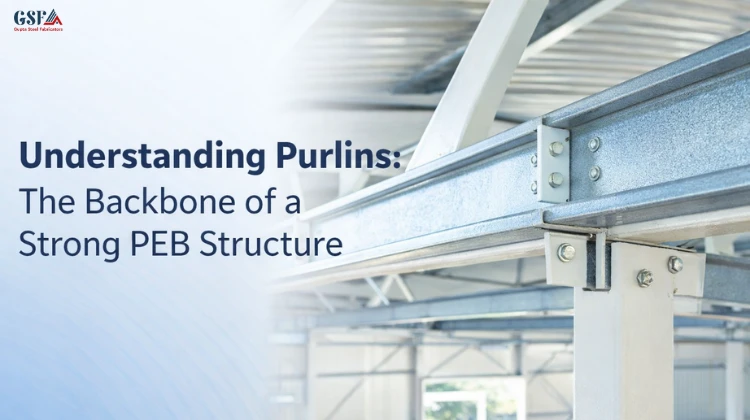

Have you noticed that pre-engineered buildings, though they are so well-structured, are supported by beam-like components? Such things are known as purlins. The PEBs have somewhere revolutionized modern construction by delivering with speed, accuracy, and cost-efficiency. The viable framework makes them perfect for warehouses, factories, and other commercial spaces. Beneath all this lies a network of carefully engineered components, among which purlins have garnered the attention.
So what are purlins? They are horizontal structures that support roof and wall sheeting. While they are secondary in comparison with columns and rafters, their contribution is vital to the structure and load management thereafter. Now, whether designed as Z purlins or C purlins, they are quite important members of the structure.
What Role Do Purlins Play?
After the primaries, including rafters and columns, purlins are secondary but supportive components. Their primary function is to assist roof decks and wall cladding. However, their role is more than just this. Let’s dig up a bit.
Load Transfer and Distribution
It is nothing new that roofs constantly face multiple forces from self-weight, maintenance, and environment. Wind, rain, and other things are included in the same. That’s where purlins make their entry. They act as intermediaries, transferring the load from the roof alone upon themselves. Without such bars, the roofs will sag and vibrate, causing inconvenience.
Improvement of Structural Stability
Purlins help in the improvement of the structures standing tall to withstand the massiveness of themselves. When the bars come together with cladding and bracing systems, they assist in avoiding wind-induced movements and prevent excessive deflection. Not just this, but purlins also minimize noise, vibrations, and panel dismantling, which is seemingly a common problem in lightweight steel structures.
Precision and Ease of Installation
A professional procedure carried out by a pre-engineered building manufacturer molds purlins in exact dimensions and pre-punched holes required for the project. This ensures quick installation and lessens errors, further assisting in swift project completion.
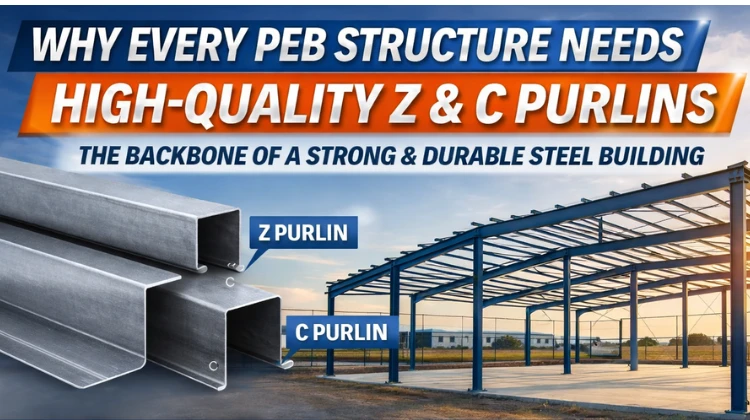
What’s the Difference Between C Purlins and Z Purlins
Normally in PEB structural components, there are two types of purlins used known as C purlins and Z purlins. Both of the types are produced from cold-formed steel. To understand which one plays what role in the building, let’s take a look at the difference between the two and their usage.
Selection between C purlin and Z purlin will depend on various factors like building span, load conditions, roof slope, cladding system, and other budgetary conditions. A qualified pre-engineered building manufacturer will evaluate these factors beforehand to ensure optimal safety and structural effectivity and efficiency.
Conclusion
While they are the hidden gems of this whole PEB structure, purlins play an important role in defining the building’s aura, strength, and stability. Not only do they distribute load and support cladding, but they also enhance rigidity while contributing to overall safety. So, whether using GSF Industries C purlins or Z purlins, both are used for practical applications and long-span efficiency, respectively. In PEB construction, one thing’s for sure: what may look like a minor component can prove to be a major one
Source Link: GSF Industries

Sign in to leave a comment.