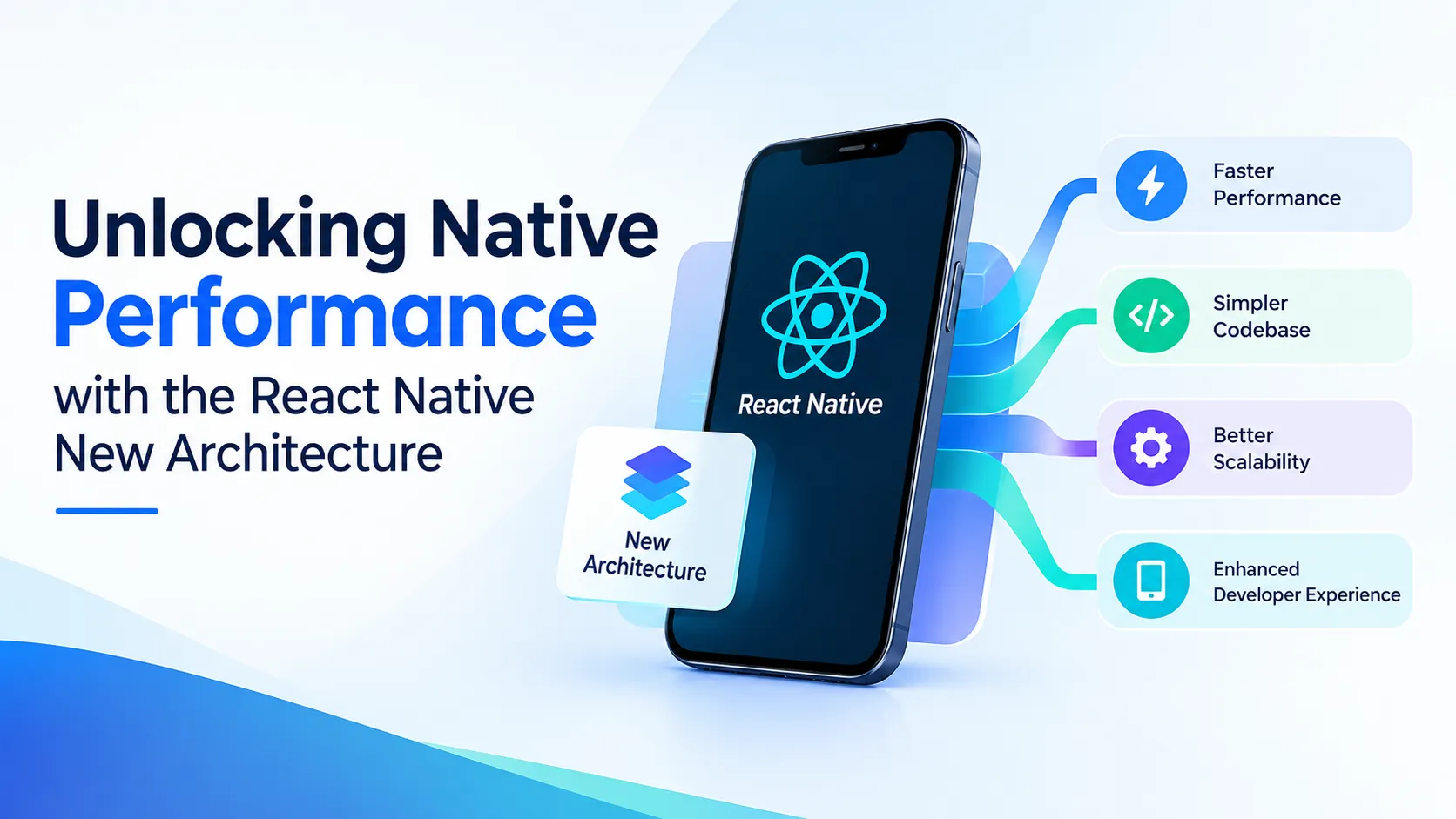

For years, React Native relied on an asynchronous JSON bridge to facilitate communication between JavaScript and native platforms. While revolutionary for cross-platform development, this bridge introduced serialization bottlenecks, thread-blocking layout calls, and high startup latency for complex enterprise applications. The React Native New Architecture fundamentally reimagines this core framework by replacing the legacy bridge with a high-performance C++ core.
What is the React Native New Architecture?
The React Native New Architecture is a ground-up rewrite of React Native’s core engine designed to provide direct memory access between JavaScript and native runtimes. Built on four primary architectural pillars, it allows mobile applications to achieve native-tier smoothness and synchronous execution.
The Four Pillars of the New Architecture:
- JavaScript Interface (JSI): A lightweight C++ layer that replaces JSON serialization with direct C++ object references, enabling synchronous native function calls from JavaScript.
- Fabric Renderer: A modernized rendering engine built in C++ that enables concurrent rendering, multi-threaded layout calculations, and direct UI updates across both iOS and Android.
- TurboModules: A lazy-loaded native module system that initializes native capabilities on demand during application runtime rather than during cold starts.
- Codegen: A build-time tool that automatically generates type-safe C++, Objective-C, and Java interface bindings directly from TypeScript or Flow types.
Why Enterprise Teams Are Upgrading
Migrating to the React Native New Architecture delivers up to 30% faster app startup times, eliminates UI layout thrashing, and unlocks modern React features like Suspense, automatic batching, and concurrent transitions.
Partnering with an experienced React JS development company allows engineering teams to maximize cross-platform code sharing, bridge web and mobile design systems, and future-proof their entire product ecosystem. By eliminating the legacy bridge, engineering teams can integrate complex native C++ libraries effortlessly and deliver seamless, native-tier performance across multi-platform enterprise software.





















Sign in to leave a comment.