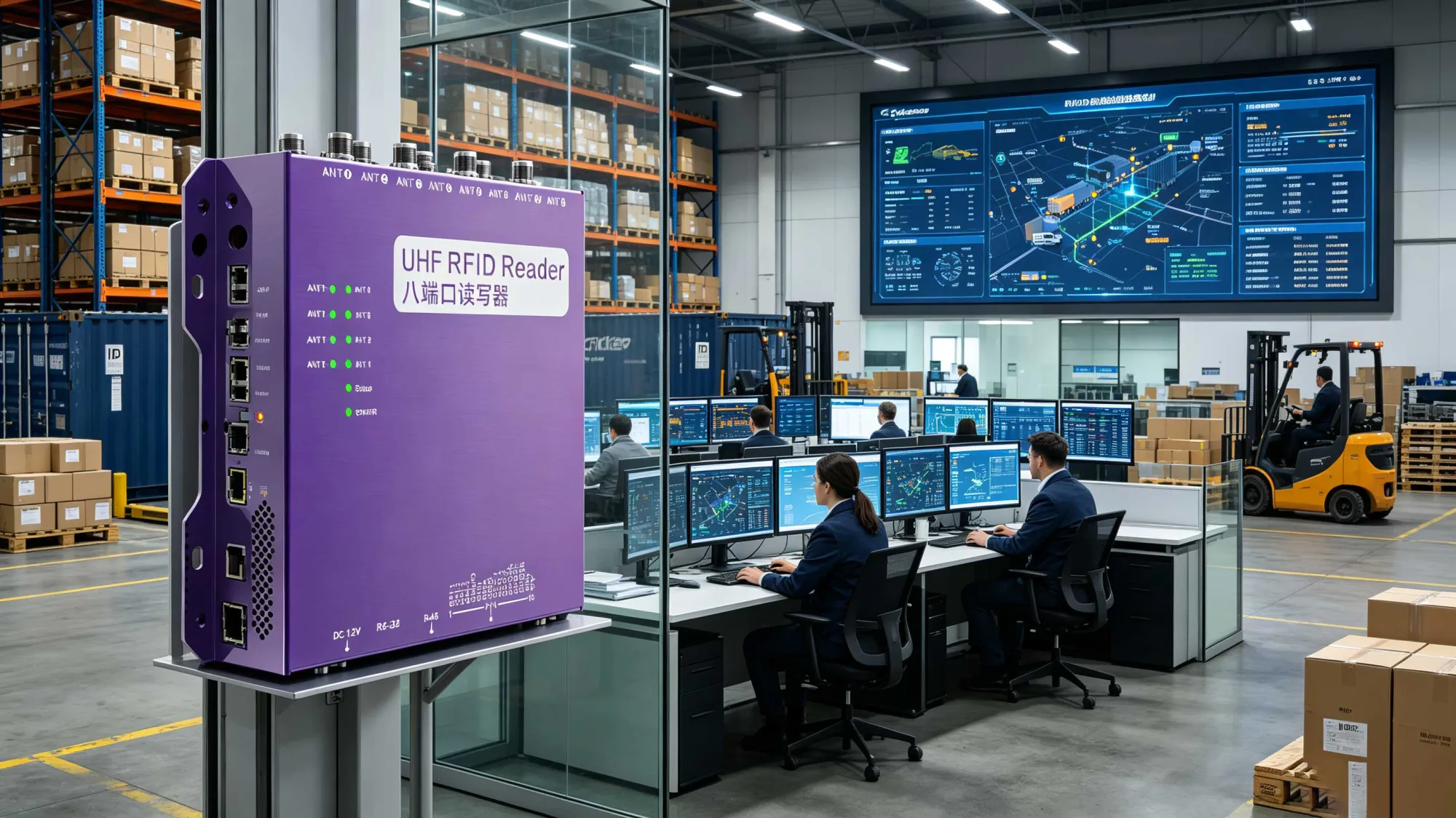

A usb rfid encoder connects RFID tag programming directly to a computer, giving operators and developers a practical way to identify, write, verify, and register RFID tags from a workstation. In real deployment work, the important part is not simply whether the encoder can write data. It is whether the entire encoding process remains controlled when tags arrive in batches, different materials are involved, and every programmed identifier has to match the correct digital record.
That distinction becomes obvious on a production desk.
A blank tag is placed in position.
The application sends the write command.
The software returns a success message.
It looks finished.
But I still want the tag read again.
That extra step has caught more problems than a reassuring green “Success” indicator ever will.
A reliable USB RFID encoder should therefore be treated as a programming station, not merely as an RFID writer attached to a USB cable.
What Is a USB RFID Encoder?
A USB RFID encoder is an RFID reader/writer designed to communicate with a computer through USB while supporting RFID tag programming functions.
Depending on the RFID technology and hardware architecture, an encoder can perform operations such as:
- Detecting RFID tags
- Reading tag identifiers
- Writing supported tag memory
- Encoding EPC information
- Reading data after programming
- Verifying written information
- Filtering tag responses
- Registering tags in software
- Supporting application APIs
- Managing reader parameters
The workstation provides the application environment.
The encoder handles the RFID communication.
A typical workflow looks like this:
Tag → USB RFID encoder → PC application → database
For many organizations, that is enough to build a compact RFID registration and encoding station without deploying a large fixed-reader installation.
The physical equipment may occupy only a small section of a desk.
The data being written can become part of an organization's entire asset, inventory, or traceability system.
USB Is Only the Computer Interface
A common mistake when purchasing an RFID encoder is to focus on the USB connection before checking the RFID technology.
USB tells you how the encoder communicates with the host computer.
It does not tell you which tags can be encoded.
For UHF RFID, the underlying air-interface standard matters.
GS1's EPC UHF Gen2 protocol defines the physical and logical requirements for passive UHF RFID systems operating from 860 MHz to 930 MHz. GS1's current standards repository lists EPC Gen2 version 3.0.1, ratified in February 2026.
The logical interface covers much more than simple identification. It includes mechanisms for tag selection, inventory, and access to tag memory.
That is why a proper encoder evaluation starts with questions such as:
- Which RFID protocol is supported?
- Which tag ICs are compatible?
- Which memory banks can be accessed?
- What data needs to be encoded?
- Is reading supported after writing?
- Can the software control the encoding process?
- What APIs or SDKs are available?
The USB connector comes after those questions.
Why a USB RFID Encoder Makes Sense at a Workstation
Encoding is often performed where the computer already exists.
A label administrator sits at a desk.
An asset database is open.
Blank RFID labels are stacked nearby.
The operator needs to create a relationship between a physical tag and a digital record.
A USB RFID encoder fits naturally into that environment.
Typical applications include:
- Asset tag registration
- RFID label encoding
- Tool identification
- Library tag registration
- Product identification
- Inventory preparation
- Document tracking
- Laboratory sample identification
- Retail item registration
- OEM RFID development
The advantage is not simply installation convenience.
The computer can immediately become part of the encoding transaction.
The application can determine what should be written, trigger the encoder, read the result, and save the completed record.
That creates a much stronger relationship between physical tag and digital identity.
The Difference Between Writing and Encoding
The words “write” and “encode” are often used interchangeably.
In a production environment, I prefer to distinguish them.
Writing means transferring data into supported RFID tag memory.
Encoding means putting the correct structured identity into the tag as part of a larger business process.
For example, an application may have a product record containing:
- Product identifier
- Serial number
- Batch
- Manufacturing information
- Internal asset ID
The encoder does not decide what the business identity should be.
The application does.
The encoder performs the physical RFID operation.
GS1's EPC Tag Data Standard defines EPC structures and their relationship with GS1 keys and other identifiers. It also defines data carried on EPC-encoded RAIN RFID tags, including EPC, User Memory, control information, and tag-manufacturer information.
That distinction becomes important when an organization wants RFID data to remain consistent with existing identification systems.
A Good USB RFID Encoder Workflow Is Deliberately Boring
This is one of those cases where boring is good.
A reliable workstation process might look like:
Create record → Present tag → Read → Encode → Read again → Verify → Save
Nothing dramatic happens.
That is exactly what you want.
The first read establishes which physical tag is being processed.
The write operation places the intended data into supported memory.
The second read confirms what is actually present.
The application then commits the result to the database.
I have always preferred this approach to treating the write command itself as the final confirmation.
A successful communication transaction does not automatically mean the business record is correct.
Verification creates a second checkpoint.
Why Read-After-Write Verification Matters
Imagine a workstation processing 2,000 RFID labels.
The operator writes each tag.
The application displays “completed.”
At tag number 1,437, an unexpected problem appears.
Now the question becomes:
Which tags were affected?
Without verification, the answer may be difficult to establish.
With read-after-write verification, the application can immediately identify a mismatch.
That allows the system to isolate the problem at the encoding station rather than discovering it later in production or inventory.
This is particularly useful when tags are being serialized.
A practical application can compare:
Expected EPC ≠ Actual EPC
and stop the transaction.
The operator can then replace or re-encode the tag.
It takes seconds.
Finding the same error after the tagged product has entered the supply chain is another matter.
USB RFID Encoder for EPC Programming
For UHF RFID applications, EPC programming is one of the most common encoding tasks.
The EPC is not simply an arbitrary string that should be generated independently of the company's identification system.
GS1's EPC Tag Data Standard provides structured encoding rules for EPC identifiers and their relationship to GS1 keys. The current GS1 EPC Tag Data Standard is version 2.3.0, according to the GS1 standards repository.
That gives engineering teams a useful framework when designing an RFID encoding application.
The software can generate or receive the intended identifier.
The encoder performs the tag operation.
The application verifies the result.
The database records the completed relationship.
The RFID tag then carries an identity that can be used by downstream systems.
This is considerably more robust than manually typing identifiers into a database and assuming the physical label matches.
USB RFID Encoder for PC Integration
A usb rfid encoder for pc should be selected with software integration in mind from the beginning.
I normally ask engineering teams to demonstrate more than the manufacturer's desktop utility.
I want to see the actual application.
Questions include:
- Can the software trigger a read?
- Can it start and stop inventory?
- Can it select a specific tag?
- Can it write EPC data?
- Can it read the written value?
- Can it report failures?
- Can duplicate tag responses be filtered?
- Can the application detect an absent tag?
- Is an SDK available?
- Is there an API?
- Can firmware be updated?
A demo application proves that the hardware works.
An SDK proves that the hardware can become part of someone else's software.
For OEM development, that distinction matters.
Cykeo RFID platforms are designed with OEM integration requirements in mind, including API and SDK support for application development.
USB RFID Encoder and Tag Selection
One issue becomes particularly important when several tags are physically close together.
Suppose a workstation has a box containing blank RFID labels.
The operator intends to encode one label.
Several tags are inside the encoder's RF field.
The system must identify the intended tag before writing.
This is not simply a software convenience.
It is an RFID protocol and RF-environment problem.
GS1's EPC Gen2 protocol includes mechanisms for tag selection and inventory. The current Gen2 specification also includes additional selection capabilities intended to focus operations on tags of interest.
In practical terms, the encoding application should make the selected tag unambiguous.
That can involve:
- Physical positioning
- Controlled antenna coverage
- Tag selection
- EPC filtering
- Short encoding windows
- Read-before-write verification
NIST similarly emphasizes that antenna coverage should be appropriate to the intended communication area rather than unnecessarily broad.
The goal is simple:
one intended tag, one controlled encoding operation.
Antenna Design Still Matters on a USB Encoder
USB does not make RF behavior predictable by itself.
The antenna remains part of the RFID system.
A desktop encoder may use a near-field or controlled reading area depending on its design. The important factor is that the RF field matches the workstation task.
NIST's RFID guidance specifically notes that antenna types have different coverage patterns and recommends designing coverage around the range required to communicate with intended tags. It also points out that detachable antennas can be useful where specific coverage areas are required.
This becomes obvious when tags are close together.
If the reading area is too large, the encoder may see neighboring tags.
If it is too small, the operator may need to position every label precisely.
Neither extreme is ideal.
The useful range is the range that makes the physical workflow repeatable.
Encoding RFID Tags on Real Products
The cleanest laboratory test uses a loose RFID inlay.
Production rarely does.
The tag may be:
- Attached to plastic
- Mounted on metal
- Laminated
- Embedded in a label
- Applied to a tool
- Attached to a product package
- Positioned near another RFID tag
The material changes the RF environment.
Metal deserves particular attention.
A tag designed for ordinary packaging should not automatically be assumed to perform the same way when attached directly to steel.
When evaluating an encoder, I prefer to use the final tag construction and the final object as early as possible.
That means testing:
actual tag + actual object + actual encoder + actual software
Not a convenient substitute.
USB RFID Encoder for Asset Registration
Asset management is one of the clearest applications for an RFID encoder.
A new tool arrives.
The asset record is created.
The RFID tag is selected.
The encoder reads the tag.
The application writes the assigned identifier.
The tag is read again.
The record is saved.
The physical object and database now share the same identity.
This can be useful in:
- Tool rooms
- Maintenance departments
- Laboratories
- Warehouses
- Libraries
- Equipment management
- Manufacturing
Cykeo's RFID technology is designed for applications such as tag registration, item management, tool management, and desktop RFID workflows.
The encoder becomes the point where the digital record meets the physical object.
USB RFID Encoder for Library Tag Registration
Library RFID projects provide a particularly clear example.
A librarian or tag administrator may need to process thousands of books and other items.
The workstation must be able to:
- Identify the item.
- Register its RFID tag.
- Associate the RFID identifier with the library record.
- Verify the programmed information.
- Record the transaction.
A desktop RFID platform can support related functions such as item registration, tag registration, borrowing, returns, shelf-tag registration, item search, statistics, and log queries.
The workflow is compact.
The data relationship is not.
A well-designed encoder station prevents the RFID tag from becoming an isolated identifier that exists separately from the management system.
USB RFID Encoder in Industrial Environments
Industrial encoding introduces additional variables.
A tool may have a steel surface.
A product may be wrapped in material that changes RF behavior.
Tags may arrive in rolls.
An operator may need to encode several hundred items per shift.
A successful system therefore needs repeatability, not just a successful demonstration.
I would test:
Tag Consistency
Use tags from multiple batches where appropriate.
Physical Position
Check whether small changes in placement affect encoding.
Nearby Tags
Introduce adjacent tags to reproduce the actual environment.
Write Verification
Read back every encoded identifier during validation.
Operator Speed
Run the workstation at the pace expected in production.
Software Recovery
Test interrupted USB communication and application errors.
The fastest encoder is not useful if operators have to stop repeatedly to recover from ambiguous tag selection.
Security and RFID Tag Writing
Writing RFID data introduces security considerations that do not exist in exactly the same form when a tag is only being read.
If unauthorized users can rewrite an identifier, the physical tag may no longer represent the object the database expects.
NIST SP 800-98 was specifically developed to help organizations understand RFID risks and implement appropriate security and privacy controls. The guidance covers RFID system components, communication, security risks, and operational considerations independently of a specific hardware platform.
Depending on the application, engineering teams may need to consider:
- Access control
- Password protection
- Write permissions
- Application authentication
- Database authorization
- Audit logs
- Reader access control
- Tag memory protection
The correct security model depends on what the RFID tag represents.
A warehouse label and an authentication credential should not necessarily receive the same treatment.
USB RFID Encoder vs. RFID Printer Encoder
A USB RFID encoder is not automatically the same thing as an RFID printer/encoder.
An RFID printer/encoder generally combines label printing with RFID encoding.
A standalone USB encoder focuses on the RFID operation and can be used where printed output is handled separately.
A standalone encoder can make sense when:
- Labels are already printed
- Existing printers remain in use
- RFID tags are embedded in non-printable objects
- A workstation only needs tag programming
- The organization already has a label-printing workflow
The correct architecture depends on what happens before and after encoding.
What I Look for in a USB RFID Encoder
A specification sheet should answer the basic questions.
A deployment test should answer the difficult ones.
I look for:
- Compatible RFID protocols
- Supported tag ICs
- Reliable tag detection
- Controlled RF coverage
- Read-after-write capability
- Memory access
- EPC programming support
- Anti-collision functions
- Tag filtering
- Stable USB communication
- SDK/API availability
- Firmware update capability
- Practical development documentation
Then I run the actual workflow.
One tag.
Then another.
Then ten.
Then one hundred.
Then the same operation with the final tag construction.
That is where a product starts revealing whether it belongs in a production environment.
Cykeo USB RFID Encoder Solutions
Cykeo develops RFID technologies for asset management, library systems, tool registration, industrial identification, tag programming, and OEM applications.
Our RFID platforms are designed to connect RFID tag operations with software workflows where controlled identification, programming, and verification are important.
Depending on the application, Cykeo RFID solutions can support:
- RFID tag identification
- Multi-tag recognition
- Data filtering
- Tag registration
- Tag writing
- Reader configuration
- API integration
- SDK development
- Firmware upgrades
- Desktop software integration
For an OEM team, the most useful encoder is rarely the one with the longest feature list.
It is the one that can be integrated into the application, controlled consistently, and verified against the actual physical tag.
The USB connection gets the encoder onto the workstation.
The RFID engineering determines whether the workstation can be trusted.
A usb rfid encoder should ultimately turn a blank or unassigned RFID tag into a verified digital identity—without making the operator fight the equipment to get there.
Author's Technical Perspective
This article is written from a practical RFID engineering perspective, covering RFID reader/writer hardware, UHF tag encoding, antenna behavior, workstation registration, tag verification, and OEM software integration.
Technical references were checked against established standards and government guidance rather than unsupported performance claims.
GS1's EPC Gen2 standard defines the UHF RFID air interface and its physical and logical requirements. The latest listed version, 3.0.1, was ratified in February 2026.
GS1's EPC Tag Data Standard defines EPC structures and data carried on EPC-encoded RAIN RFID tags, including EPC and User Memory information.
NIST SP 800-98 provides independent guidance on RFID system design, security, privacy, reader communication, and antenna placement. The publication was authored by Tom Karygiannis of NIST and colleagues and was published by the National Institute of Standards and Technology.






















Sign in to leave a comment.