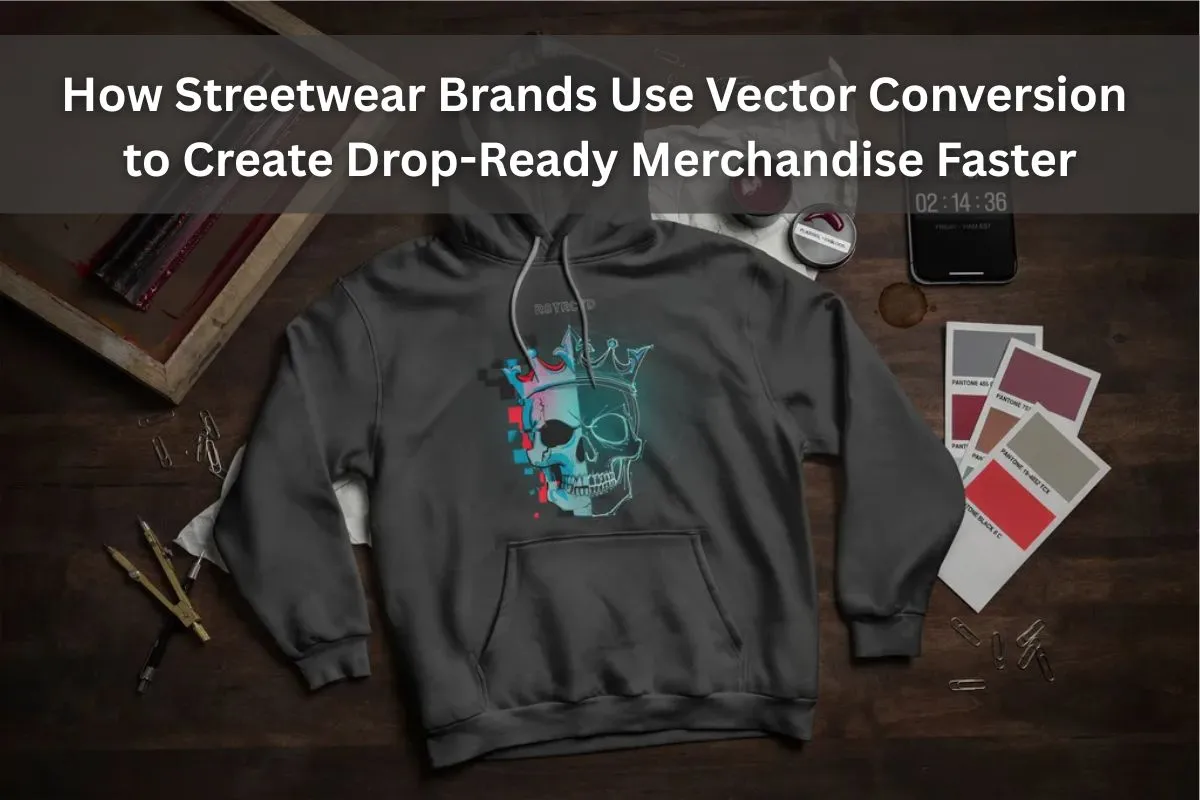

The "the drop," which is the modern streetwear term for something that drops, runs the entire show in the modern streetwear world. The key to success in this hypercompetitive market is to build a lot of excitement around a brand, have a limited edition collection, and deliver orders quickly. Independent brands and big fashion brands both have been revolutionized by the print-on-demand (POD) model. Converting a digital concept to a physical garment, however, is a huge technical challenge: preservation of artwork quality. The industry's leading manufacturers heavily depend on the vector conversion services to ensure that the intricate designs are perfectly transferred over to the physical fabric. These can transform chaotic pixels into flawlessly scalable digital blueprints, serving as the driving force behind the most successful merchandise drops of all time.
Why Low-Resolution Artwork Slows Down Apparel Production
There's a reason why apparel preparation is a specific workflow and you need to know about the foundation of digital art to understand that. In general, artists tend to doodle their ideas on paper or on a digital painting application that is based on raster graphics. Raster images are created from thousands of small, individual coloured blocks called pixels. Pixelated images such as JPEGs and PNGs are ideal for social media and smartphones, but they are a pain in the back of the neck in the physical manufacturing process.
A streetwear designer tries to enlarge an image that is too small to fit the back of an oversized graphic tee and the image degrades. Those little coloured blocks are subjected to the software's "stretch" function, which creates blurred edges, jagged lines and an unprofessional "muddy" look. Apparel printing machines can't really predict where crisp lines are, they just print where they are ordered to print. Serving them low res images ensures that they'll come out looking cheap and will instantly destroy a brand's reputation in a market that values high quality visuals.
How Vector Artwork Delivers Perfect Results from Print to Embroidery
Brands use scalable vector graphics (SVGs or EPS files) to avoid the pixel issue. Vector art is built by mathematical equations that determine the precise location of lines, curves and solid shapes, unlike a raster file. The artwork is not defined by a grid of blocks, but by Math, which means that it is infinitely scalable. Your vector logo can be scaled to fit a bespoke zipper pull, or it can be scaled up to cover a whole shipping container, and the edges will still be sharp.
This kind of detail, on a huge garment line, is a requirement only a reliable vector art conversion service can provide. One design can be easily routed to various production processes. To achieve vivid, solid colour blocks with Direct-to-Garment (DTG) printing, it is crucial to have clean vector lines. They are essential for traditional screen-printing frames to burn and fire and they're an absolute given where you have to start from if you need to create embroidery from a piece of artwork that's not thin or light.
How Vector Files Eliminate Print-on-Demand Production Bottlenecks
The key to the print-on-demand business is automation. Once a customer buys a hoodie from the brand's online shop, the order is sent to the brand's printing plant located all across the world, the hoodies are produced and then delivered to the customer. But when the artwork files are uploaded with bugs, this whole automated machine comes to a halt.
The automated system will either reject the artwork because of transparent pixel artifacts, unclosed path or jagged resolution or worse print the artwork as is, which delays the fulfillment process. Brands proactively overcome this operational hurdle by leveraging vector conversion services. They upload pristine, production ready files to their own POD dashboards which automatically start the manufacturing process and execute it flawlessly every time a transaction happens.
Why Streetwear Brands Outsource Vector Conversion for Faster Product Launches
Being a successful streetwear brand is a much harder task that involves intense creative focus, community participation and trend forecasting. These creative directors and founders shouldn't be spending dozens of hours bent over the keyboard, manually refining a design file by adjusting anchor points and cleaning up bezier curves.
This highly technical and repetitive work gives a huge strategic edge to delegate. Numerous custom apparel companies rely on specialized agencies like Visuals Clipping to deal with the back-end artwork prep. Brand owners can send rough sketches or low-quality digital files to dedicated professionals and have all their seasonal catalog converted to flawless drop-ready vectors overnight. By outsourcing to professional vector conversion services, designers will be able to dedicate their time and concentrate entirely on creating the next big and expected collection while not bothering with the software restrictions.
How Vector Conversion Protects Product Quality and Brand Reputation
There are no words big enough to explain how expensive it is to have a mistake in your custom apparel business. Each time a t-shirt or a cap is miss aligned or a patch is not placed correctly, it will mean a refund, bad reviews, and no loyalty left. Streetwear buyers are critical and invest in checking the fabric's weight, the pigment of the ink, and the lines' sharpness. The use of vector conversion services as an essential means of quality control ensures that the physical product completely matches the high-quality marketing images that led the customer to purchase it.
Final Thoughts: Vector Conversion Powers Successful Streetwear Drops
Street fashion and print-on-demand have formed a beautiful era for independent fashion designers. It's possible to start a brand from a bedroom, but it's a saturated market that requires absolute professionalism in production. But even the best marketing cannot save a garment that is ruined by bad file formatting. Modern clothing brands can ensure that their apparel is always scalable, precisely accurate and ready for another large drop by incorporating vector conversion services into their regular operations.
Also Read: Raster vs Vector: Why Businesses Choose Vector Art Conversion for Logos



















Sign in to leave a comment.