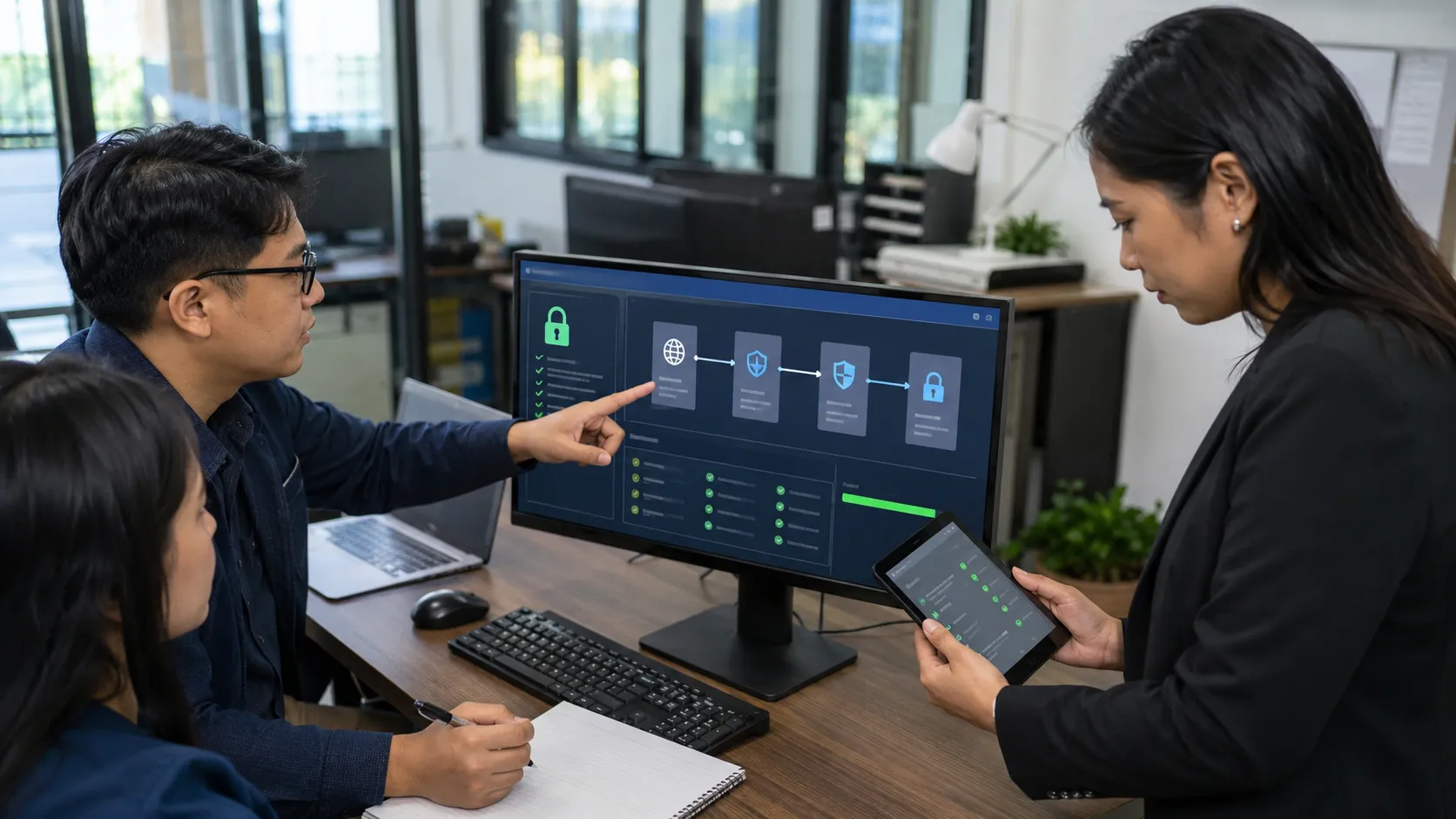

Local government units (LGUs) verify certificate chain completeness on citizen portals by checking the exact certificates a citizen portal sends, confirming the end-entity certificate appears first, confirming each intermediate certificate links to the next issuer, and testing whether representative clients reach a trusted root without downloading a missing intermediate from another source. The GoLGU SSL Certificate service provides related context on encrypted browser-to-server connections, while chain verification still requires technical testing and local approval.
What Does a Complete Certificate Chain Mean?
A certificate chain connects the portal certificate to a certificate authority trusted by the citizen's browser, mobile device, application, or integration. The portal certificate is often called the end-entity or leaf certificate. Intermediate certificate authority certificates follow when the issuing path requires them. The client then uses a locally trusted root certificate as the trust anchor.
Completeness does not mean the server must send the root certificate. Transport Layer Security (TLS) 1.3 places the sender's certificate first and expects each following certificate to directly certify the one before it. The trust-anchor certificate is often omitted because clients normally receive trust anchors through separate trusted stores.
For a public portal, the practical test is simple: does the server provide the leaf certificate and the intermediate certificates needed by supported clients to build and validate a path to a trusted root?
Why Might a Portal Work on One Device but Fail on Another?
A portal sometimes appears normal on an administrator's computer because the device stored the missing intermediate certificate during an earlier connection. A newly installed device, older browser, mobile application, or external service might lack the same cached certificate.
This difference creates a false sense of readiness. The leaf certificate might show the correct domain and a future expiration date, yet citizens still receive a warning or failed connection when the server omits a required intermediate.
Testing only one office computer is therefore weak evidence. Certificate chain verification for LGU portals needs clean or representative clients that reflect the devices and software used by citizens and connected services.
What Must the Server Present During the TLS Handshake?
The server presents the citizen portal's end-entity certificate first. The next certificate is the intermediate authority that issued the end-entity certificate. Any further intermediate directly certifies the preceding intermediate until the client reaches a trust anchor in its trusted store.
The test team must not assume that a longer chain is better. Extra, outdated, duplicated, or incorrectly ordered certificates create compatibility problems. Compare the delivered chain with current installation instructions from the certificate issuer or authorized service provider.
The team also needs to separate three questions:
- Did the server send the required chain?
- Did the client build a valid path to an approved trust anchor?
- Did the end-entity certificate pass separate checks for domain name, validity period, permitted use, and status?
A complete chain does not replace those other checks.
What Evidence Do LGUs Need Before Testing?
Start with a defined scope. Record every citizen-facing hostname covered by the test, including the main portal, service subdomains, login routes, application forms, payment routes, file-upload routes, status pages, and application programming interface endpoints used by approved mobile applications or partner systems.
Gather these items before the first test:
- The approved portal hostname and environment.
- The current certificate issuer and certificate serial number.
- The expected end-entity and intermediate certificates.
- The certificate installation date and responsible technical owner.
- The supported browser, mobile, operating-system, and integration profiles.
- The test date, tester, approver, and change reference.
- The fallback or hold procedure when the chain fails.
What Steps Help ICT Teams Verify Certificate Chain Completeness on Citizen Portals?
- Open each portal endpoint through a clean test route. Use a device, browser profile, container, or command-line environment that does not depend on a previously cached intermediate certificate.
- Capture the chain delivered by the server. Record the certificates presented during the TLS handshake. Store certificate fingerprints or approved evidence files instead of copying private configuration data.
- Identify every certificate's role. Mark the first certificate as the end-entity certificate. Identify each intermediate authority and the expected trust anchor.
- Check issuer and subject relationships. Confirm that each intermediate directly certifies the certificate before it. Review basic constraints, key usage, signature validation, and validity periods through an approved certificate-testing method.
- Run TLS certificate path validation. Confirm that the client builds a path from the target certificate to a trusted anchor. Test without relying on automatic intermediate retrieval when the testing method supports that control.
- Repeat the test across representative clients. Include supported desktop browsers, common mobile devices, approved applications, and integrations that connect directly to the portal.
- Record the result and retest after correction. Mark each endpoint as accepted, held, or accepted with a documented limitation. Keep the failed result, correction reference, and final verification evidence.
A related pre-go-live route test results record shows a useful expected-versus-actual evidence pattern. Certificate testing still needs its own technical fields and approval criteria.
Which Certificate Details Require Review?
The end-entity certificate needs the correct citizen portal hostname, an active validity period, an approved public key and signature profile, and suitable extended key usage for server authentication. The test also confirms that the certificate matches the deployed private key through an approved method.
Each intermediate certificate needs a valid issuer relationship, appropriate certificate authority constraints, suitable key usage when the extension is present, an active validity period, and a signature that validates under the issuing certificate.
The trust anchor is a local policy input. Different client platforms trust different root sets. The LGU needs to define its supported client set rather than assuming every device uses the same trust store.
How Can LGUs Test Citizen Devices and Integrations?
Utilize a small compatibility set that is based on real service access. A municipal portal used through desktop browsers needs current versions of the browsers supported by the LGU. A service promoted through mobile devices needs representative Android and iOS tests. A portal connected to a mobile application, payment provider, notification service, or document exchange needs separate integration tests.
Record the client name, version, trust-store source, network route, result, and error. Avoid writing only “works” or “failed.” A useful result states whether the handshake completed, which path was built, and which certificate caused the failure.
Do not bypass a warning and count the page as passed. The acceptance test needs to reflect the normal citizen journey.
What Belongs in a Certificate Chain Verification Record?
One record covers one defined portal endpoint and one deployment state. Include:
- Portal hostname and tested route.
- Production, staging, or test environment.
- End-entity certificate subject, issuer, serial number, fingerprint, and validity period.
- Intermediate certificate names, order, fingerprints, and validity periods.
- Expected trust anchor.
- Test method and tool version.
- Representative clients and results.
- Automatic intermediate retrieval allowed or disabled during the test.
- Failure message and affected service.
- Corrective action, owner, and target date.
- Retest result and evidence reference.
- Acceptance, limitation, or hold decision.
- Approving technical and service owners.
What Does a Practical Failure Look Like?
An LGU launches an online permit status page on a new subdomain. The certificate displayed in the browser covers the hostname and has not expired. Office computers open the page without a warning.
A citizen using a recently reset mobile device receives a certificate error. A clean-client test shows that the server sends only the end-entity certificate. The office computers had cached the required intermediate certificate from another website.
The Information and Communications Technology (ICT) team installs the correct intermediate bundle, restarts the affected service through the approved change process, and repeats the test. The clean mobile device, desktop browser, and status-notification integration then build a valid path to their trusted roots. The record links the failed evidence, change ticket, retest evidence, and release decision.
Who Owns the Review and Decision?
The ICT or web administration team performs the technical test. The hosting provider or developer corrects server configuration when its contract assigns that duty. The service office confirms the affected citizen route and service impact. The Data Protection Officer reviews related personal-data risks when the portal processes personal information.
An authorized technical owner approves the chain result. A service owner approves release when a failure affects public transactions. Procurement, legal, or contract personnel need the evidence when a third-party provider misses agreed security or support requirements.
What Does Certificate Chain Completeness Not Prove?
A complete chain does not prove that the portal application is free from vulnerabilities. It does not verify access controls, secure coding, database protection, backups, transaction accuracy, or service availability.
It also does not prove hostname coverage, revocation status, approved algorithms, or future validity. Those checks belong in the wider TLS and portal security review.
Republic Act No. 10173 requires reasonable and appropriate safeguards based on risk. Republic Act No. 12254 supports citizen-centered services, data security, resilience, and suitable controls for government information assets. Neither law defines a universal certificate-chain tool or automatic pass rule. The LGU must apply verified technical standards to its own system, clients, contracts, and risk decisions.
How Do LGUs Close the Verification?
Close the review only after the required endpoints pass on the approved client set or an authorized official records a limited acceptance. The final evidence identifies what changed, who approved it, and which deployment was tested.
Repeat the review after certificate renewal, server migration, load-balancer change, content-delivery network change, certificate authority change, subdomain launch, major hosting update, or a citizen report that indicates a trust-path failure.
For a broader review of portal encryption requirements, certificate ownership, and service responsibilities, request a GoLGU consultation for your LGU portal.
Conclusion
LGU teams verify certificate chain completeness on citizen portals by proving that each citizen-facing endpoint sends the correct end-entity and intermediate certificates, supports a valid path to an approved trust anchor, and works across representative clients without hidden dependence on cached intermediates.
A strong result is more than a screenshot of a padlock. It is a controlled record of the delivered chain, path-validation result, client coverage, failure evidence, correction, retest, and authorized release decision.
Frequently Asked Questions
Does the server need to send the root certificate?
Usually, no. Clients normally receive root trust anchors through their operating system, browser, application, or managed trust store. The server sends the end-entity certificate and the intermediates needed to reach a trusted root.
Is a valid leaf certificate enough for a citizen portal?
No. A correct hostname and active date on the leaf certificate do not fix a missing intermediate. The client still needs a valid certification path to a trusted anchor.
Why does the portal pass on an office computer but fail on a mobile device?
The office computer often holds or caches a missing intermediate certificate. A clean mobile device then exposes the incomplete server configuration.
Does the LGU need every possible certificate in the chain?
No. The server provides the required path, not an arbitrary bundle. Extra, duplicated, expired, or incorrectly ordered certificates reduce compatibility.
When is certificate chain verification repeated?
Repeat it after renewal, hosting or server changes, load-balancer changes, certificate authority changes, new subdomains, major deployment updates, and reported trust errors.
Does a complete chain mean the portal is fully secure?
No. Chain completeness supports certificate authentication. The LGU still needs separate reviews for hostname matching, validity, revocation, TLS configuration, application security, access control, privacy, records, and service continuity.
References
- Republic Act No. 12254, E-Governance Act
- Republic Act No. 10173, Data Privacy Act of 2012
- National Privacy Commission Circular No. 2023-06
- RFC 8446, The Transport Layer Security Protocol Version 1.3
- RFC 5280, Internet X.509 Public Key Infrastructure Certificate and CRL Profile
Disclaimer
This material provides general operational guidance. It is not legal, cybersecurity, procurement, privacy, or technical implementation advice. LGUs need to follow approved policies, contracts, certificate issuer instructions, and guidance from authorized professionals and government agencies.

























Sign in to leave a comment.