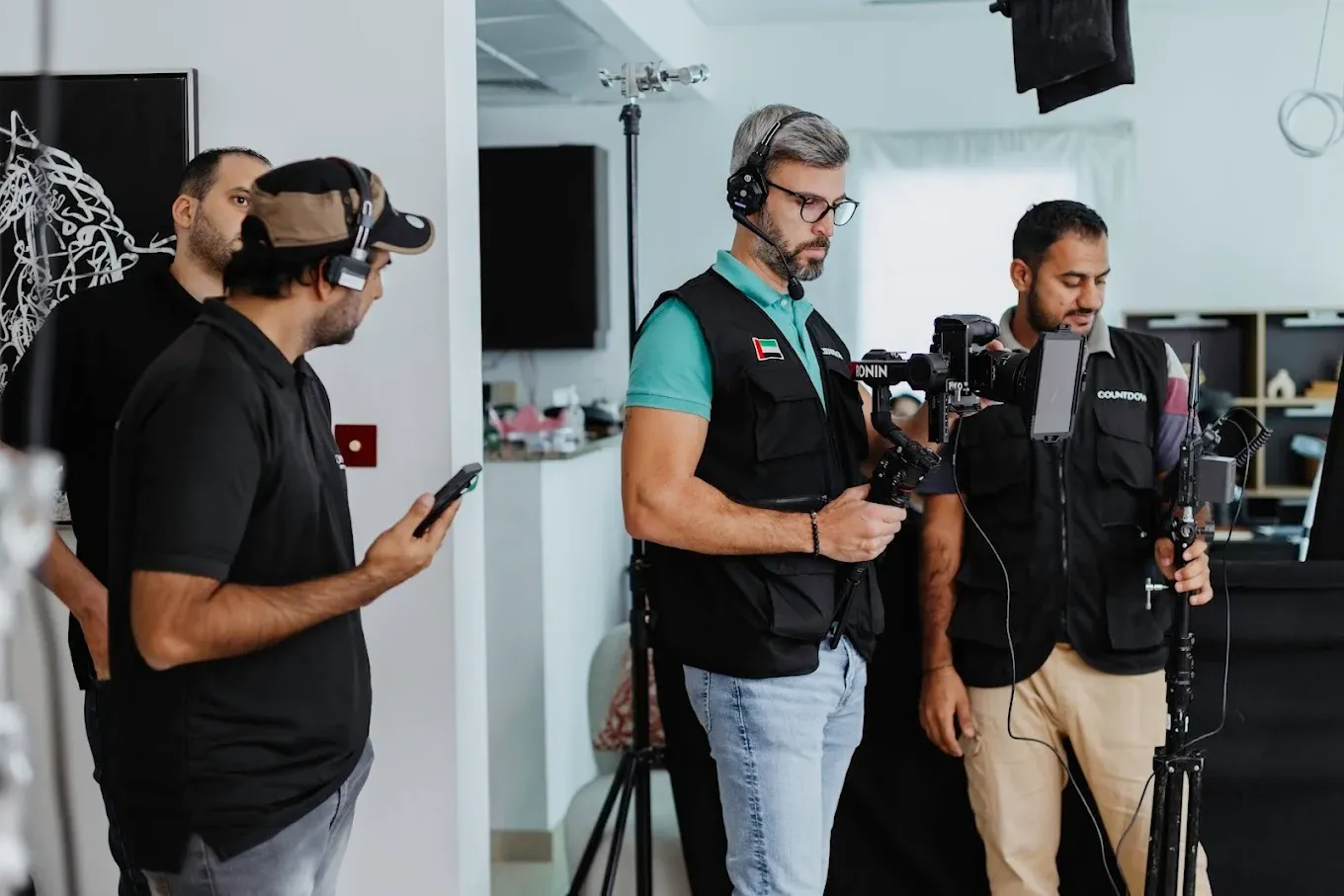

Video production looks straightforward from the outside. Plan the shoot, press record, edit the footage. But anyone who has worked on a real project knows it rarely unfolds that cleanly.
Most problems do not come from dramatic failures. They come from small, compounding gaps — a vague brief, an unchecked location, a feedback loop with no clear endpoint. Each one is manageable on its own. Together, they determine whether a project delivers on time, on budget, and at the quality the client expected.
These are the ten challenges that most reliably derail video productions, and what actually prevents them.
1. No clear goal at the start
This is the root cause behind most production problems, including several others on this list. A brief that says "we need a corporate video" or "something for social media" is not a goal. It is a format. The goal is what the video is supposed to change — in a viewer's understanding, behaviour, or perception.
Without that definition, every subsequent decision becomes a guess. The script tries to say too much. The visuals pull in different directions. Editing becomes a negotiation rather than a craft. A single, specific goal — written down and agreed upon before scripting begins — prevents all of that. It is the one step that costs nothing and saves the most.
2. Pre-production is treated as optional
Pre-production is not exciting, so it gets compressed. That is where most shoot-day problems are created.
Scripting, shot planning, location checks, scheduling, and stakeholder approvals are not administrative formalities. They are the decisions that determine whether a crew arrives knowing exactly what they need, or spends the first two hours solving problems that should have been resolved the week before.
The most common results of rushed pre-production:
Key shots are missing because they were never on a list:
Locations that look wrong on the day and cannot be changed.
A talent who has not been properly briefed and needs repeated takes.
Crew waiting on approvals that should have been secured in advance.
Thorough pre-production does not slow a project down. It front-loads the decisions so the shoot itself can move fast.
3. Budget and expectations pulling in different directions
The challenge is rarely the budget itself. Small budgets produce good work when the scope is matched to them. The problem is misalignment — when a client expects a broadcast-quality brand film and the budget covers a half-day shoot with one camera operator.
This conversation is uncomfortable to have early and far more expensive to avoid. When the budget, scope, and expected output are agreed in writing before production begins, the entire process operates with fewer compromises. When they are not, the compromises happen at the worst possible stage: late in the edit, when options are limited and time is already gone.
4. Deadlines that underestimate what production actually takes
Scripts take longer to approve than expected. Shoots run over schedule. Editing reveals gaps that require additional footage. Feedback cycles stretch when multiple stakeholders are involved.
None of this is unusual. All of it is predictable. The problem is not that production takes time — it is that timelines are built without accounting for it. When a deadline is set too tightly, teams begin making cuts: shots are dropped, sound issues are left unaddressed, and editing becomes reactive rather than considered. Some urgency is unavoidable. Sustained urgency from start to finish is a planning failure, not a production one.
5. Communication that assumes rather than confirms
Video production involves a chain of people — clients, producers, directors, camera crew, editors, and sometimes talent. When information does not travel cleanly through that chain, different people end up working from different assumptions.
What that looks like in practice:
Multiple versions of a script are in circulation with no clear master.
Feedback given to the editor that contradicts feedback given to the director.
Changes approved verbally but never documented, then disputed later.
Crew members are making creative decisions that were not theirs to make.
The fix is not more meetings. It is a single source of truth for each decision — written approvals, shared documents, and one person with final authority at each stage. Clarity of process prevents the majority of communication failures before they happen.
6. On-camera discomfort that the set makes worse
Most people are not comfortable on camera. That is not a problem — it is a condition to be managed. Executives, employees, and clients who appear stiff or unconvincing on screen are almost always people who were put in front of a camera without adequate preparation, in an environment that amplified their discomfort rather than reduced it.
A crowded set, complex scripted lines, and a crew visibly waiting for a perfect take will produce poor performances from confident, articulate people. A calm set, a natural conversation structure, and a director who prioritises ease over precision produce footage that looks and sounds genuine. The environment shapes the performance as much as the individual does.
7. Sound problems that cannot be fixed after the fact
Audio processing is the most consistently underestimated variable in video production. Footage with poor sound is not fixable in post — it is unusable. Viewers will tolerate imperfect visuals; they will not stay with audio they cannot follow clearly.
Background noise, room echo, inconsistent mic levels, and ambient hum from air conditioning or nearby machinery are all addressable before recording begins. They require attention during setup, not after playback. Built-in camera microphones are not adequate for professional use. Proper mic placement and continuous monitoring with headphones throughout the shoot are not optional steps. They are the baseline for footage that will actually be usable in the edit.

8. Locations that have not been properly assessed
Not every space that looks good in a photograph works for video. Low ceilings create echo. Reflective surfaces cause lighting problems. Offices that appear quiet at 10 AM are often next to busy corridors. Power access may be limited. Natural light that looks clean in the morning shifts within an hour.
None of these issues are production-stoppers when they are known in advance. All of them become expensive when discovered on shoot day. A proper location recce — not a brief walk-through but a structured technical assessment — is the only way to know what a space will actually require. It is one of the cheapest steps in pre-production and one of the most consistently skipped.
9. Revision cycles with no defined endpoint
Editing is where creative decisions that were deferred earlier in the process tend to resurface. Multiple stakeholders review the cut. Feedback conflicts. Small changes are added, then reversed, then added again. The edit grows longer as confidence in it shrinks.
This is a process failure, not a creative one. Defined approval stages — with a limited number of reviewers, clear feedback windows, and one person empowered to make final decisions — compress revision cycles significantly. Without that structure, editing can consume more time than the shoot itself, with diminishing returns on quality.
10. Platform requirements considered last
A video built for a website homepage is not automatically suitable for Instagram, LinkedIn, or an internal training platform. Aspect ratios, length, pacing, caption requirements, and the assumption of whether viewers have sound on all vary by platform. These are not minor differences. They change how a video is shot and edited.
When platform requirements are treated as a post-production question rather than a pre-production one, re-edits become necessary — sometimes requiring new footage that was never captured. Deciding where a video will live before scripting begins costs nothing. Re-editing a finished video to work on a platform that was always the intended destination costs time, budget, and occasionally the quality of the original cut.
What these challenges have in common
Every problem on this list is a planning problem. Not a talent problem, not a budget problem, and not a technology problem. The productions that run smoothly are not the ones with the biggest crews or the most expensive equipment. They are the ones where goals were defined clearly, pre-production was taken seriously, and communication had structure from the first brief to the final approval.
Problems still happen on well-run productions. The difference is that they are isolated and manageable rather than compounding. The final video reflects the discipline behind it — and experienced clients and viewers can almost always tell.
Working on a video production and want to avoid these pitfalls from the start? The brief is the best place to begin. Get in touch before pre-production starts.






























Sign in to leave a comment.