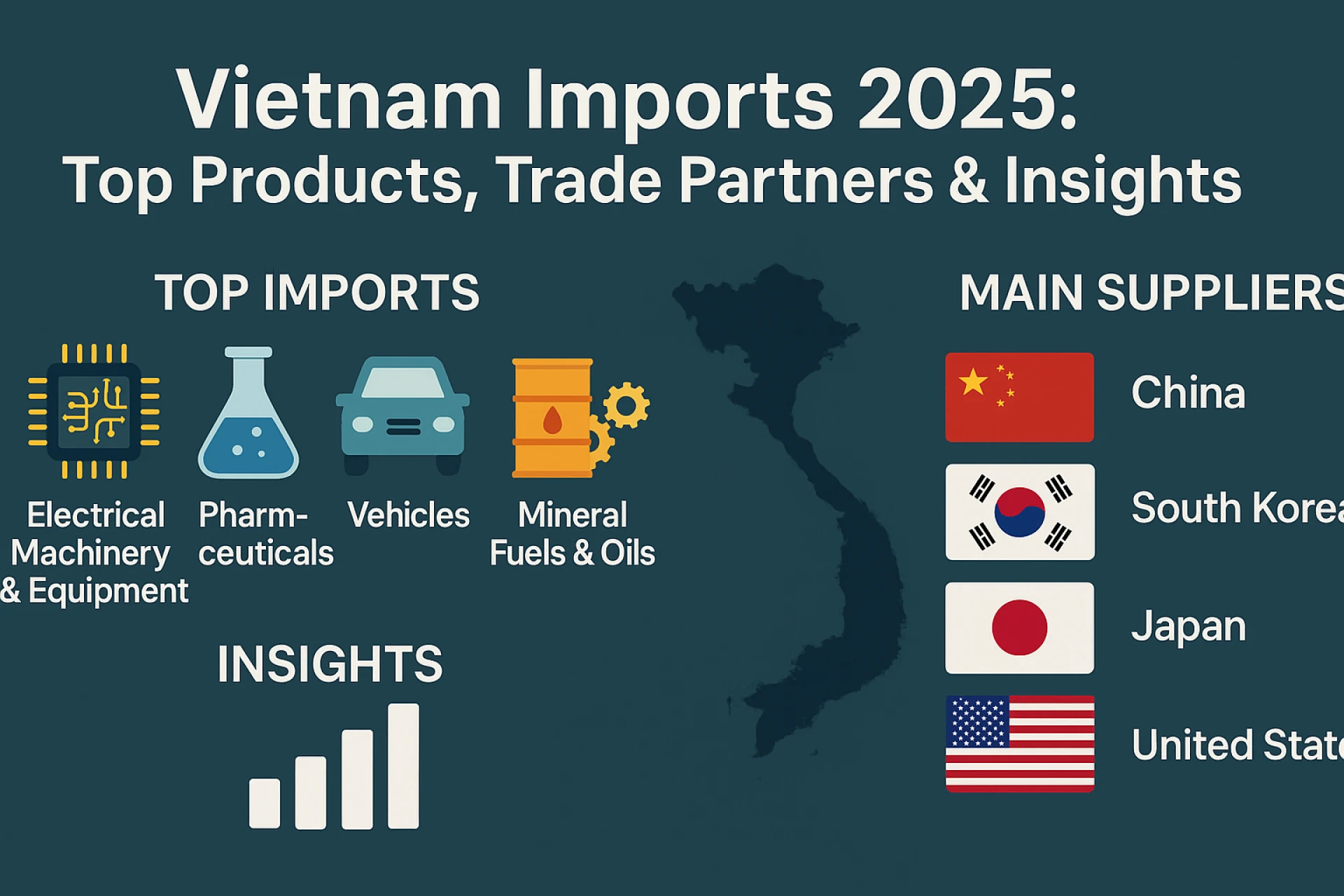

Vietnam has emerged as a critical hub in the global supply chain, balancing its booming exports with a rapidly growing volume of imports. As the Vietnamese economy diversifies and industrializes, Vietnam imports have witnessed significant year-on-year growth, reflecting both domestic consumption trends and industrial demand.
In 2024, Vietnam’s total imports reached $379 billion, marking a 7.2% increase over 2023. According to Vietnam trade data, this upward trend has continued into early 2025, with import values reaching $175.56 billion in just the first five months—a remarkable 17.4% jump year-on-year.
This comprehensive look at Vietnam imports will explore the country’s top imported goods, major importing companies, Vietnam imports by country, sectoral trends, and regulatory developments, especially the new U.S. tariffs that came into play in 2025.
Top Products Driving Vietnam’s Import Market
The surge in Vietnam imports is primarily driven by the demand for production materials, which made up 93.8% (or $164.75 billion) of imports in early 2025. This is no surprise, as Vietnam continues to strengthen its role as a global manufacturing hub.
Here are Vietnam's top 10 imported products in 2025 (by HS Code):
- Electrical Machinery & Equipment (HS 85) – $116.54 billion
- Widely used across telecom, manufacturing, and consumer electronics.
- Nuclear Reactors & Machinery (HS 84) – $29.10 billion
- Essential for industrial expansion and energy infrastructure.
- Plastics & Articles (HS 39) – $16.48 billion
- Feeding Vietnam’s packaging, automotive, and consumer goods sectors.
- Mineral Fuels & Oils (HS 27) – $16.03 billion
- Key for transport and industrial energy demands.
- Iron & Steel (HS 72) – $12.21 billion
- Vital for construction and infrastructure projects.
- Vehicles (HS 87) – $7.22 billion
- Reflecting Vietnam’s rising urbanization and car ownership.
- Optical & Medical Instruments (HS 90) – $7.12 billion
- Supporting healthcare system modernization.
- Knitted/Crocheted Fabrics (HS 60) – $6.68 billion
- Backbone of Vietnam’s garment industry.
- Cereals (HS 10) – $4.79 billion
- Ensuring national food security.
- Cotton (HS 52) – $4.75 billion
- Feeding the textile export engine.
These categories illustrate the duality in Vietnam's import economy: consumer-focused goods and industrial inputs.
Vietnam Imports by Country: Top Trade Partners in 2025
Vietnam's import portfolio is broad and diversified. However, some countries stand out as key trading partners due to strong bilateral ties, geographical proximity, and industrial synergy.
Here’s a breakdown of Vietnam imports by country in 2024–25:
- China – $144.3 billion
- Vietnam’s top source for electronics, machinery, fabrics, and chemicals.
- South Korea – $79.7 billion
- Dominant in high-tech components, semiconductors, and heavy machinery.
- Japan – $35.8 billion
- Major supplier of automobiles, electronic parts, and medical equipment.
- Taiwan – $32 billion
- Strong in ICT, telecom, and integrated circuits.
- United States – $14.3 billion
- Supplies machinery, food products, and technology.
- Thailand – $11.6 billion
- Key exporter of food, automobiles, and electrical equipment.
- Malaysia – $7.3 billion
- Specializes in chemicals and electronics.
- Indonesia – $5.8 billion
- Major supplier of coal, minerals, and agricultural commodities.
- India – $5.7 billion
- Strong in textiles, pharmaceuticals, and engineering goods.
- Australia – $4.5 billion
- Exporter of agricultural products and minerals.
Understanding Vietnam imports by country helps businesses pinpoint supply chain opportunities, mitigate risks, and optimize sourcing strategies in Asia.
Top Importers Fueling Vietnam's Trade Engine
Vietnam’s import sector is dominated by major FDI-backed corporations, especially in electronics and semiconductors. According to the Vietnam Importers Database (2024–25), the top players include:
- Intel Vietnam – $9.9 billion
- Hanyang Vina – $8.5 billion
- Samsung Thai Nguyen – $7.9 billion
- Samsung HCMC – $5 billion
- Compal Vietnam – $2.9 billion
These companies primarily import integrated circuits, micro-assemblies, and ICT components from China, South Korea, and Taiwan. In 2024 alone, electronics and computer imports topped $107 billion, up 21.7% YoY.
U.S. Tariffs Shake Up Vietnam Imports in 2025
A significant development in 2025 is the imposition of U.S. tariffs on Vietnamese imports. These include:
- 25% tariffs on steel and aluminum (Feb 2025)
- 10% universal baseline tariffs (April 2025)
- Up to 46% “reciprocal” tariffs on various Vietnamese goods
- Solar panel tariffs averaging 396%, peaking at 800%
These tariff measures have impacted Vietnam’s electronics and steel exports to the U.S., compelling Vietnamese manufacturers to diversify supply chains and explore alternative markets.
Trends Shaping Vietnam’s Import Outlook
As per the latest Vietnam trade data, several trends are shaping the country's import future:
- Surge in high-tech imports: Apple and Samsung suppliers are expanding operations.
- Auto parts and EVs: Rising sharply, especially from Thailand and China.
- Green imports: Demand for renewable energy equipment is growing.
- Intermediate goods: Rise in imports of semi-finished products for regional assembly.
- Supply chain diversification: Vietnam is reducing its reliance on China, sourcing more from ASEAN, India, and Europe.
Historical Snapshot: Vietnam Imports Over the Last Decade
Year Import Value ($ Billion)
2014 147.83
2015 165.77
2016 174.97
2017 213.21
2018 236.86
2019 253.44
2020 261.30
2021 330.75
2022 358.78
2023 325.44
2024 379.00
2025 (Jan–May) 175.56
The numbers highlight steady growth, especially in post-pandemic years, driven by Vietnam’s deepening industrial and consumer markets.
Conclusion
Vietnam’s import landscape in 2025 demonstrates a dynamic and fast-evolving market. From electronics and machinery to cereals and textiles, the country’s import needs span various sectors. With diversified Vietnam imports by country, robust industrial demand, and geopolitical changes such as U.S. tariffs, it is essential for businesses to stay updated using verified Vietnam trade data.
For detailed reports and shipment-level information, businesses can access real-time trade data from platforms like VietnamExportData, which offer custom solutions for product-level, company-level, or HS-code-level Vietnam import insights.










Sign in to leave a comment.