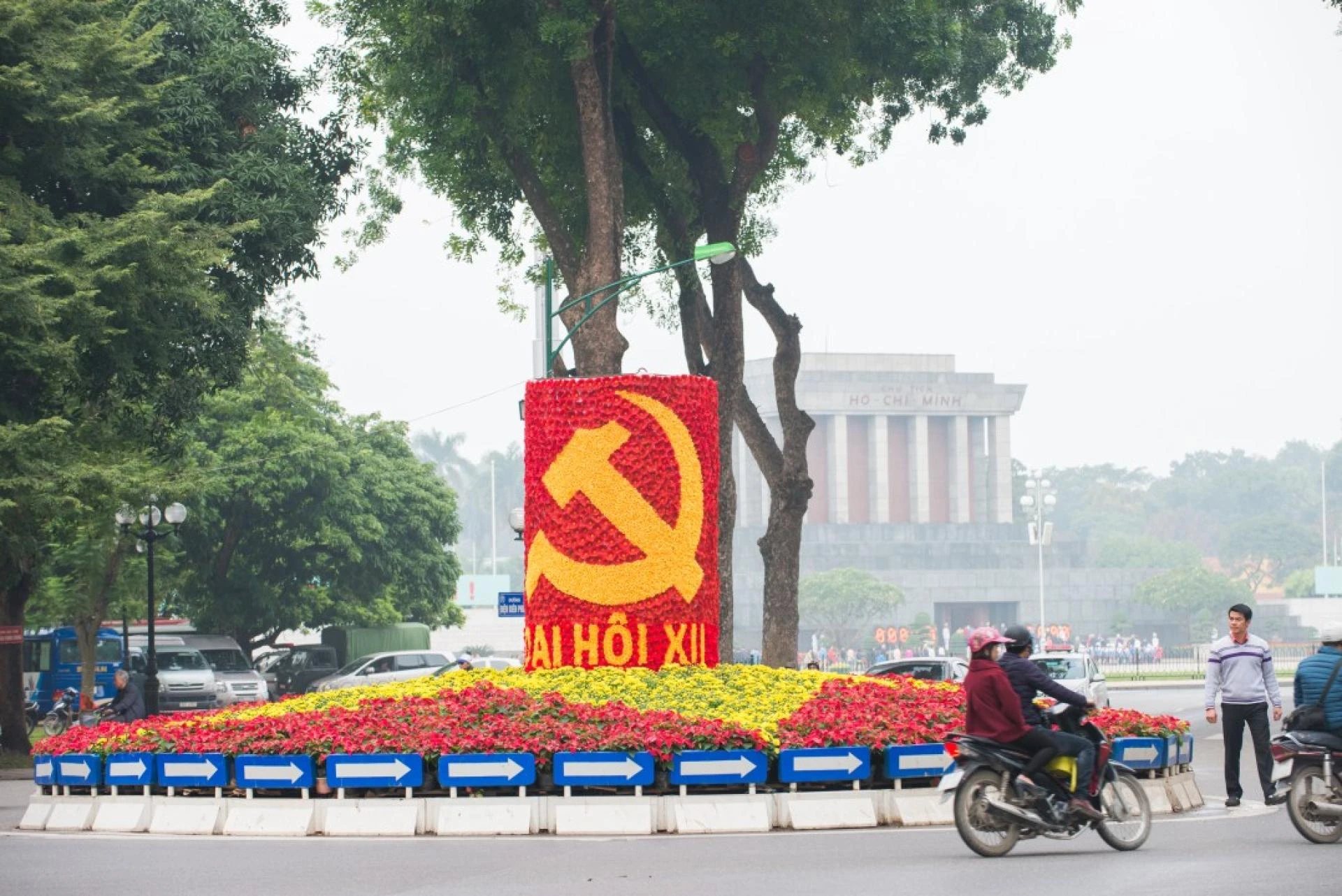

The Communist Party of Vietnam (CPV) concluded its 13th National Congress last week. Nguyen Phu Trong (“Trong”) was re-elected as General Secretary of the Party, despite both his age and having already served two terms. The other positions in the country’s traditional ‘four-pillar’ leadership model will not be confirmed until the next meeting of the National Assembly in a few months. However, even before the Congress concluded there were leaks as to who would hold office.[1] The publication of the new Politburo places Nguyen Xuan Phuc (“Phuc”), Pham Minh Chinh (“Chinh”) and Vuong Ding Hue (“Hue”) immediately behind Trong and is consistent with the earlier leaks.
* Full title - Communist Party of Vietnam Central Commission of Personal and Organisation
BM&A presents its analysis on the new leadership line-up as well as the possible policy implications and challenges.
Brief bios
Trong became Party Secretary in 2011 and will now serve a third term, despite also breaching the age limit of 65. (Traditionally a two-term limit has been observed along with the age limit). However, with the appointment of Phuc as President Trong relinquishes a role he assumed in October 2018 upon the passing of then President Tran Dai Quang.
In April 2019, Trong was rushed to hospital when visiting Kien Giang Province in southern Vietnam. Eventually the government confirmed that he had been ‘unwell’ but subsequently he resumed his duties and apparently intends to continue to do so for some time.
Trong may serve on an ‘interim basis’ and be replaced mid-term, although such an arrangement was supposedly in place when he was elected in 2016.
Phuc is the former PM and from Central Vietnam. His continuation in government suggests he remains in favour and retains influence. It is unclear whether he sought a second term as PM.
Chinh is the current Head of the CPV Central Commission. This is an important post, overseeing an essential element of the functioning of the CPV. He held the rank of Lieutenant General, Deputy Minister of Public Security (2010).
Chinh is a former General Secretary of Quang Ninh Province (2010-15), the northern most province of the eastern seaboard that borders China. Some analysis suggests Chinh is close to China although it is hard to verify such claims.
Hue is currently Secretary of the Hanoi Party Committee. He has held the position of Deputy PM (2016-June 2020), Minister of Finance (2011-13) and is a Professor of Economics.
Relaxation of the rules on age and terms
Both as a legacy of history and to ensure a balance between competing interests, Vietnam has observed some unwritten rules in the conduct of government appointments. Limits on age (65) and term (two) coupled with geographical representation have helped ensure an orderly succession of power. In the line-up recommended by the 15th Plenum and approved at the 13th National Congress (1,590 delegates) each of those rules have been tested and, for the moment at least, relaxed.
As noted, Trong will serve a third term as Party Secretary despite being 76 and Phuc will become President at the age of 66.
The current line does not have any representation from the south of the country. Indeed Phuc is the lone representative not to hail from the north.
These rules may prove progressively redundant. Extended life expectancy and improved healthcare are undermining the notion that 65 is an appropriate retirement age. At 78 the current US President is ‘junior’ in name only. As such, a relaxation of the age limits is a natural response to this reality.
That said, as noted Trong has experienced poor health and President Quang passed away in office. Therefore, the retention of Trong as Party Secretary, even if only on an interim basis, suggests disagreement about his successor. Tran Quoc Vuong (67) was viewed as close to Trong having served his anti-corruption drive as Chairman of the Central Inspection Committee. But he was unable to secure a position in the upper echelon. This implies that while Trong retains personal authority to safeguard his own position that does not appear to extend to his allies.
There is a risk that an extension of age and term limits unsettles the division of spoils among the party elite. A generation of senior politicians in their late 50’s would expect an imminent shot at the top positions. If the current incumbents serve into their 70’s, primarily Chinh and Hue, then even with term limits the opportunities at the next Plenum will be curtailed.
Moreover, Chinh leapfrogged no fewer than five Deputy PM’s to become PM.
Are there any policy implications?
In short, we do not expect any significant policy changes as a result of the change in leadership positions. Vietnam is wedded to its current policies and there is minimal discussion or dissent. The caveat being, of course, that even were there any discussion is would most likely be shrouded in secrecy.
Foreign Policy - The four No’s
Vietnam has long positioned itself as neutral in relation to the superpowers. That has led to ‘the four No’s’
No military alliancesNo siding with one country against anotherNo foreign military baseNo use or force of threat to use force in international relationsVietnam has a strategic interest in international law given its claims in the South China Sea and the regular breaches and infringements emanating from China. A policy of neutrality risks becoming redundant if China perceives it as weakness or indeed simply wishes to push its territorial claims still further.
In a 2019 defence white paper Vietnam qualified its policies by observing that
“depending on circumstances and specific conditions, Vietnam will consider developing necessary, appropriate defense and military relations with other countries.”[2]
Moreover, foreign policy consensus in Hanoi may not necessarily result in unchanged policies. Chinese assertiveness and a new American administration raise the prospect of continued tensions and Vietnam may have to respond.
An open economy and coexistence between the state owned and private sectors
A cornerstone of Vietnam’s economic policies in recent years has been an openness to foreign trade. Having joined ASEAN in 1995 and the WTO in 2007 the pace of agreements has accelerated in recent years.
The Regional Comprehensive Partnership Framework (RCEP) includes 15 countries from the ASEAN bloc plus China, South Korea, Australia and New Zealand and was launched in 2012. It expects to eliminate 90% of tariffs within twenty years and also establish common rules in areas such as e-commerce and intellectual property.
The Comprehensive and Progressive Agreement for Trans-Pacific Partnership (CPTPP) became effective in early 2019 and includes 11 Pacific nations, with Vietnam the only low/middle income country in Asia to have ratified the deal. An example of the benefits to Vietnam will be the elimination of tariff levels of about 15% on exports such as garments and electrical equipment to countries such as Canada and Mexico.
The EU-Vietnam Free Trade Agreement (EUVFTA) became effective in August 2020 and will see further reductions or elimination of tariffs. According to The Economist Intelligence Unit one major beneficiary is footwear exports, where some 40% by value (2019) were subject to 30% tariffs that will now disappear over four years.
These trade agreements are reciprocal in nature, but the economic consequences are complementary. Export markets will be opened up and present new opportunities while increased competition from imports will promote efficiency and drive Vietnam up the value-added chain even as winners and losers are determined at the company level.
Supremacy of the party and suppression of dissent
Human rights and the suppression of dissent are another area of policy continuity among the elite. This an area that could prove problematic in relations with the US, the EU and potentially other countries.
Of late Amnesty International has reported a crackdown,[3] typified by the recent conviction of three freelance journalists for ‘spreading anti-state propaganda’ and sentenced to 11-15 years in jail.
Task Force 47, formed in 2018, is a special military cyber unit dedicated to monitoring online activity and effectively stifling, and indeed prosecuting, offenders. Facebook and other social media are ubiquitous in Vietnam and the communist party will not tolerate any challenge to its authority.
The proposed new government does not hold out the prospect of any relaxation in policy. Trong and Phuc are incumbent at the highest level of policy making and can therefore be assumed to be fully supportive of existing policy. Both Chinh and Hue are steeped in the workings of the party and have held high office in the apparatus by which it controls society.
The policy challenges
Walking a tightrope between China and the US
The new leadership does not change this dynamic, nor is there any reason to believe policy will change. Vietnam continues to resist China’s territorial encroachments and violations without provoking outright conflict. It uses regional forums such as ASEAN to register its objections with like-minded countries.
The Biden administration may hold out the prospect of a more dynamic and coherent relationship with the US. However, Vietnam is highly unlikely to deviate from the ‘Four No’s’ at the heart of its foreign policy for fear of antagonising China.
The manifest risk is that China moves to push Vietnam off balance. For the moment, its assertive foreign initiatives seem to be focused on Taiwan and India, while domestically it has moved with relentless force to crush dissent in Hong Kong and among the Uighurs.
Vietnam continues to be harassed by the Chinese in the maritime theatre on a regular basis. The risk of a more serious conflagration is omnipresent.
Economic Policy – infra is lacking and a pressing necessity
Vietnam may be the darling of the international community at the moment with its hitherto successful battle to contain Covid-19 and a vibrant economy that is among very few to have posted growth last year (~2.5%). Foreign Direct Investment has exceeded USD 15 billion per annum in the period 2013-20 and the relocation and expansion of manufacturing for export is a running theme in the international press.
Vietnam has a deficiency in infrastructure that compromises growth and may prove a greater obstacle in coming years.
For example, according to the latest data from the World Economic Forum Vietnam’s port infrastructure and efficiency ranks below India, Sri Lanka and Indonesia. Rosier projections for manufacturing growth and exports will not be met unless ports improve to keep pace.
Power generation is another area where Vietnam faces challenges. Additional generation from hydro will be minimal, leaving renewables and traditional fossil fuels to meet demand. The country is heavily reliant on coal generation and the most promising base load alternative is LNG. However, the expenditure for such facilities runs to several billion dollars and likely beyond the capacity of state-owned companies. If international know-how and capital is to enter the sector then Vietnam will have to accommodate the private sector and international, commercial banks. In short, the whole legal process and commitment to guarantee revenues will have to mark something of a sea change from current practices.
We could add more examples, but it is important to bear in mind that for all Vietnam is rightly lauded as an increasingly open economy it remains inefficient and bureaucratic the closer one gets to the operating end of the stick.
Conclusions
The Government of Vietnam is controlled by the Communist Party, shrouded in secrecy and characterised by overt consensus. Policies are revealed by implementation rather than at the conclusion of debate, or at least certainly not a public debate.
Yet powerful themes are driving Vietnamese policy and there is no reason to expect the change in leadership to alter their direction. A growing private sector, openness to foreign trade and investment, harmonious foreign relations while avoiding strategic commitments and an intolerance of domestic dissent look set to continue as key policies of the administration.
Given the current government line-up and relaxation of age limits the ‘next generation’ of aspiring leaders born in the 1960’s may have to be even more patient for their turn than even they may have expected.
[1] https://fulcrum.sg/the-cpvs-15th-plenum-the-art-of-the-possible-in-vietnamese-politics/
[2] https://amti.csis.org/vietnams-2019-defense-white-paper-preparing-for-a-fragile-future/
[3] https://www.reuters.com/article/us-vietnam-security-trial-idUSKBN29A0VI
0



























Sign in to leave a comment.