
Introduction
Most people who decide to go solar focus on the panels. Understandably so. Panels are visible, they sit on the roof, and they are the part everyone photographs. But the panels alone do almost nothing useful. The real intelligence of a solar system lives in what happens after the electricity leaves the panel, and that chain of events, from raw DC current to usable power in your home or factory, is where most of the confusion also lives.
This is worth understanding properly, not because the wiring is complicated, but because the decisions you make about how these components connect will affect your electricity bills, your backup reliability, and your long-term maintenance costs for the next fifteen to twenty-five years.
Electricity leaves the panel in a form nothing can directly use
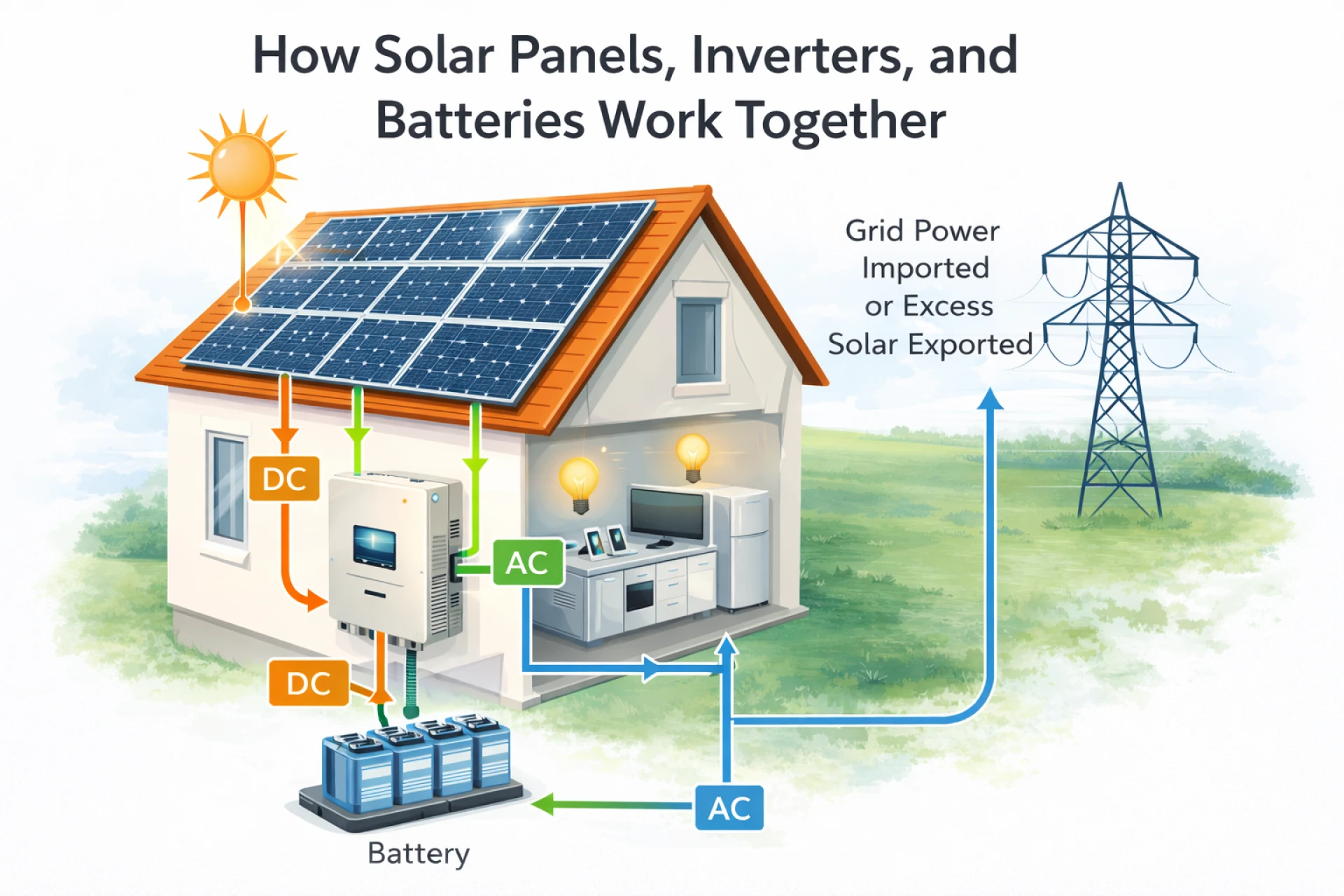
Solar panels produce direct current. Every panel in a typical installation is generating DC voltage the moment sunlight hits it, but that voltage is not fixed. It shifts constantly depending on cloud cover, temperature, panel age, and even the angle of the sun across the day. This variability is one of the first things a well-designed system must manage.
When panels are wired in series, their voltages add up. Wire four panels producing 40 volts each, and you get 160 volts DC going into your inverter. Wire them in parallel and the current adds up instead. Most residential and commercial systems use a combination of both to hit the voltage and current sweet spot that the inverter is designed to receive. Get this wrong and the inverter either underperforms or, in worse cases, trips out repeatedly because the input falls outside its acceptable range.
The charge controller, in systems that include batteries, sits between the panels and the battery bank. Its job is to manage how aggressively the panels push current into the batteries at any given moment. A good MPPT controller tracks the shifting output of the panels in real time and adjusts the charging rate accordingly, which in practice means you recover significantly more energy on partly cloudy days than you would with a basic controller.
The inverter is where the system either earns its cost or wastes it
Inverters convert DC to AC. That is the textbook answer and it is also only part of the story.
A string inverter takes the combined output of all panels wired to it and converts that as a single input. This works well when all panels face the same direction, have no shading, and perform consistently. The moment one panel in a string underperforms, say because a tree casts a shadow across one corner of your roof in the afternoon, the entire string suffers. It is the electrical equivalent of a series circuit in a strand of old Christmas lights.
Microinverters solve this by attaching a small inverter to each panel individually. Each panel operates independently. Partial shading on one panel does not drag down the rest. The tradeoff is cost and the number of components on the roof, which can complicate maintenance.
Hybrid inverters are a third category, and they are increasingly what makes sense for anyone considering battery storage. A hybrid inverter manages the DC input from panels, the DC connection to a battery bank, and the AC output to your building, all simultaneously. It decides in real time whether incoming solar should charge the battery, power the load directly, or feed back to the grid. That decision-making happens automatically based on rules you or the installer program during commissioning.
Connecting batteries changes everything about how the system behaves
A system without batteries is reactive. It produces what the sun provides, uses what the building needs at that moment, and either exports the surplus or wastes it if export is not possible. There is no memory, no buffer, no backup.
Add batteries and the system gains something closer to agency. Surplus daytime production now has somewhere to go. Evening consumption draws from stored energy rather than the grid. And when the grid fails, the battery and inverter together can keep running critical loads without any interruption.
The physical connection between a hybrid inverter and a battery bank is a DC cable, sized carefully based on the battery voltage and the maximum charge and discharge current the system will see. Most modern lithium battery systems communicate with the inverter through a data cable as well, typically using a protocol called CAN bus or RS485. This communication channel lets the battery tell the inverter things like its current state of charge, its temperature, and whether it is willing to accept more charging current. Without this link, the inverter operates blind and tends to either undercharge or stress the battery.
Lead-acid batteries, still used in some off-grid installations because of their lower upfront cost, require a different management approach. They tolerate overcharging less gracefully, they need periodic equalisation charges, and they lose capacity faster if regularly discharged below 50 percent. Lithium iron phosphate batteries are more forgiving, more compact, and cycle far more times before degrading, which is why almost every new hybrid installation now uses them.
A scenario worth thinking through
Consider a mid-sized garment factory on the outskirts of Chandigarh running three shifts. Daytime power demand is high, the grid is mostly reliable but experiences sharp voltage fluctuations in summer, and electricity costs have been climbing. The owner installs a 50 kW solar array with a hybrid inverter and a 100 kWh lithium battery bank.
During the day, solar covers most of the factory floor load directly. The battery charges from whatever the panels produce beyond what the machines are consuming. When the grid dips or cuts out, the inverter transfers to the battery in under 20 milliseconds. Workers do not notice. Production does not stop. At night, the battery handles lighting, security, and computer systems until it reaches its lower threshold, at which point the grid takes over.
Without the battery, that same solar array would have shut down entirely every time the grid failed, because grid-tied inverters are legally required to cut off during outages to protect utility workers. The battery changes the risk profile of the investment entirely.
What most installers do not spend enough time explaining
System sizing is where most solar investments either work beautifully or disappoint. Panels are sized to generation targets. Inverters must match or slightly exceed expected panel output. Batteries need to cover the gap between what solar produces and what the building consumes during non-solar hours, while also accounting for depth of discharge limits and degradation over years.
The wiring between components carries risks that deserve serious attention. DC systems at high voltage can arc silently inside conduit, particularly if connectors are not properly rated or if the installation is done in a hurry. Grounding the system correctly prevents shock hazards and also protects equipment from lightning-induced surges. Fusing on both the DC and AC sides of the inverter is not optional. Every point in the circuit where a fault could cause sustained current flow needs protection.
Cable sizing matters more than most buyers realise. Undersized cables between the battery and inverter create resistive losses, generate heat, and can cause the inverter to see lower voltage under load than it expects, triggering fault shutdowns. The cost difference between adequate and undersized cabling is small. The performance difference over a decade is not.
Final Thougth
There is a reason solar adoption among factories, schools, commercial buildings, and homes has accelerated so sharply in northern India over the past few years. The economics are genuinely compelling, and the technology has matured to a point where reliability is no longer a question mark. But the difference between a system that performs for twenty years and one that causes constant headaches usually comes down to decisions made during the design and installation phase, specifically how the panels, inverter, and battery are matched, connected, and commissioned.
For anyone considering solar installation in Chandigarh, whether for a single-floor home in Sector 20 or a large industrial unit on the city's periphery, understanding these connections is not about doing the work yourself. It is about knowing enough to ask the right questions, verify that the design makes sense for your load profile, and ensure that the installer is not cutting corners on the components that determine whether your investment actually delivers what the sales pitch promised.


























Sign in to leave a comment.