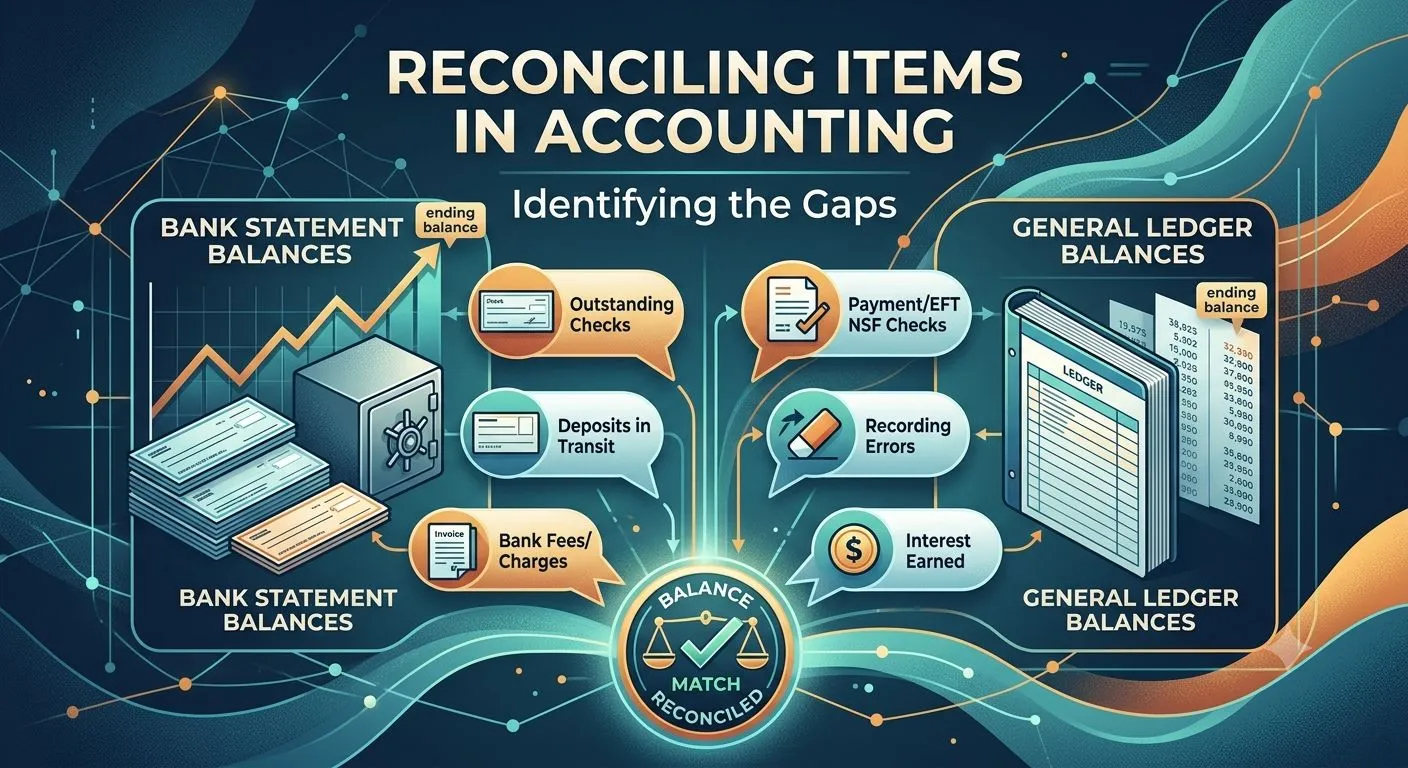

Financial records rarely match perfectly on the first review. A deposit may appear in the accounting system before it clears the bank. A supplier credit may be missing from the ledger. A customer payment may be applied to the wrong invoice. These differences can delay reconciliation, affect reporting accuracy, and create audit questions if they are not resolved.
Reconciling items help finance teams explain why two related records do not agree. This article explains what reconciling items mean, why they occur, common examples in accounting, which items need urgent review, and how finance teams can manage them more effectively.
Why Reconciling Items Matter in Financial Reporting
Reconciling items matter because they explain the gap between two financial records.
Why differences naturally occur between related financial records
Differences occur because banks, ERPs, subledgers, payment systems, and accounting records do not always update at the same time.
Relationship between reconciling items and accurate account balances
A reconciling item helps finance teams decide whether a balance difference is valid, temporary, incorrect, or unsupported.
Impact of unresolved reconciling items on reporting and audits
Unresolved items can lead to inaccurate balances, delayed close, audit questions, and post-close corrections.
What Are Reconciling Items?
Reconciling items are differences found during reconciliation that explain why two records do not match.
Definition of reconciling items
A reconciling item is a transaction, adjustment, timing difference, or error that creates a difference between two related financial records.
Why reconciling items appear during account reconciliation
They appear when finance teams compare records such as bank statements, ledgers, invoices, subledgers, payment files, and supporting schedules.
Difference between a reconciling item and an accounting error
A reconciling item is not always an error. Some items, such as deposits in transit, are valid timing differences. Errors require correction. For broader context, account reconciliation explains how finance teams compare records and confirm account accuracy.
Why Reconciling Items Occur
Reconciling items usually arise because financial activity moves through multiple systems and approval steps.
Timing differences between accounting systems
One system may record a transaction before another system updates.
Transactions recorded in one record but not another
A payment may appear in the bank statement but not yet in the ledger.
Pending approvals and delayed postings
Invoices, credits, or journal entries may wait for approval before posting.
Manual adjustments and corrections
Manual entries can create differences when they are incomplete, duplicated, or unsupported.
Common Types of Reconciling Items in Accounting
Reconciling items vary by account type and transaction flow.
Deposits in transit
Deposits in transit are amounts recorded in the books but not yet reflected in the bank statement.
Outstanding checks
Outstanding checks are issued payments that have not cleared the bank.
Bank service charges and fees
Banks may deduct fees before accounting records are updated.
Interest income and interest expense
Interest may be recorded by the bank before finance teams post it.
Unrecorded electronic payments and receipts
ACH payments, wires, and direct debits may appear before internal records are updated.
Duplicate transactions
Duplicate entries overstate balances or activity.
Missing transactions
Missing entries create differences between ledgers, subledgers, and external records.
Timing differences between reporting periods
A transaction may be recorded in one period in one system and another period elsewhere.
Journal-entry corrections
Corrections can create reconciling items until they are approved and posted.
Customer payment allocation differences
Payments applied to the wrong invoice or customer create AR differences.
Supplier invoice differences
Supplier balances may differ because of missing invoices, credits, or payment timing.
Currency conversion differences
Foreign-currency activity can create differences because of exchange-rate timing.
Common Examples of Reconciling Items
Examples make reconciling items easier to understand.
Bank reconciliation example
A company records a $5,000 deposit on March 30, but the bank clears it on April 2. The $5,000 is a deposit in transit.
Accounts receivable reconciliation example
A customer pays $2,000, but the payment is applied to the wrong invoice. The balance needs correction.
Accounts payable reconciliation example
A supplier statement includes a credit note that is missing from the company’s AP records.
General ledger reconciliation example
A duplicate journal entry overstates an expense account and must be reversed.
Which Reconciling Items Require Immediate Investigation
Some reconciling items require faster review than others.
High-value unexplained differences
Large unexplained items can affect financial statements and should be investigated quickly.
Recurring reconciling items across reporting periods
Recurring items may signal a process issue.
Items affecting financial-statement accuracy
Any item that affects reported assets, liabilities, revenue, or expenses should be prioritized.
Reconciling items creating audit and compliance risk
Unsupported adjustments, aged differences, and unapproved write-offs require special attention.
How Finance Teams Investigate Reconciling Items
Investigation should focus on cause, support, and resolution.
Compare balances with supporting documentation
Finance teams compare ledgers, bank statements, invoices, schedules, and subledger reports.
Review transaction history and source records
Transaction dates, references, amounts, approvals, and posting details should be reviewed.
Validate journal entries and approvals
Corrections and adjustments should have proper approval.
Record investigation findings and corrective actions
Each item should include cause, owner, action taken, and final status.
How Reconciling Items Affect Month-End Close
Reconciling items can slow the close process if they remain unresolved.
Delayed reconciliation completion
Open items prevent account sign-off.
Increased correcting journal entries
Late investigations often lead to last-minute adjustments.
Higher review and approval effort
Reviewers spend more time checking explanations and evidence.
Greater risk of post-close adjustments
Unresolved items may require corrections after reports are finalized.
Reconciling Items Across Different Account Types
Reconciling items appear across many finance processes.
Cash and bank accounts
Common items include deposits in transit, outstanding payments, fees, and interest.
Accounts receivable
Common items include unapplied cash, customer disputes, and incorrect payment allocations.
Accounts payable
Common items include supplier invoice differences, missing credits, and duplicate payments.
Payroll, tax, and accrual accounts
Differences may come from estimates, filings, deductions, and timing.
Inventory and fixed assets
Reconciling items may include valuation differences, stock adjustments, missing additions, and disposals.
Intercompany accounts
Differences may come from timing gaps, currency conversion, and mismatched entity records.
Common Mistakes When Managing Reconciling Items
Poor handling of reconciling items can create further errors.
Treating timing differences as permanent issues
Timing differences should be tracked until they clear.
Posting adjustments without investigation
Adjustments should follow review, not replace it.
Carrying unresolved items into the next reporting period
Open items should have owners and deadlines.
Missing documentation supporting corrections
Corrections without evidence create audit risk. Many account reconciliation errors come from weak investigation, poor documentation, or unsupported adjustments.
Reconciling Items in Multi-Entity Organizations
Multi-entity businesses face additional reconciliation challenges.
Intercompany timing differences
One entity may record a transaction before the other entity posts the corresponding entry.
Cross-border transactions and exchange-rate impacts
Currency differences may arise between invoice date, payment date, and settlement date.
Shared ERP environments
Shared systems require consistent coding, ownership, and posting rules.
Consistent reconciliation governance across entities
Standard policies help finance teams manage reconciling items across business units.
Risks of Managing Reconciling Items Through Spreadsheets
Spreadsheets can become difficult to control as reconciliation volume grows.
Version-control problems
Different file versions can show different reconciling item statuses.
Formula and manual-entry errors
Manual formulas and copied data can create mistakes.
Limited visibility into unresolved differences
Managers may not see open items until close deadlines approach.
Difficulty maintaining audit-ready documentation
Evidence may be spread across emails, folders, and worksheets.
Controls That Reduce Reconciling Items
Strong controls reduce recurring differences.
Standardized transaction-recording procedures
Consistent posting rules reduce missing and misclassified entries.
Approval workflows for adjustments
Adjustments should be reviewed before posting.
Regular reconciliation reviews
Frequent review prevents aged reconciling items from building up.
Documentation standards supporting audits
Each item should have clear explanation, evidence, and review history.
Metrics That Measure Reconciling Item Management
Metrics help finance teams identify reconciliation risk.
Number of open reconciling items
This shows unresolved workload.
Aging of unresolved differences
Older items require escalation.
Frequency of recurring reconciling items
Recurring items may indicate process weakness.
Percentage of reconciliations completed without exceptions
This shows reconciliation quality.
Close delays linked to unresolved reconciling items
This shows which accounts create reporting delays.
How Automation Helps Manage Reconciling Items
Automation helps finance teams identify and track reconciling items faster.
Automatic identification of reconciliation differences
Systems can compare records and flag differences automatically.
Continuous monitoring of unresolved items
Open items can be tracked throughout the reporting period.
Real-time visibility into reconciliation exceptions
Dashboards show status, owners, aging, and risk.
Centralized documentation of investigation and resolution activities
Centralized records help teams maintain explanations, approvals, and evidence.
What High-Performing Finance Teams Do Differently
Strong finance teams do not wait until close to resolve differences.
Resolve reconciling items throughout the reporting period
They review and clear items regularly.
Assign ownership for recurring differences
Each recurring item has a responsible owner.
Review root causes instead of repeated corrections
They fix the process issue behind the difference.
Maintain consistent reconciliation documentation
They keep records ready for review and audit.
Future Direction of Reconciling Item Management
Reconciling item management is moving toward earlier detection and continuous visibility.
AI-assisted identification of unusual reconciliation differences
AI can flag unusual patterns, duplicate records, and high-risk items.
Predictive detection of recurring discrepancy patterns
Predictive checks can identify accounts likely to create repeated differences.
Continuous reconciliation across connected finance systems
Continuous reconciliation reduces period-end pressure.
Real-time visibility into reconciling-item status and financial risk
As finance teams manage higher transaction volumes, an account reconciliation platform can help centralize matching, exception tracking, supporting evidence, approvals, and reconciling-item status across finance processes.





















Sign in to leave a comment.