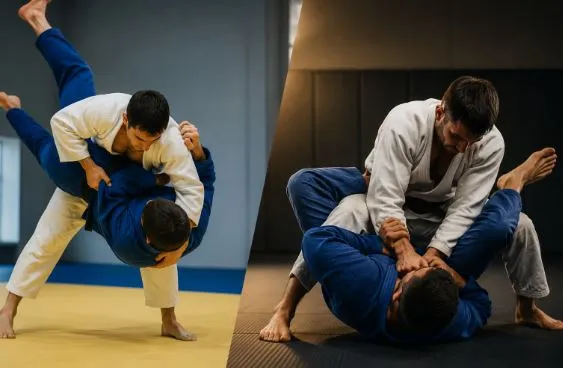

Brazilian Jiu-Jitsu and Judo are two of the most popular grappling martial arts in the world. They share a common historical origin and many overlapping techniques, yet they have developed into very different systems in terms of strategy, rules, training style, and overall philosophy.
For beginners, the two can look similar at first glance—both involve throws, grappling, pins, and submissions. However, once you spend time training or studying them, the differences become very clear.
Origins and Historical Background
Judo was created in 1882 by Jigoro Kano in Japan. Kano studied traditional jujutsu schools and refined their techniques into a safer, more structured martial art. His goal was not only self-defense but also physical education, discipline, and character development. Over time, Judo became a competitive sport and was eventually included in the Olympic Games.
Brazilian Jiu-Jitsu developed later in the early 20th century. Mitsuyo Maeda, a Judo expert and traveler, brought grappling knowledge to Brazil. There, the Gracie family—especially Helio Gracie—adapted and refined the techniques. They placed a much stronger emphasis on ground fighting, leverage, and submissions, especially in situations where a smaller person might face a larger opponent.
While Judo remained more focused on throwing and explosive standing techniques, Brazilian Jiu-Jitsu evolved into a system heavily centered on ground control and submission fighting.
Core Philosophy and Goals
At the heart of each martial art is a different strategic mindset.
Judo is built around the principle of efficiency and decisive action. The ideal outcome is to throw an opponent cleanly onto their back with control and force, often ending the match instantly.
Brazilian Jiu-Jitsu focuses on the idea that a fight can be controlled and finished on the ground. Instead of relying on a single explosive moment, BJJ emphasizes positional control, gradual advancement, and submissions such as chokes and joint locks.
In simple terms:
- Judo: Win quickly with a clean throw or pin
- Brazilian Jiu-Jitsu: Control the opponent on the ground and submit them
Both rely heavily on leverage and timing rather than brute strength, but their end goals differ significantly.
Rules and Competition Structure
Competition rules strongly influence how each martial art is practiced.
In Judo competitions, the goal is to achieve an “ippon,” which instantly ends the match. An ippon can be awarded for a perfect throw, a strong pin held for a set duration, or a submission. There are also partial scores like waza-ari, and two of these equal an ippon. Because matches can end in seconds, Judo is very fast-paced and explosive.
Standing techniques are extremely important in Judo. Most matches begin with grip fighting, where each competitor tries to gain control of the other’s jacket (gi). Once a strong grip is established, throws are attempted aggressively.
Brazilian Jiu-Jitsu competitions, on the other hand, are usually longer and more methodical. Points are awarded for achieving dominant positions such as mount, back control, or passing the guard. Submissions still end the match immediately, but if no submission occurs, the winner is decided by points.
Because of this structure, BJJ matches often spend much more time on the ground, with athletes working through complex positions and transitions.
Techniques and Fighting Style
While both martial arts share techniques, their emphasis is very different.
Judo focuses heavily on throws, sweeps, and takedowns. Techniques like hip throws, foot sweeps, and shoulder throws are central. Once the opponent is on the ground, Judo also includes pins and some submissions, but groundwork is usually limited in time and importance compared to standing exchanges.
Brazilian Jiu-Jitsu focuses primarily on ground fighting. It includes a wide variety of guard positions such as closed guard, open guard, and half guard. From these positions, practitioners work on sweeps, submissions, and positional advancement.
Submissions are a major part of BJJ. Common techniques include arm locks, triangle chokes, rear-naked chokes, and various joint manipulations. Unlike Judo, practitioners often spend long periods actively fighting from their back, which is a central concept in BJJ.
In short:
- Judo: Stand-up throws and quick control
- Brazilian Jiu-Jitsu: Ground control and submissions
Training Methods and Gym Culture
Training styles also differ noticeably between the two disciplines.
Judo training is typically intense and structured. Classes often focus on repetitive drilling of throws, grip fighting, and randori (sparring). Randori in Judo is usually fast-paced and emphasizes timing, balance, and explosiveness. The environment tends to be disciplined and traditional.
Brazilian Jiu-Jitsu training is often more flexible in structure. Classes usually include technical instruction followed by positional sparring or full “rolling.” Rolling allows practitioners to start in specific positions and work through real resistance for extended periods. The atmosphere in many BJJ gyms is more relaxed and experimental, although intensity varies by school.
Both systems require discipline, but they express it differently—Judo is more explosive and structured, while BJJ is more exploratory and adaptive.
Self-Defense Effectiveness
Both martial arts are highly effective for self-defense, but they approach it differently.
Judo is excellent for controlling distance and neutralizing an opponent quickly with a throw. If a confrontation happens standing up, Judo techniques can end the situation fast by taking an attacker to the ground in a dominant position.
Brazilian Jiu-Jitsu is particularly effective if the fight goes to the ground. It teaches how to stay calm under pressure, escape bad positions, and control or submit an opponent without needing strikes.
In real-world situations, both skills can complement each other. Judo helps you manage standing confrontations, while BJJ helps you survive and control ground situations.
Physical and Mental Benefits
Each martial art develops different physical attributes.
Judo tends to build:
- Explosive strength
- Grip endurance
- Balance and coordination
- Fast reaction timing
Brazilian Jiu-Jitsu tends to build:
- Muscular endurance
- Flexibility
- Strategic thinking under pressure
- Patience and problem-solving ability
Mentally, Judo trains decisiveness and timing, while BJJ trains persistence and adaptability.
Which One Should You Choose?
The choice between Judo and Brazilian Jiu-Jitsu depends on personal goals.
If you prefer fast-paced throwing, explosive movement, and shorter exchanges, Judo may suit you better. If you enjoy ground fighting, submissions, and longer technical battles, Brazilian Jiu-Jitsu may be a better fit.
Many practitioners eventually realize that training both offers the most complete grappling skill set. Judo provides strong takedown ability, while BJJ offers deep ground control and submission knowledge.
Conclusion
Although Brazilian Jiu-Jitsu and Judo come from a shared lineage, they have evolved into distinct martial arts with different priorities and strategies.
Judo focuses on powerful throws and rapid victory through decisive action, while Brazilian Jiu-Jitsu emphasizes ground control, patience, and submissions. Neither is superior; they simply represent different approaches to grappling.
For many modern martial artists, the best approach is not choosing one over the other, but understanding how both systems can work together to create a more complete and effective grappling skill set.
Looking to train Brazilian Jiu Jitsu in Minneapolis? Join Warrior’s Cove and start building real grappling skills in a supportive, high-level training environment. Whether you’re a beginner or advanced, step onto the mats and level up your game today.































Sign in to leave a comment.