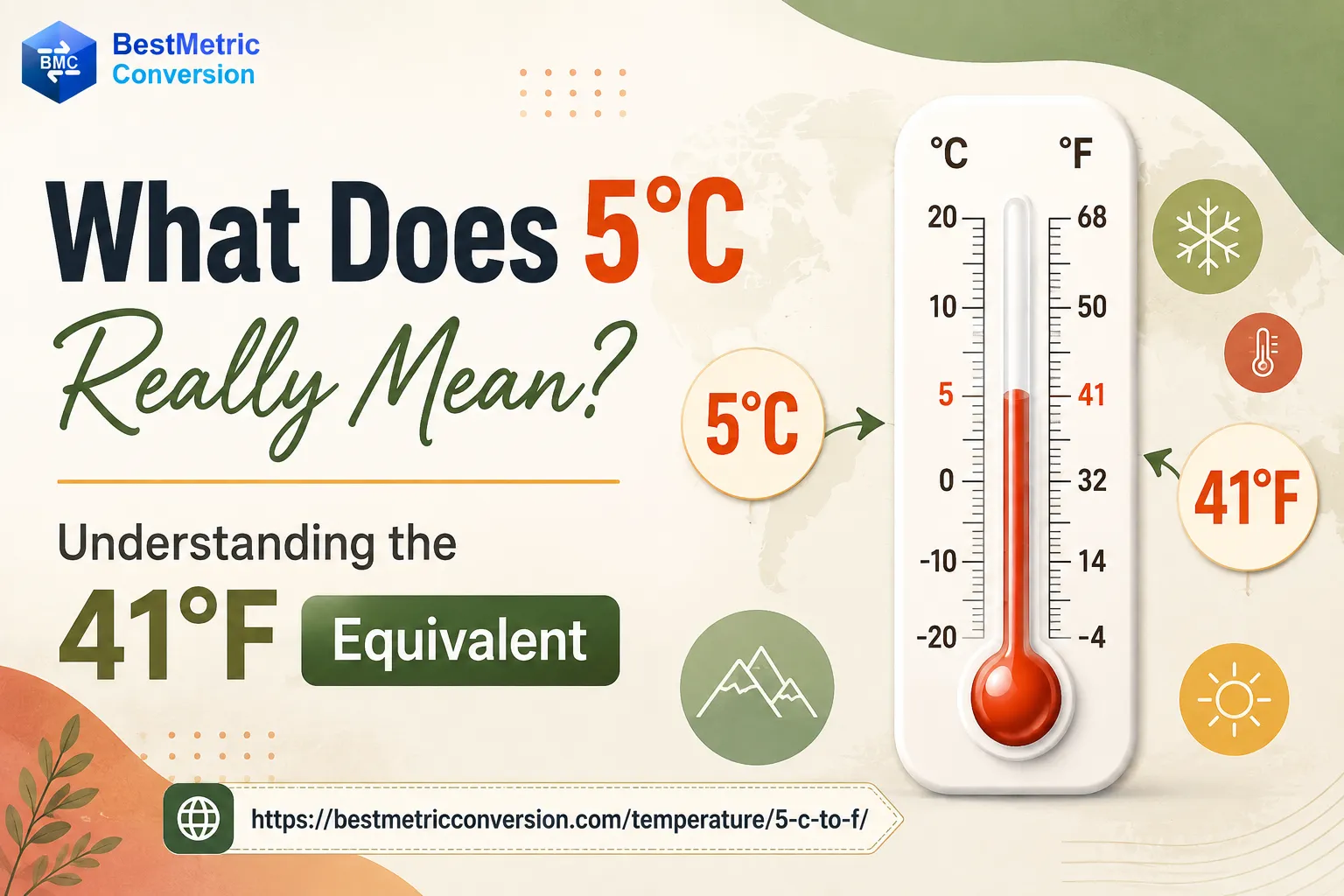

Temperature can look very different depending on the measurement scale being used. A weather forecast may show 5°C, while another source may report the same conditions as 41°F. Although the numbers are different, both measurements describe the same temperature.
This can be confusing when traveling, checking international weather reports, studying temperature measurements, or simply trying to understand a temperature expressed in an unfamiliar unit. Fortunately, the relationship between Celsius and Fahrenheit is straightforward once you understand the formula behind it.
In this guide, we’ll explore what 5°C represents, how it relates to Fahrenheit, how the conversion is calculated, and where this knowledge can be useful in everyday situations.
What Is 5°C in Fahrenheit?
The Celsius and Fahrenheit scales use different numerical systems to describe temperature.
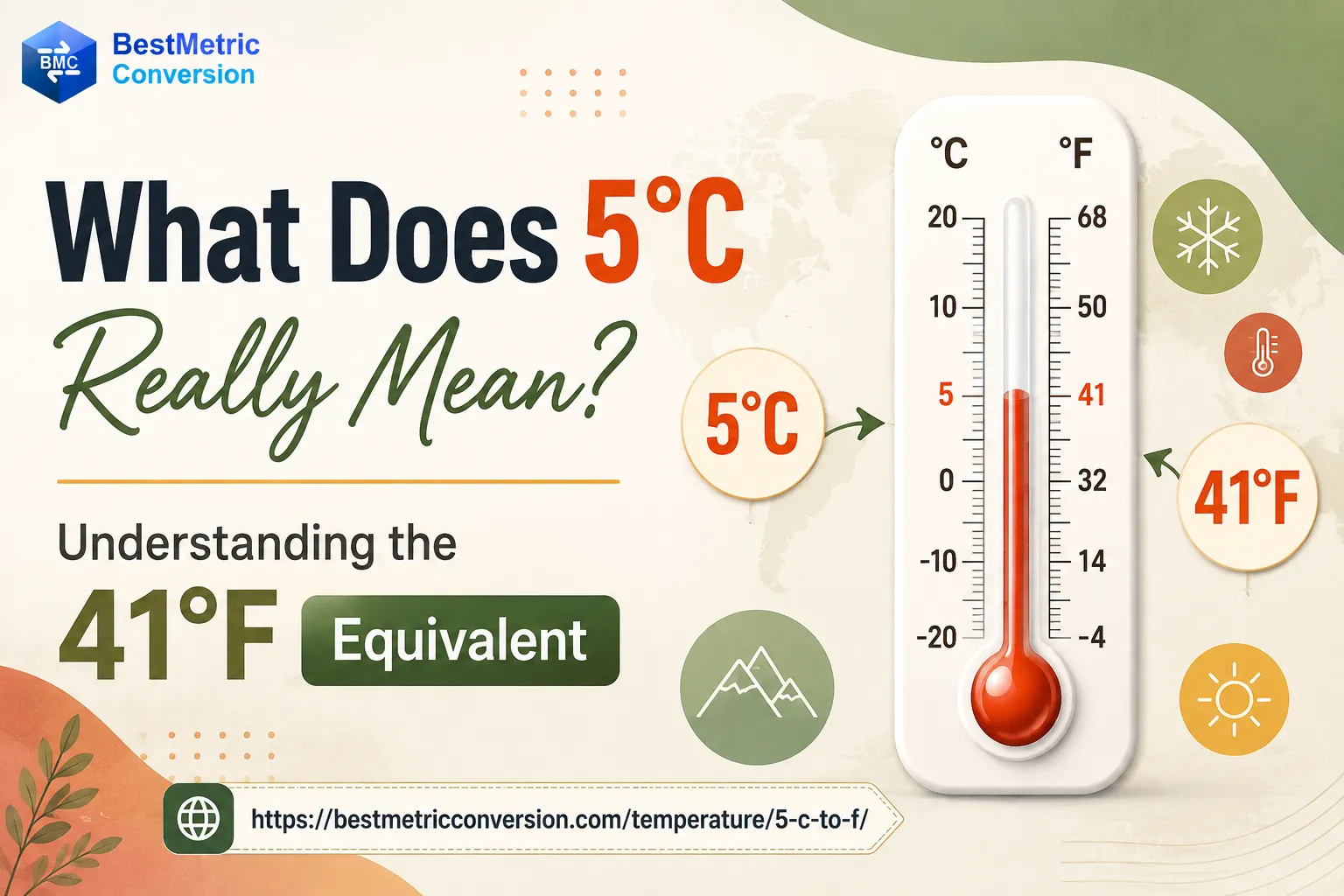
When 5 degrees Celsius is expressed using the Fahrenheit scale, the result is:
5°C = 41°F
So, a weather forecast showing 5°C is describing exactly the same temperature as one showing 41°F.
The difference in the numbers comes from the way the two scales were designed. Celsius and Fahrenheit have different reference points and different intervals between temperature values.
Understanding the Celsius and Fahrenheit Scales
Celsius is widely used around the world for everyday temperature measurements. It is also commonly used in science, education, weather reporting, and many other applications.
Fahrenheit is mainly used for everyday temperature measurements in the United States.
The scales have different reference points. Under standard atmospheric pressure, water freezes at 0°C on the Celsius scale and 32°F on the Fahrenheit scale. Water boils at 100°C and 212°F, respectively.
This difference explains why the numerical values do not match when the same physical temperature is expressed in the two systems.
How the 5°C to 41°F Calculation Works
The standard formula for converting Celsius to Fahrenheit is:
°F = (°C × 9/5) + 32
An alternative way to write the same formula is:
°F = (°C × 1.8) + 32
Let's use 5°C as an example.
First, multiply 5 by 9/5:
5 × 9/5 = 9
Then add 32
9 + 32 = 41
Therefore:
5°C = 41°F
Because the result is exactly 41, no rounding is necessary.
Why the Formula Uses 9/5
The 9/5 part of the formula exists because a degree on the Celsius scale represents a different temperature interval than a degree on the Fahrenheit scale.
Between the freezing and boiling points of water, Celsius has 100 degrees:
100°C − 0°C = 100 degrees
Fahrenheit has 180 degrees between the same points:
212°F − 32°F = 180 degrees
The ratio is therefore:
180 ÷ 100 = 1.8
That is why a change of 1°C corresponds to a change of 1.8°F.
The additional 32 is needed because the freezing points of the two scales are different.
A Quick Way to Verify the Result
If you are only converting one temperature, the formula takes just a few seconds. However, an online calculator can be convenient when you need to check several values or work with decimal temperatures.
For example, the 5 C to F conversion formula and calculation can be checked using an online conversion tool.
This is useful when you want to verify a manually calculated answer or quickly convert values such as 5.5°C, 7.2°C, or -3°C.
The important point is that an online calculator should complement your understanding of the formula rather than replace it completely. Knowing how the calculation works allows you to recognize whether a result makes sense.
Is 5°C Considered Cold?
For many people, 5°C would be considered cool or cold weather.
Since 5°C is equivalent to 41°F, it is well above the freezing point but can still feel quite chilly outdoors. The actual experience can vary depending on wind, humidity, sunlight, and clothing.
For example, 5°C on a sunny and calm day may feel different from 5°C with strong winds and rain.
This is one reason weather forecasts often provide more than just temperature. Other conditions can influence how the temperature actually feels.

When Is Celsius to Fahrenheit Conversion Useful?
Understanding temperature conversion can be helpful in many everyday situations.
Checking Weather Reports
Different websites, apps, and weather services may use different temperature scales. If you normally use Fahrenheit but encounter a Celsius forecast, knowing the conversion makes the information easier to understand.
For example, seeing 5°C immediately tells you that the temperature is 41°F.
Traveling Internationally
Travelers may encounter Celsius in countries where Fahrenheit is not commonly used. Being able to understand both scales can make it easier to interpret local weather conditions.
This can be particularly helpful when deciding what clothing to pack or planning outdoor activities.
Following International Recipes
Recipes can use different temperature units depending on where they were created. Understanding Celsius and Fahrenheit can help prevent confusion when following instructions from another country.
Although 5°C is not a typical cooking temperature, the same conversion principle applies to much higher temperatures used for ovens and cooking equipment.
School and Educational Work
Temperature conversion is also a common topic in mathematics and science. Students may need to convert values between Celsius and Fahrenheit and show the calculation.
Understanding the formula makes these problems easier to solve without relying entirely on a calculator.
Common Celsius-to-Fahrenheit Mistakes
The conversion formula is simple, but a few mistakes can produce incorrect answers.
One common error is multiplying the Celsius value by 1.8 and forgetting to add 32. Another is using the Fahrenheit-to-Celsius formula when the required conversion is in the opposite direction.
It is also important to pay attention to negative temperatures. The same Celsius-to-Fahrenheit formula works for negative values, but the calculation needs to be performed carefully.
For decimal temperatures, avoid unnecessary rounding during the intermediate steps. Keeping the original value until the final result can help maintain accuracy.
A Simple Temperature Reference
Here are several common Celsius values and their Fahrenheit equivalents:
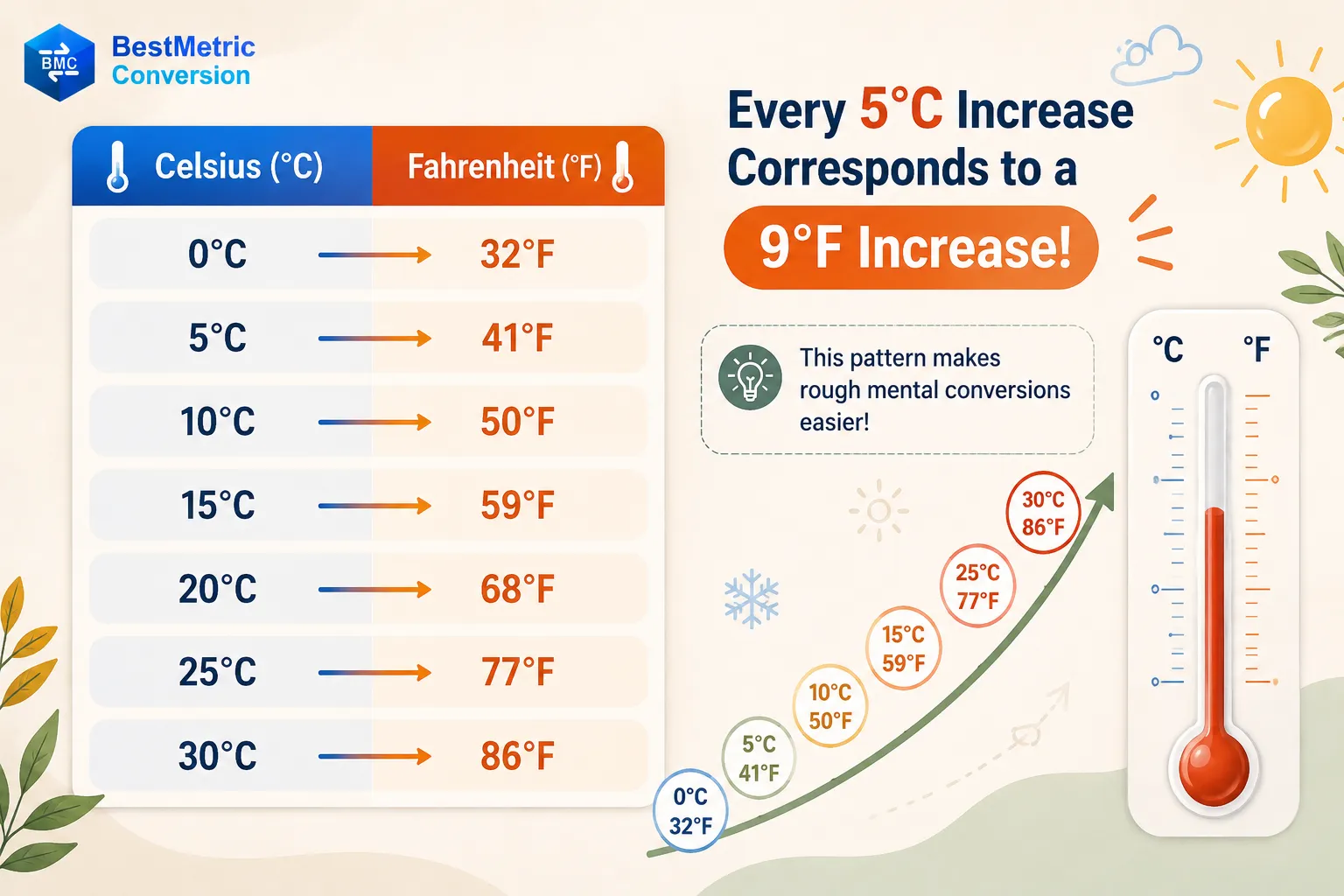
This table also shows a useful pattern. Every 5°C increase corresponds to a 9°F increase.
That relationship can make rough mental conversions easier, although the standard formula is still the best choice when an exact result is required.
A Visual Explanation of the Conversion
Some people find mathematical conversions easier to understand when they can see the calculation being performed. A short demonstration can show the process from Celsius to Fahrenheit without requiring a lengthy explanation.
For a quick visual reference, you can watch this 5 C to F conversion explained in a short video.
A short video can be especially useful for beginners who want to see how the formula is applied to an actual temperature value.
Why Accurate Conversion Matters
Temperature may seem like a simple measurement, but accuracy can be important in certain situations.
A small error may not matter when casually discussing the weather, but incorrect conversions can cause confusion in educational work, technical information, cooking instructions, or other situations where a precise measurement is expected.
Using the correct formula and checking the result with a reliable calculator can help reduce these errors.
It is also useful to remember that converting a temperature does not change the actual temperature. It only changes the way that temperature is represented.






















Sign in to leave a comment.