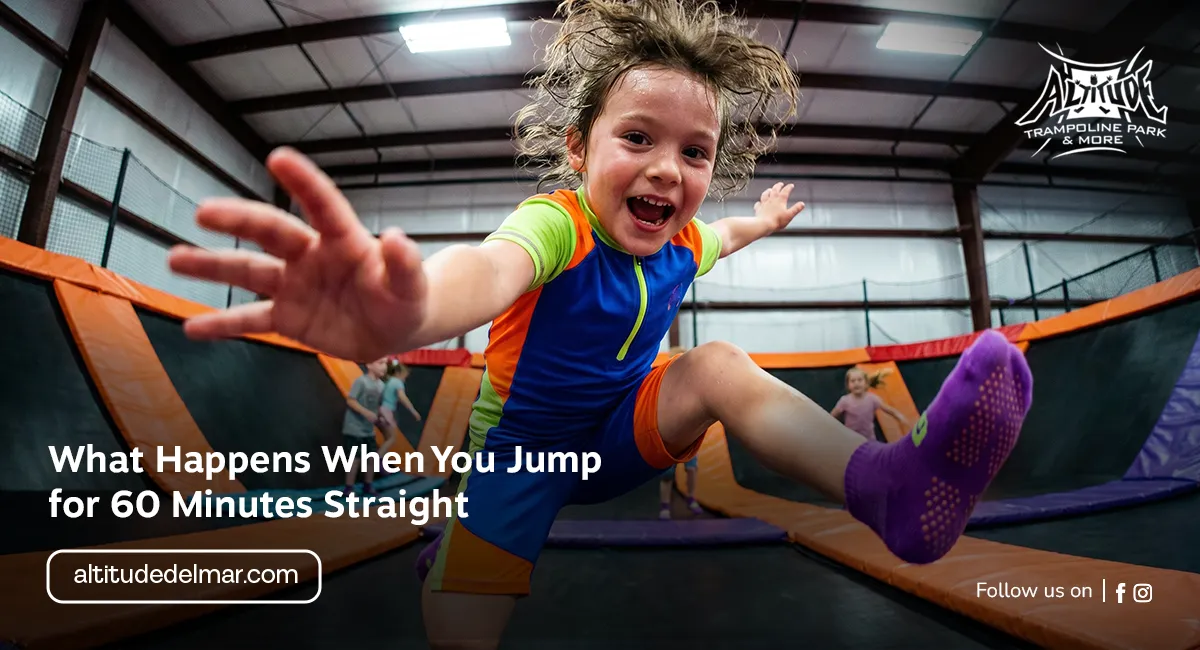

Remember being a kid and jumping on your bed until your mum yelled at you to stop? No rules, reps, and counting calories. Just pure, unfiltered joy. The kind that makes your stomach flip and your face hurt from smiling.
That feeling? It didn't go anywhere. You just stopped permitting yourself to feel it.
That's exactly what changes the moment you step onto a trampoline at Altitude. Because 60 minutes of jumping isn't just exercise. It's something bigger. Something your body and your brain have both been quietly craving for a long time.
Let's talk about what actually happens when you jump for a full hour. Buckle up. It's a good story.
The First 10 Minutes: Your Body Wakes Up
You step on the trampoline and take that first bounce. And something shifts.
Your legs absorb the rebound. Your core engages without you even thinking about it. Your arms find their rhythm. Within the first couple of minutes, your heart rate is already climbing. You are not on that dreaded treadmill, but in the "oh wow, this is actually fun" way.
Here's what's happening under the hood...
Your body is activating multiple muscle groups simultaneously. This includes calves, quads, hamstrings, glutes, core, and back. Rebounding requires constant micro-adjustments for balance. This means your stabilizer muscles are working overtime. And because the trampoline surface absorbs impact, your joints aren't taking the beating they would on a hard floor.
By minute 10, you're warm. You're loose. You're grinning at a stranger across the court because they just attempted a spin and landed sideways. At Altitude, the space is designed to ease you in. Open jump areas where you can find your flow before you commit to anything more adventurous. No pressure, no performance. Just you, the mat, and gravity doing its thing.
Minutes 10–20: The Cardio Kicks In
It's one of the most effective cardiovascular workouts you can do, and it feels nothing like one.
Studies have shown that 10 minutes of rebounding can be equivalent to half an hour of running in terms of cardiovascular benefit. Your heart is pumping, your lungs are working, your circulation is firing. But your brain is too busy having fun to file it under "exercise."
This is the magic of movement that doesn't feel like a chore.
By the 15–20 minute mark, most people hit a natural high. Your body starts releasing endorphins. The beautiful little mood-boosting chemicals that make the world feel slightly more okay than it did an hour ago. Stress? What stress? You're literally airborne.
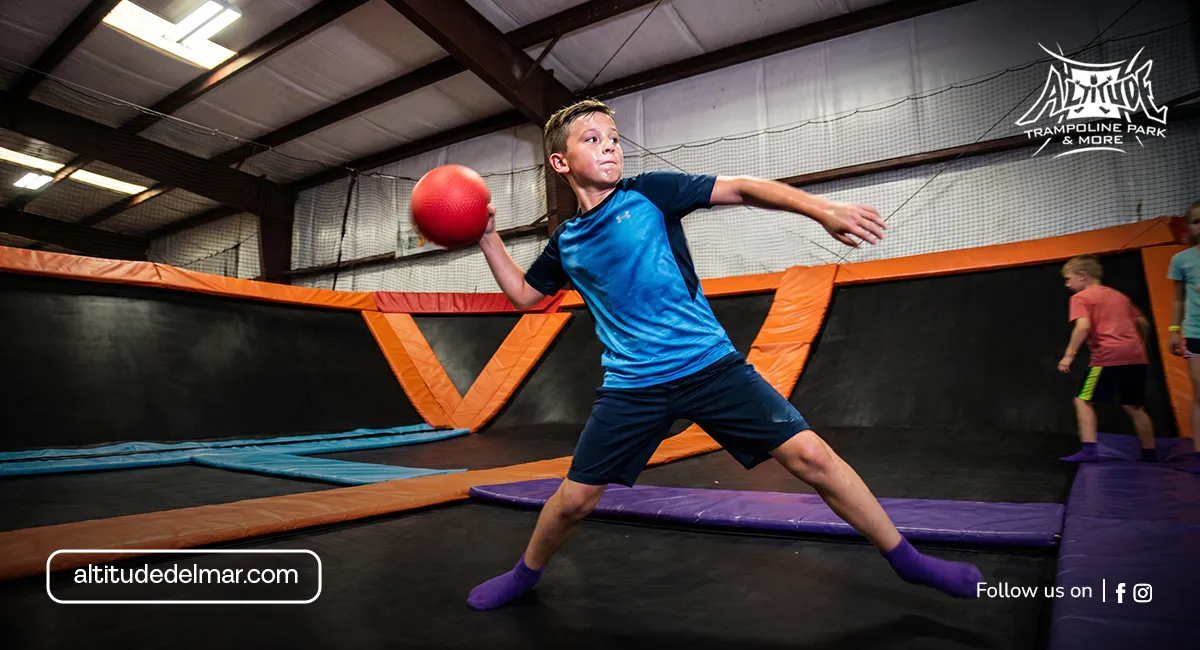
At Altitude, this is also around the time people start getting brave. The foam pit is calling. The slam dunk basketball hoop suddenly looks very achievable. The dodgeball court is heating up, and someone's already trash-talking. The environment pulls you deeper into the experience without you even realizing you've been moving for 20 minutes straight.
You Enter the Flow State
You know that feeling when you're so locked into something that time just dissolves? That's flow state. And jumping is one of the fastest ways to get there.
Around the 20–30 minute mark, something quietly beautiful happens. The self-consciousness fades. You stop worrying about how you look mid-air. You stop thinking about your to-do list, your inbox, or that awkward thing you said three years ago at a dinner party.
You're just here. Fully, completely here.
This isn't an accident, but neuroscience. Rhythmic, repetitive physical movement activates the brain's default mode network and helps quiet the prefrontal cortex. It's the part responsible for overthinking, self-criticism, and anxiety. Jumping literally turns down the noise in your head.
It's meditation, but make it fun.
For kids, this zone is where confidence builds quietly. At Altitude, children are attempting things they weren't sure they could do, small jumps becoming big ones, fear dissolving into focus. Parents watching from the sidelines often say the same thing, "I haven't seen them that focused in ages."
For adults, it's different but equally powerful. It's a reminder that your body is capable of joy. That play isn't just for children. That fun is, actually, a form of self-care.
The Real Physical Work Happens
Let's get a little nerdy for a second because your body is doing something genuinely impressive right now.
By the halfway mark of a 60-minute session, you've been engaging your lymphatic system in ways most workouts simply don't. The up-and-down motion of rebounding is one of the most effective ways to stimulate lymph circulation. This supports your immune system, helps flush toxins, and reduces inflammation.
Your core strength is tested and built in real time, as every landing requires you to stabilize your center. Your balance and coordination are improving with every bounce, as your vestibular system gets a genuine workout.
And then there's the bone density benefit. The gentle impact of rebounding helps stimulate bone tissue, which is especially important as we age. Your skeleton is literally getting stronger while you're doing backflips into a foam pit. Add improved posture, better proprioception, and a metabolism that's been quietly revving this whole time.
At Altitude, this is also the stretch where group energy hits differently. You're not grinding through a solo workout. You're surrounded by people laughing, cheering, attempting ridiculous things, and occasionally failing spectacularly. That shared energy? It pushes you further than you'd ever push yourself alone.
The Emotional Landing
You're on the home stretch now. Your body is warm and worked. Your face is flushed. Your hair is definitely a disaster. And you feel genuinely good. Not just "I finished a workout." Something richer than that.
There's a lightness that settles in the final stretch of a long jump session. The kind that comes from doing something purely for the joy of it. The kind that reminds you that your body is not just a machine to be optimized. It's something to celebrate.
For families, these last ten minutes are often the most precious. Kids are hyper, happy, and exhausted in the best possible way. Connections have been made on the courts. Memories have been built in the air. Parents aren't just watching their kids from the sidelines. They've been in it, jumping alongside them, rediscovering something they thought they'd outgrown.
For individuals, there's a quiet confidence that lingers after. A sense of "I did that." Small? Maybe. But those small wins add up.
What 60 Minutes at Altitude Actually Gives You
In one hour of jumping, here's what you walk away with
Physically: A full-body workout that burns between 400 and 700 calories. It helps strengthen legs and the core, improve cardiovascular health, and improve balance and coordination. It also stimulates the lymphatic system, and low-impact movement that's gentle on your joints.
Mentally: It reduces your stress hormone. It helps to achieve a flood of endorphins, a genuine flow state, and a mental reset that's hard to find anywhere else.
Emotionally: Real, unfiltered, childlike joy. The kind that's not manufactured or performed. The kind that happens when you stop trying to be productive for an hour and just play.
And none of this is accidental.
Altitude is built around the belief that movement should feel like a reward, not a punishment. The courts, atmosphere, foam pits, dodgeball, freestyle areas, and slam dunk hoops are designed to keep you moving without making you feel like you're working out because the best workout is the one you actually want to show up for.
So, What Are You Waiting For?
You've spent the last few minutes reading about jumping. Imagine spending the next 60 minutes actually doing it. Book at Altitude and give yourself an hour that your body, mind, and inner child will all thank you for. Come solo, bring a friend, drag the whole family... There's space for all of it.
The trampoline's ready. The foam pit is calling. Time to jump. 🚀





























Sign in to leave a comment.