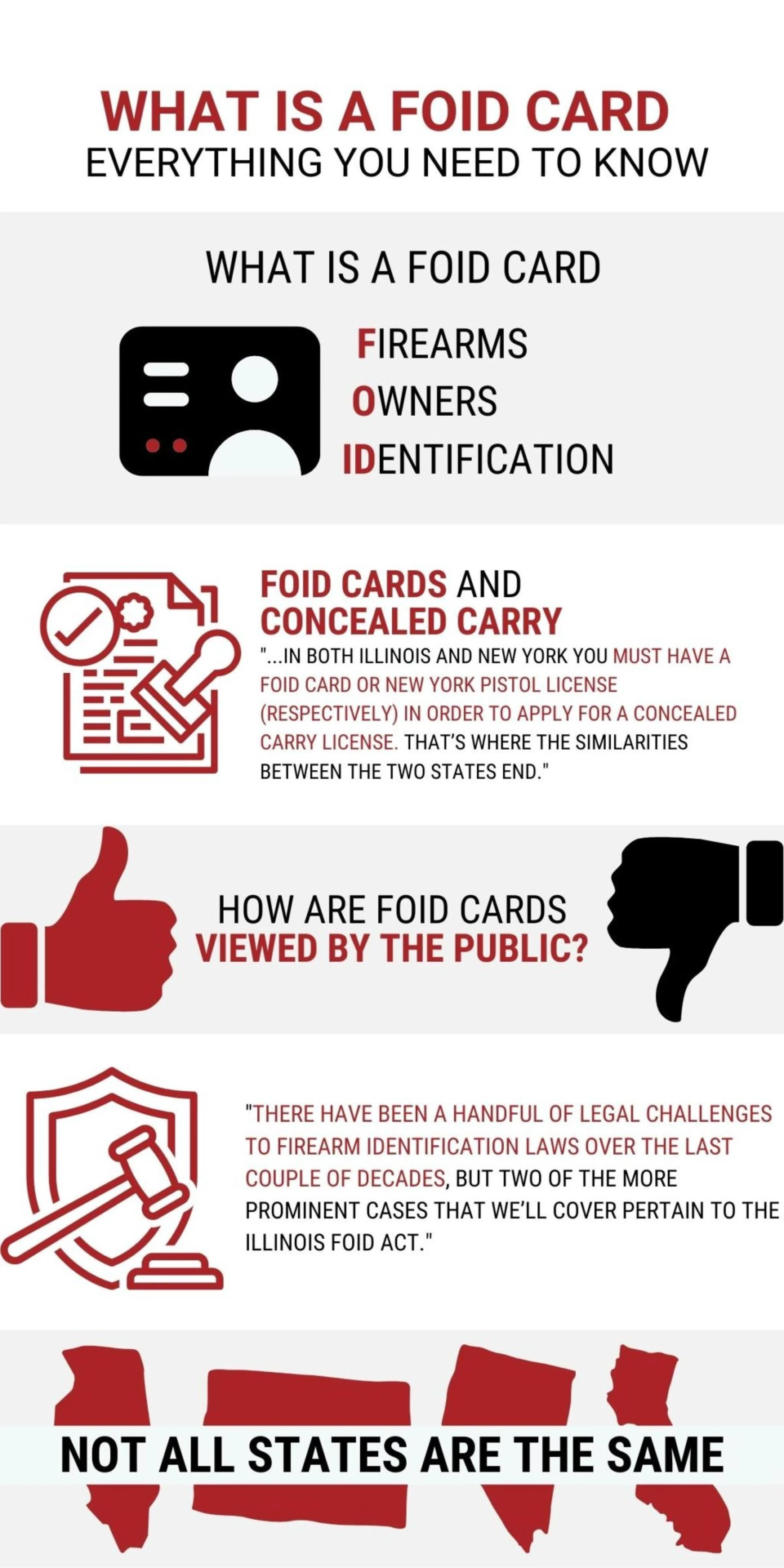

What is a FOID Card
Let’s start with what “FOID” stands for: Firearms Owners Identification. The name itself should tell you everything you need to know. A FOID card is essentially a license that the state requires residents to obtain in order to legally purchase or own any firearms or ammunition.
Illinois is currently the only state in the Union to require a FOID card, although a few other states have their own version of the license or permits that serve a similar purpose.
For example, the state of New York requires residents to obtain a permit to purchase and own a handgun. The State of Hawaii has a similar Permit to Acquire that requires completion of a firearm safety or training course (see Haw. Rev. Stat. Ann. § 134-2).
The state of Massachusetts has 2 different types of licenses that residents must obtain in order to purchase, own, or possess various types of firearms. These are the FID card and LTC-A. A FID card allows a resident to have a non-large capacity long gun.
An LTC-A allows residents to obtain large capacity long guns and handguns. This license also allows an individual to concealed carry given they have no restrictions placed on them.
What is the Purpose of a FOID Card?
According to the Illinois State Police website, the purpose of the FOID card is to identify individuals who are eligible to purchase and possess firearms. Given that there are specific laws and conditions that one must have broken to become ineligible, it’s safe to say that most law-abiding Illinois residents are eligible to receive a FOID card.
It is also worth noting that the ISP website states that its website is not intended to replace statutory language.
The Illinois General Assembly website paints a slightly different picture. According to 430 Illinois Compiled Statutes (ICS) 65, the explicit purpose of the FOID card is to identify individuals who are not eligible to own or possess a firearm or ammunition.
Regardless, the result of the FOID Card Act is a state record of gun owners and users. And if you don’t have a FOID card, using or owning a firearm will get you thrown behind bars.
Public Safety is the Prominent Reason Given for Establishing These Laws
By and large, the United States is a safer place than it was when these laws were originally passed. The 60s especially were a very turbulent time and crime was rampant. And while many Americans may feel that this nation is more dangerous now than it was in the past, the violent crime rate is lower than decades past. According to the U.S. Department of Justice, the homicide rate peaked in 1980 at 10.2 per 100,000 people. The CDC Mortality Dashboard shows that in 2020, the homicide rate spiked to 6.6 per 100,000 people.
Even though pockets of violence still exist in states with firearm ID laws, it’s not nearly as widespread as it once was.
How Long Have FOID Cards Existed?
Firearm ID cards are relatively new in both Illinois and Massachusetts. Both were passed in their respective state in 1968 as part of public safety initiatives.
New York’s licensing laws are significantly older. Handgun permits in New York were first required by the Sullivan Act of 1911 in response to rising urban crime.
FOID cards and Concealed Carry
While a Massachusetts LTC-A does permit an individual to concealed carry, it is the only state that handles firearm IDs in this way.
Again, it’s important to note that firearm ID cards in Illinois and New York are not the same as concealed carry licenses (CCL).
However, in both Illinois and New York you must have a FOID card or New York Pistol License (respectively) in order to apply for a concealed carry license. That’s where the similarities between the two states end.
Shall-Issue or May-Issue?
Of the 3 states requiring firearm IDs, Illinois is the only one to adopt a “shall-issue” policy for concealed carry licenses. Once a valid FOID cardholder completes 16 hours of training and passes a universal background check—among other conditions—the Illinois State Police will issue them a license once they have received the president’s application.
New York and Massachusetts on the other hand have “may-issue” policies. That means that even after you’ve met all the requirements and paid to apply, the state can deny your application and keep you from exercising your right to carry a concealed firearm.
How are FOID Cards Viewed by the Public?
Public opinions regarding the FOID Act and other firearm ID laws are widely varied. For the sake of this article, we’ll focus on Illinois where the topic is under intense scrutiny.
Proponents of firearm regulations argue that the FOID Act helps keep guns out of the hands of violent criminals. Many of these advocates would argue that the gun violence in Cook County or Winnebago County, Illinois is directly attributable to relaxed gun laws in neighboring states.
On the other hand, pro-gun advocates in the state argue that the current gun laws on the books, including the FOID Act, restrict law-abiding citizens’ ability to exercise their constitutionally protected rights. One key issue is that applicants must pay a modest fee in order to apply for a right supposedly guaranteed by the state constitution.
Some Counties Have Taken the Issue into Their Own Hands
26 of the counties in Illinois have dubbed themselves “gun sanctuaries” who will not enforce gun laws they deem to be unconstitutional. Another 13 counties are considering whether or not to become gun sanctuaries. If they did, then ⅓ of the state’s counties would have the title.
To find out the legal challenges to FOID Cards and our closing thoughts read the full article here: What Is A FOID Card – Everything You Need To Know












Sign in to leave a comment.