
Cranes are an essential part of most civil engineering projects. Depending on the weight to be lifted and the available space for movement, several types of cranes are used. The jib crane is one variety of such cranes.
A jib crane is a kind of crane that lifts, moves, and lowers items using a mounted arm. The arm, which is positioned at an acute angle upwards from or parallel to a wall or pillar, may revolve for a complete circle or a restricted arc around the central axis.
In places like docks and warehouses, these cranes are often used to load and unload cargo containers.
A jib crane’s history began in ancient Greece when the concept of lifting goods with a mechanical arm was widely employed. Similarly, the Romans eventually borrowed the notion and used it to build aqueducts, highways, and other technical facilities.
Cranes progressed, but their designs remained unchanged until the development of the steam Engine Jib Crane and the industrial revolution in the nineteenth century.
Cranes evolved in complexity and scale throughout this time, in response to the ever-expanding development on both land and water, as well as the rising needs of shipping corporations and complicated industries.
Jib Crane Functioning Concepts
The notion of mechanical advantage supports the basic concept of a crane. Mechanical advantage is the notion that a machine, such as a pulley, may double the force applied to it by a specific factor.
This explains why, for example, one guy can use a pulley to raise a big object that would need the combined force of several men to lift directly. A crane combines a variety of pulleys with basic devices such as levers and gears to greatly improve lifting capability.
In modern jib cranes, the robust metal cable is wrapped around the jib strut ends, with one end of the hoist frequently attached to an electromagnet or hook and the other end to a metallic winch.
When the winch is activated, the pulley produces a lifting force equivalent to the force exerted by the metallic winch. The hoist may travel inwards or outwards along the length of the jib, offering even more motion versatility.
A jib crane is not limited to a single place and may be put on a mobile chassis for use in military operations or at other temporary work locations. Such cranes often prioritize mobility over lifting capability.
Outriggers are often employed in jib cranes to maintain stability under load. Stationary cranes, on the other hand, are often anchored in place.
Jib Crane Types
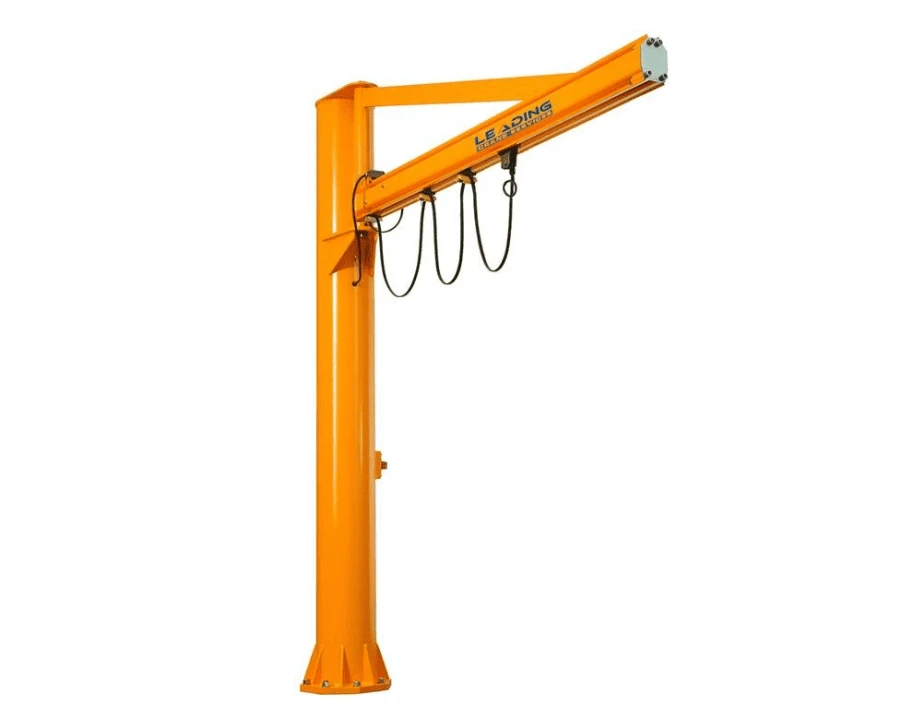
Free Standing
When set on the floor, this kind of crane does not need any support. To keep them sturdy, they come with a big foundation base. The foundation’s base and height are heavily influenced by the weight to be raised. This crane has a significant advantage over its competitors in that it does not need a strong structure or wall to support itself. It also has the maximum coverage and span.
Mast Style
This jib crane is very similar to the freestanding kind. The sole distinction is that the latter does not need any assistance to be stable. A mast-type crane, on the other hand, is placed at the bottom and top, yet it is one of the most efficient transportation cranes. With a 360-degree spin, it provides maximum lift.
Wall Bracket
In terms of construction and installation requirements, this crane is comparable to its wall-mounted version, but it includes a bracket. This equipment has a wide range of hoist coverage, making it an effective tool in warehouses and factories. It can swing goods all around despite impediments and barriers on the floor.
Wall – Mount
Wall-mounted cranes, as the name implies, are attached to the walls. When installed closer to the roofs, it provides the best lift. This jib crane’s coverage is comparable to that of other kinds of cranes. It is round in form. When the floor is covered with other items, materials are successfully moved.




Sign in to leave a comment.