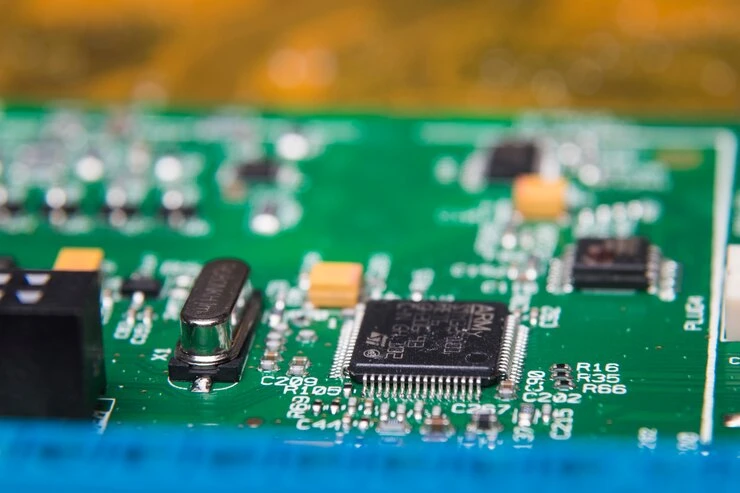

Printed Circuit Boards (PCBs) are an essential component in electronics prototype and circuit design because they provide a basic foundation for assembling electronic components. In contrast to breadboards, which are transient and perfect for rapid prototyping without soldering, printed circuit boards (PCBs) provide a permanent or semi-permanent solution with multiple unique benefits. This article examines the key features of printed circuit boards (PCBs), their advantages over breadboards, and the reasons why different electronic applications use PCBs instead of breadboards.
What is a to PCBs?
A printed circuit board, or PCB, is a flat board covered in a thin layer of conductive metal, usually copper, and constructed of non-conductive materials such as a fiberglass or epoxy. The electronic components installed on the board are connected via traces made of this etched metal layer. The accurate designing and routing of these traces on PCBs is achieved by the use of specialist software, which guarantees the effective operation of electrical circuits.
What is a Breadboard?
A breadboard, on the other hand, is a temporary platform for prototyping electronic circuits without soldering. It consists of a plastic board with a grid of holes, each containing a metal clip beneath. Components are inserted into the holes and secured by bending the metal clips, allowing for easy connections and modifications.
Advantages of Using PCBs
Reliability and Durability: PCBs offer a long lasting foundation, for circuit components. The etched copper traces ensure connections decreasing the chances of loose connections or short circuits when compared to using a breadboard.
Compactness: it is another advantage of PCBs as they allow for circuit designs. By soldering components onto the board there is space between connections enabling layouts that may not be achievable with a breadboard.
Electromagnetic Interference (EMI) Reduction: PCBs are also tailored to reduce Electromagnetic Interference (EMI) through layouts and grounding techniques. This reduction in interference can enhance the performance of circuits in contrast, to using breadboards.
Production Scalability: Once a PCB assembly design is finalized, identical boards can be manufactured efficiently and economically, making them suitable for mass production in commercial and industrial applications.
Breadboard vs. PCB
While breadboards offer convenience for quick prototyping and experimentation without soldering, they have limitations in terms of durability, complexity of designs, and reliability over time. PCBs, on the other hand, provide a more permanent and robust solution suitable for applications where reliability and performance are critical.
sect
Printed Circuit Board (PCB)
Breadboard
Purpose
Designed for permanent or semi-permanent circuits
Temporary prototyping and testing without soldering
Construction
Consists of non-conductive material with etched copper traces
Plastic board with grid of holes and metal clips for temporary connections
Complexity and Design
Supports intricate designs with multiple layers of copper traces
Limited to simpler circuits due to layout constraints
Reliability
Offers superior reliability due to soldered connections
Connections are temporary and can become loose over time
Durability
Provides robustness and stability for long-term use
Prone to mechanical stress and environmental factors
EMI Control
Can incorporate measures to reduce electromagnetic interference (EMI)
Limited ability to control EMI, which can affect circuit performance
Scalability and Production
Suitable for mass production once design is finalized
Not suitable for mass production; each circuit is unique
Advantages
Compact design, reliable connections, suitable for complex circuits
Flexibility, no soldering required, easy to modify circuits
Conclusion
PCBs represent a significant advancement in electronic circuit design and manufacturing. They offer reliability, durability, compactness, and scalability that make them the preferred choice over breadboards for many electronic projects and commercial applications. Understanding the advantages of PCBs allows electronics enthusiasts and professionals alike to leverage these benefits in designing and deploying sophisticated electronic systems.










Sign in to leave a comment.