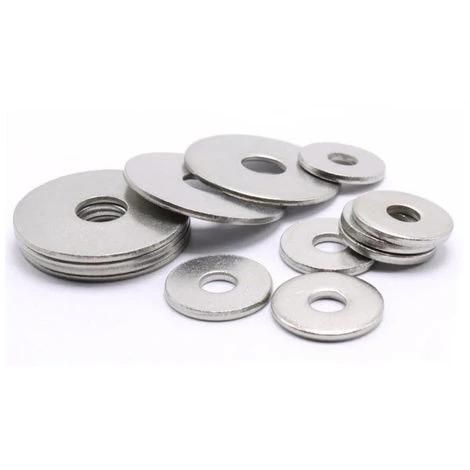

Washers serve primarily as a load distribution seat, but they can also provide spring tension, cover oversized holes, insulate, seal, or provide electrical connections. Flat, conical, and helical washers, toothed or splined lock washers, and special washers are among the various types. Flat washers, also known as plain washers, are used to provide a bearing surface for a nut or screw head, cover large through holes, and distribute fastener loads over a large area, particularly in soft materials.
Types of washers-
Type A is a family of steel washers with wide tolerances for which design refinement is unimportant. They range in size from No. 6 to 3-in. overall and from 3/16 to 5-in. OD. For most assemblies, Type A washers are adequate.Type B washers are of high quality and are available in narrow, regular, and wide diameters for screw sizes ranging from 0 to 3 inches. Furthermore, many other standard sizes are available. Conical spring washers are used with screws to increase screw elongation by adding spring take-up.L-type taper washers are intended to be used with unhardened screws. Type H screws are hardened screws. Taper washers are intended to flatten to approximately half of the maximum load of the screw.Application of Washers-
Helical spring washers are made of slightly trapezoidal wire formed into a spiral helix with a free height nearly double the cross section thickness. They are typically made of hardened carbon steel, but they can also be made of aluminum.Tooth lock washers are used with screws and nuts to increase frictional resistance under the screw head or nut face and to add spring take-up to the screw elongation. They provide an interference lock by biting into both the screw head and the work surface. The tooth lock washer provides frictional resistance to loosening even at zero tension.Rib washers (serrated safety washers) combine conical spring washers' significant spring properties with tooth lock washers' increased frictional resistance. They are made from a variety of materials.Finishing washers, for example, eliminate the need for a countersunk hole and are widely used for attaching fabric coverings. The material is gripped over a wide area by the outer rim.The fairing washer is an aircraft development that is used on aluminum sinks with flat-head screws. The holding pressure is distributed over a wide area, preventing localized strains around the screws. This washer's shape allows for flush surfaces.Visit: Washer Suppliers
Sign in to leave a comment.