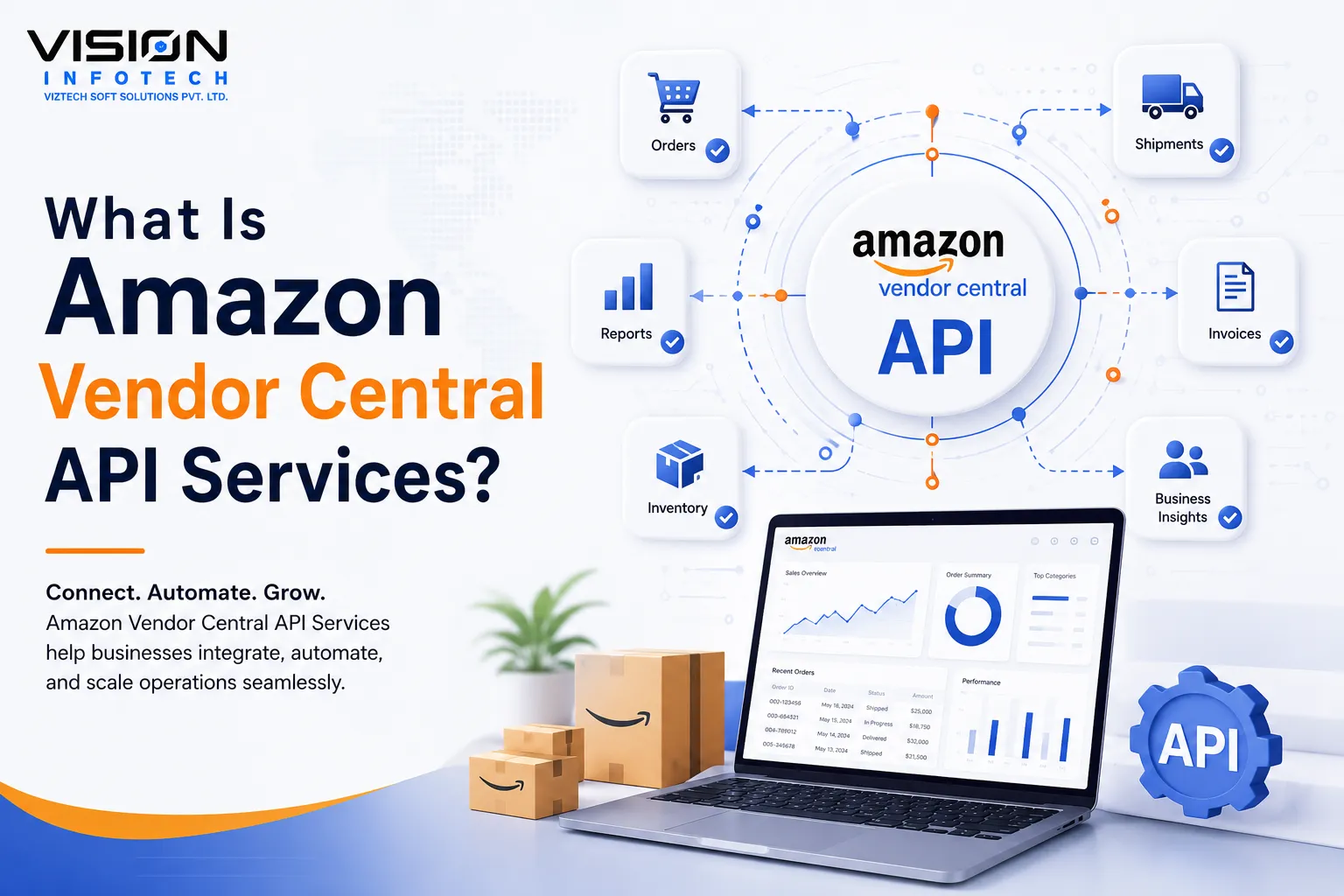

Managing an Amazon Vendor Central API account isn't easy. Between processing purchase orders, updating pricing, tracking shipments, and pulling reports, the day-to-day workload can pile up fast, especially as your catalog grows. If you're a first-party vendor, you've likely experienced these challenges firsthand.
Here's the good news: most of that manual work doesn't have to stay manual. Amazon Vendor Central API Services leverage the Amazon Vendor Central API to automate critical business processes, helping you streamline operations, reduce manual errors, and improve efficiency. This allows your team to spend less time on repetitive administrative tasks and more time growing your business.
What Is Amazon Vendor Central?
Before diving into the API side of things, let's quickly clarify what Vendor Central actually is.
Amazon Vendor Central is a platform designed for manufacturers, distributors, and brand owners who sell products directly to Amazon in bulk. Unlike third-party sellers who list and manage their own inventory through Seller Central, vendors sell wholesale to Amazon, and Amazon then resells those products to customers under the "Ships from and sold by Amazon" label.
This relationship comes with its own set of responsibilities: accepting purchase orders, managing chargebacks, submitting product content, tracking co-op advertising spend, and much more. Doing all of this manually, especially at scale, quickly becomes unmanageable.
What Is Amazon Vendor Central API?
The Amazon Vendor Central API, officially known as the Selling Partner API (SP-API) for vendors, is a set of programmatic tools that allow developers and businesses to connect their internal systems directly with Amazon's vendor operations.
Instead of logging into Vendor Central every day to check purchase orders, update pricing, or download reports, the API lets your systems talk directly to Amazon's servers. This means data flows automatically, decisions can be made faster, and your team spends less time on repetitive administrative tasks.
Core Functions of the Vendor API
The Vendor Central API covers a wide range of operational areas, including:
- Purchase Order Management – Automatically retrieve, accept, or reject purchase orders in real time.
- Inventory and Sales Reporting – Pull sell-through data, inventory levels, and forecasting reports.
- Pricing and Cost Management – Update product costs and promotional pricing programmatically.
- Shipment and Logistics Tracking – Monitor shipment status, confirm ASNs (Advance Shipment Notices), and manage chargebacks.
- Product Content and Catalog Updates – Sync product titles, images, bullet points, and A+ content across your catalog.
- Financial Reporting – Access invoices, payment data, and deduction reports for reconciliation.
By connecting these functions directly into your ERP, inventory management system, or a custom dashboard, businesses gain a level of control and visibility that manual processes simply can't match.
Why Amazon Vendor API Services Matter
You might be wondering: why not just handle everything manually through the Vendor Central dashboard? For small catalogs, that might work. But as your product range and order volume grow, manual management becomes a major bottleneck.
1. Time Savings Through Automation
Every hour spent manually downloading reports or updating purchase orders is an hour not spent on strategy, marketing, or growth. API integration automates these repetitive tasks, freeing up your team's time for higher-value work.
2. Fewer Costly Errors
Manual data entry is prone to mistakes, especially when dealing with hundreds or thousands of SKUs. A single pricing or inventory error can lead to stockouts, chargebacks, or lost revenue. Automated API workflows significantly reduce this risk.
3. Real-Time Decision Making
With API-driven data feeds, you get near real-time visibility into inventory levels, sales trends, and purchase order status. This allows for faster, more informed decisions, particularly important during peak shopping seasons.
4. Scalability
As your catalog and order volume grow, manual processes simply can't keep up. An automated system built on the Vendor Central API scales with your business without requiring a proportional increase in staff.
5. Better Forecasting and Inventory Planning
Access to detailed sales and inventory data through the API helps brands forecast demand more accurately, reducing both overstock and stockout situations, two of the most common profitability killers on Amazon.
Amazon Vendor API vs. Seller API: What's the Difference?
It's worth noting that Amazon's Selling Partner API ecosystem also supports third-party sellers through a separate but related set of endpoints. If your business operates a hybrid model, selling both as a vendor and through a seller account, you may also benefit from complementary Amazon Business API Services, which help manage B2B transactions, bulk pricing, and business-only offers.
While the underlying technology shares similarities, vendor-focused API integrations are tailored specifically to the wholesale relationship, purchase order workflows, and reporting structures unique to Vendor Central.
How to Get Started With Amazon Vendor API Integration
Setting up a Vendor Central API integration isn't as simple as flipping a switch. It typically involves several steps:
Step 1: Register as a Developer
You'll need to register your application with Amazon's Selling Partner API developer portal and agree to their data security and usage policies.
Step 2: Authentication Setup
Amazon requires secure authentication using OAuth-based credentials to ensure only authorized applications can access vendor data.
Step 3: Choose Your Integration Scope
Decide which functions you need most, whether that's purchase order automation, reporting, pricing updates, or a combination of several.
Step 4: Build or Partner for Development
This is where many businesses choose to work with an experienced development partner rather than building in-house. API integration requires ongoing maintenance, since Amazon regularly updates its API specifications and compliance requirements.
Step 5: Testing and Monitoring
Before going live, thorough testing ensures data accuracy across purchase orders, inventory sync, and reporting. Ongoing monitoring then catches any sync issues before they impact operations.
Common Challenges With Vendor API Integration
While the benefits are significant, businesses should be aware of a few common challenges:
- Frequent API Updates: Amazon periodically updates its endpoints and deprecates older versions, requiring ongoing maintenance.
- Data Complexity: Vendor data structures can be complex, especially for large catalogs spanning multiple categories.
- Rate Limits: Amazon enforces throttling limits on API calls, so integrations need to be built efficiently to avoid delays.
- Technical Expertise Required: Successful integration requires developers familiar with Amazon's specific API documentation and authentication protocols.
This is precisely why many brands choose to work with specialized agencies rather than attempting integration independently.
Beyond API Integration: A Full-Funnel Amazon Strategy
Vendor API integration solves the operational side of selling on Amazon, but it's only one piece of a larger puzzle. Once your backend processes are running smoothly, driving traffic and conversions through advertising becomes the next priority.
For agencies and brands managing multiple vendor or seller accounts, using dedicated Amazon PPC Software for Agencies can streamline campaign management, bid optimization, and performance reporting across accounts, all from a centralized dashboard. When paired with solid API-driven operations, this combination creates a genuinely scalable Amazon growth engine.
Who Should Invest in Amazon Vendor API Services?
Amazon Vendor API Services are particularly valuable for:
- Established brands with large or growing product catalogs
- Businesses managing high purchase order volumes
- Companies looking to reduce manual administrative overhead
- Brands aiming to improve forecasting accuracy and reduce stockouts
- Agencies managing multiple vendor accounts on behalf of clients
If your team currently spends significant time manually managing Vendor Central tasks, it's a strong sign that API automation could deliver a meaningful return on investment.
Frequently Asked Questions
Is Amazon Vendor Central API free to use? Access to the API itself doesn't carry a direct fee from Amazon, but development, integration, and ongoing maintenance typically require investment, either through in-house resources or a development partner.
Do I need coding knowledge to use Vendor API Services? Not necessarily. Many brands partner with agencies or software providers who handle the technical integration, allowing business teams to interact with simplified dashboards instead.
How long does integration typically take? Timelines vary based on catalog size and integration scope, but most projects range from a few weeks to a couple of months for full implementation and testing.
Final Thoughts
Amazon Vendor Central API Services aren't just a technical upgrade; they're a strategic investment in operational efficiency. By automating purchase orders, pricing, reporting, and inventory management, brands can reduce errors, save time, and make faster, data-driven decisions.
Whether you're a growing brand looking to streamline vendor operations or an agency managing multiple accounts, the right API integration can be the foundation for sustainable Amazon growth.
Ready to simplify your Amazon vendor operations? Vision Infotech specializes in building reliable, secure, and scalable Amazon Vendor API integrations tailored to your business needs. Get in touch with the Vision Infotech team today to discover how automation can transform the way you manage your Amazon business.
























Sign in to leave a comment.