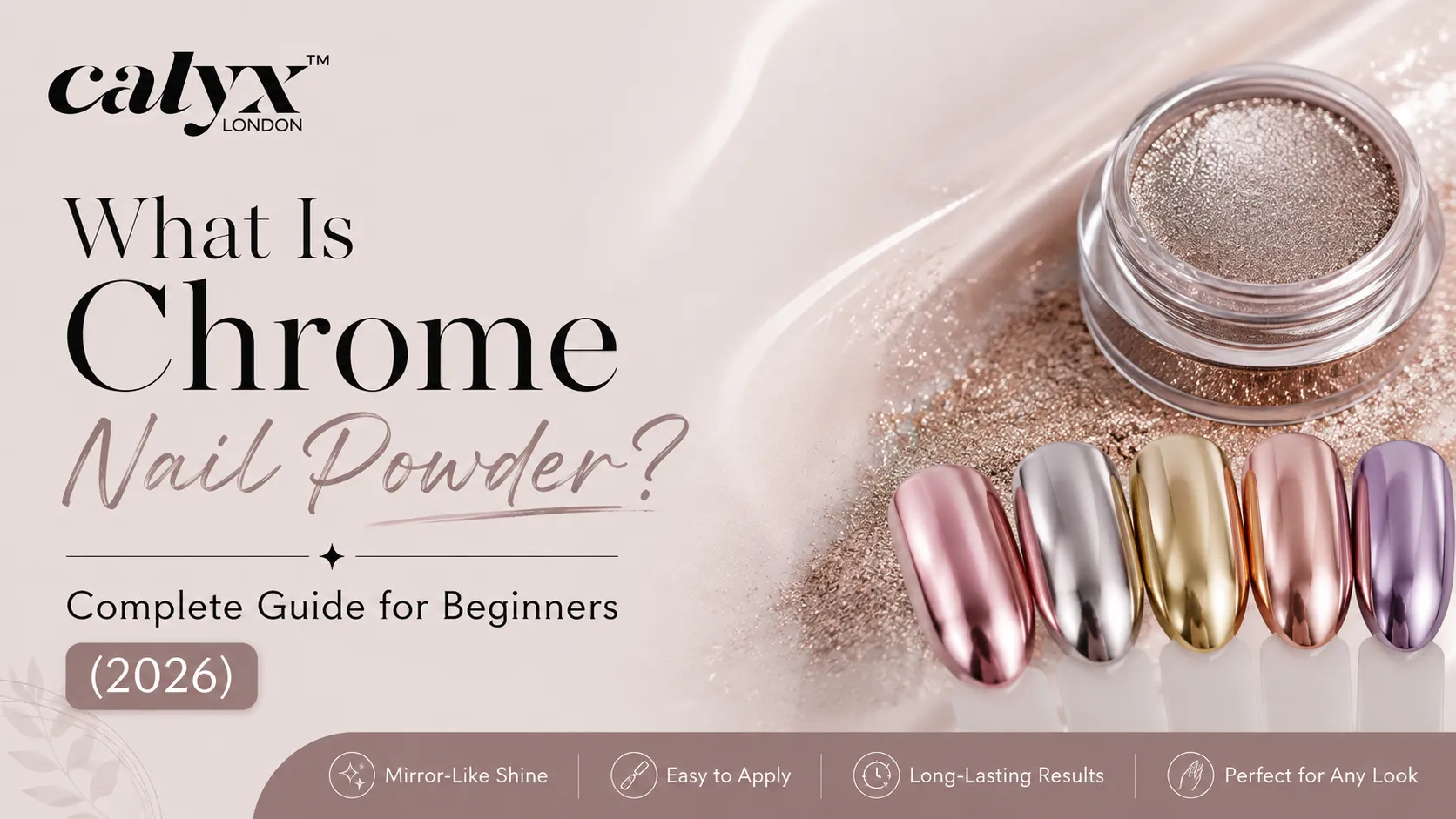

If you have scrolled through nail inspiration on social media any time in the last few years, you have almost certainly stopped on a set of nails that look like liquid metal poured over glass. That mirror-like, almost impossible shine is chrome nail powder at work, and it has quietly become one of the most requested nail trends in salons and home manicure kits alike.
The tricky part is that chrome nails look complicated, and honestly, the first time you open a jar of chrome powder without knowing what you are doing, it can feel that way too. Powder ends up everywhere except the nail, the finish comes out patchy, or the mirror effect just refuses to show up. None of that means you are bad at manicures. It usually just means nobody explained what this product actually is and how it behaves differently from polish or gel.
This guide breaks down exactly what chrome nail powder is, how it is different from chrome nail polish, the types you will come across while shopping, and what actually matters when you are trying to find the best chrome nail powder for your skill level and budget. By the end, you should be able to walk into a beauty supply store or scroll through an online listing and know precisely what you are looking at.
What Is Chrome Nail Powder?
Chrome nail powder, sometimes called chrome pigment or mirror powder, is a finely milled cosmetic powder made from mica or synthetic mica coated with layers of metallic oxide. When you buff or rub this powder onto a tacky gel surface, the tiny reflective particles align and create that dense, mirror-like finish that regular nail polish simply cannot replicate on its own.
It is not paint, and it is not a polish you brush on. Chrome powder is applied dry, using a small sponge-tip applicator or a soft silicone brush, directly onto a cured gel base that still has a slightly sticky top layer. That tackiness is what allows the pigment to grip and bond to the surface instead of just sitting loose on top.
The effect ranges from a soft satin sheen to a full-on liquid chrome look, depending on the pigment quality, the base color underneath, and how much pressure and buffing you apply. This is exactly why chrome nail powder exploded in popularity once gel manicure kits became more accessible at home. What used to require a professional salon visit is now something a lot of people attempt themselves on a Sunday afternoon.
How Does Chrome Powder Create That Mirror Effect?
The science behind it is more interesting than most people expect. Mica is a naturally occurring mineral that forms in thin, flat sheets. Manufacturers coat these microscopic sheets with metal oxides such as titanium dioxide, iron oxide, or bismuth oxychloride, depending on the color and finish they are going for.
When the powder is buffed onto a cured, tacky gel top coat, those flat particles lie down flat and reflect light almost like a broken mirror reassembled at a microscopic scale. The flatter and more uniform the particles, the more mirror-like and less glittery the final result looks. Cheaper pigments tend to have inconsistent particle sizes, which is part of why some chrome powders look chunky or grainy instead of smooth and reflective.
The gel base underneath matters just as much as the powder itself. A glossy, non-wiped gel top coat gives the pigment something tacky to bond with, while an already-cured or matte surface will not hold the chrome effect at all. This is one of the biggest reasons beginners get frustrated early on, since the application technique really cannot be separated from having the right base product.
Types of Chrome Nail Powder
Not all chrome powders are created for the same finish. Once you start shopping, you will notice they are usually grouped by effect.
Mirror Chrome (Silver/Gold)
This is the classic, most requested finish. Silver mirror chrome looks like liquid mercury or polished metal, while gold versions lean warmer and are popular for bridal or festive looks. These tend to use titanium dioxide-coated mica for maximum reflectivity.
Unicorn or Aurora Chrome
These powders shift color depending on the angle of light, often flashing pink, purple, blue, and green from the same nail. They are typically made with interference pigments, which reflect certain wavelengths of light while letting others pass through, creating that color-shifting illusion.
Holographic Chrome
Rather than a smooth reflective finish, holographic powder scatters light into small rainbow flashes across the nail, similar to a holographic sticker. It uses a slightly different particle structure than standard mirror chrome to create that diffraction effect.
Mermaid or Duochrome Chrome
These sit somewhere between unicorn chrome and standard shimmer, usually shifting between two main colors rather than the full rainbow spectrum. They tend to look more wearable for everyday manicures compared to a full mirror finish.
Matte or Satin Chrome
A newer category aimed at people who like the metallic tone but do not want a fully glossy, reflective finish. These are typically finished with a matte top coat over the chrome layer rather than a gloss coat.
What You Need Before You Start
Before buying chrome powder itself, make sure you have the supporting products, since powder alone will not do anything on its own.
- A gel base coat
- A gel color coat (optional, but recommended so you are not applying chrome directly over natural nail)
- A no-wipe or tacky gel top coat (this is non-negotiable, chrome will not stick to a fully cured, non-tacky surface)
- A UV or LED nail lamp to cure each gel layer
- A silicone-tip or sponge-tip chrome applicator, or a small eyeshadow-style brush
- A lint-free wipe and 99 percent isopropyl alcohol for cleanup
- A sealing top coat to lock the chrome finish in place and prevent it from rubbing off
If you skip the tacky top coat step, this is genuinely where most beginners go wrong. Chrome powder is not designed to adhere to skin, standard polish, or a fully cured glossy surface the way it adheres to that specific tacky gel layer.
How to Apply Chrome Nail Powder (Step by Step)
- Prep the nail. Push back cuticles, lightly buff the nail surface, and clean with alcohol to remove oils.
- Apply gel base coat and cure under your lamp according to the product's instructions.
- Apply your chosen gel color (dark colors like black or navy tend to make chrome pop the most, but pastel and nude bases are popular for a softer look) and cure.
- Apply a no-wipe gel top coat and cure fully. Do not wipe away the tacky layer as you would with a regular top coat.
- Pick up a small amount of chrome powder on your applicator and gently press and rub it onto the nail using small circular motions. Work in sections rather than trying to cover the whole nail in one swipe.
- Build up coverage gradually. Add more powder to any patchy areas until the entire nail has an even, reflective finish.
- Dust off excess powder with a clean, dry brush.
- Seal with a top coat and cure again. This step protects the chrome layer from scratching or rubbing off with daily wear.
If you are working with press-on nails instead of natural nails, the same steps apply, just make sure the press-on surface is properly prepped and roughened slightly so the gel layers adhere well.
How to Choose the Best Chrome Nail Powder
With so many options on the market, figuring out which one is genuinely worth buying comes down to a handful of practical factors rather than flashy packaging.
Particle Fineness
Finer, more uniformly milled particles give a smoother, more mirror-like finish. If reviews or product descriptions mention the powder looking "grainy" or "patchy," that is usually a sign of inconsistent particle size.
Pigment Coverage
A good chrome powder should give full, even coverage with minimal product and light pressure. If you find yourself needing several heavy applications just to get a semi-reflective finish, the pigment concentration is likely low.
Application Tools Included
Beginner-friendly kits often come with a proper applicator, since using the wrong tool (like a stiff makeup brush) can waste product and create uneven texture.
Color Range and Finish Variety
If you enjoy experimenting, look for brands offering a wide range within mirror, unicorn, and holographic categories rather than just one or two shades.
Compatibility With Your Top Coat
Since chrome powder depends entirely on a tacky gel top coat to adhere properly, check whether the brand recommends or sells a specific compatible top coat, or confirm your existing one is labeled as "no-wipe."
Longevity After Sealing
A quality chrome powder should retain its reflective finish for the full length of a normal gel manicure (typically two to three weeks) once properly sealed, rather than dulling or flaking within days.
Because pigment quality genuinely varies a lot between brands and even between batches, it is worth reading recent user reviews and, where possible, checking swatches from real customers rather than only studio marketing photos before deciding on the best chrome nail powder for your needs.
Conclusion
Chrome nail powder earns its popularity honestly. Unlike a lot of nail trends that fade after a season, the mirror and metallic effects it creates simply are not achievable with any other product, which is exactly why it has stuck around and kept evolving into new finishes like holographic and aurora chrome.
The real learning curve is not about the powder itself, it is about understanding that this is a gel system product from start to finish. Skip the tacky top coat, and no amount of expensive pigment will save the manicure. Get that part right, along with a bit of patience while you build up buffing technique, and the jump from patchy shimmer to genuine mirror shine happens faster than most beginners expect.
If you are just starting out, pick one finish, mirror chrome is the most forgiving for first attempts, get comfortable with the gel base and top coat steps, and expand into unicorn, holographic, or duochrome shades once the basic technique feels natural. That approach will save you far more frustration than trying to chase the most dramatic look on your very first try.
Chrome nail powder explained: how it creates that mirror finish, how it differs from chrome polish, and how to pick the best one for beginners





























Sign in to leave a comment.