
If you've come across the term "POSP" while researching insurance careers or buying a policy online, you've likely wondered what it actually stands for. It's a term that shows up often in insurance marketing, agent recruitment, and online policy platforms.
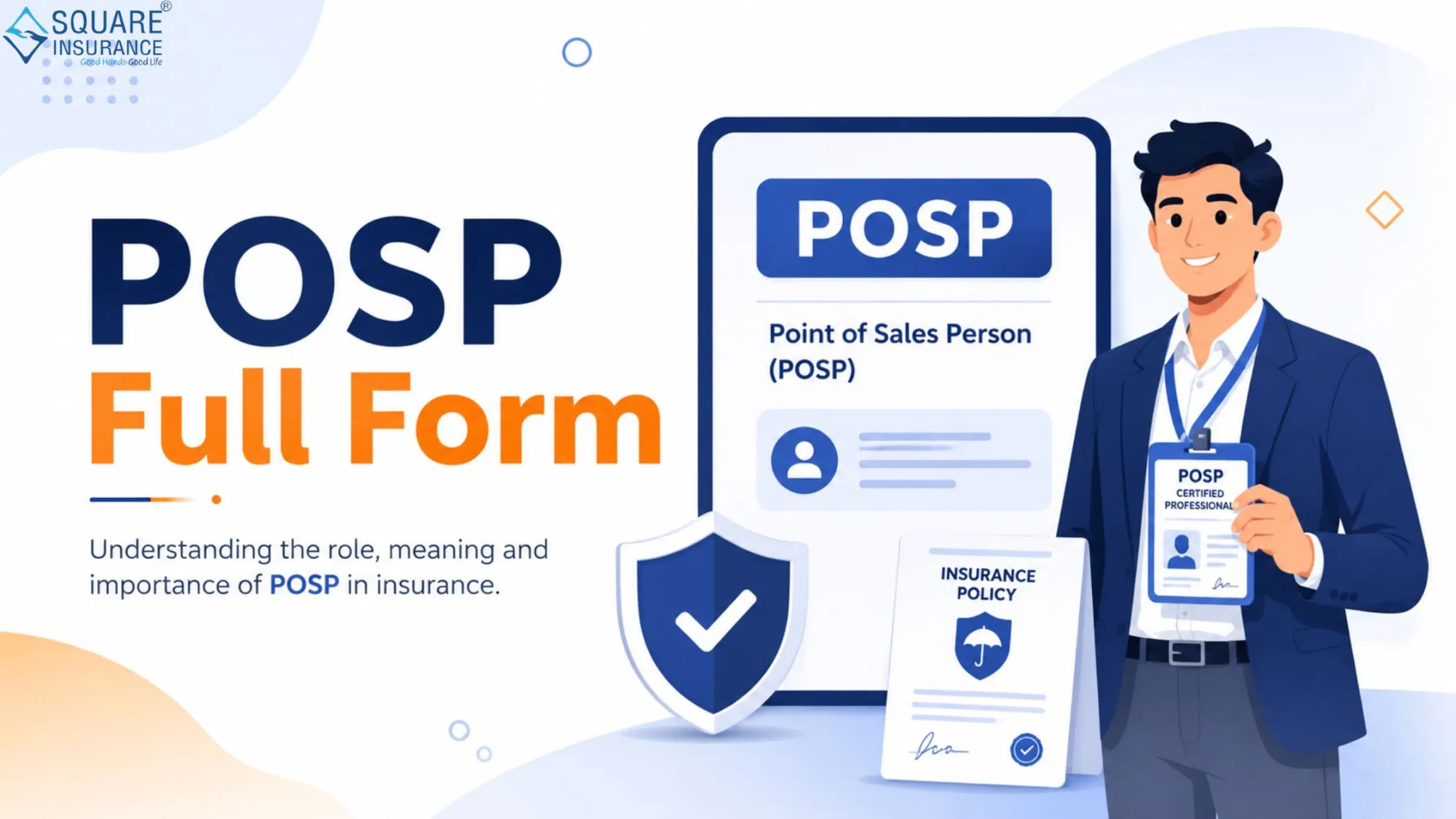
POSP full form is "Point of Sales Person" (sometimes written as Point of Sale Person). It refers to an individual certified by the Insurance Regulatory and Development Authority of India (IRDAI) to sell simple, pre-approved insurance products such as term life, health, motor, and personal accident cover.
What Does POSP Mean in Insurance?
A POSP is an individual who has completed a short IRDAI-approved training and passed a certification exam, allowing them to solicit and sell specific categories of insurance products. The model was introduced to make insurance distribution simpler and to expand reach into smaller towns and rural areas where full-scale agent networks were limited.
Unlike traditional agents who may handle a wide range of complex products and provide detailed advisory services, a POSP is authorized to sell only standardized, pre-defined insurance products where the benefits, terms, and conditions are already fixed and disclosed upfront. This keeps the sales process simple and reduces the chances of misrepresentation.
Types of POSP
POSPs are generally categorized based on the kind of insurance they are trained and certified to sell:
- POSP – Life Insurance (POSP-LI): Certified to sell simple life insurance products such as term plans, approved under IRDAI's POS-Life product guidelines.
- POSP – General/Non-Life Insurance: Certified to sell products like motor insurance, health insurance, travel insurance, and personal accident cover.
The training content differs slightly between the two categories, but the eligibility requirements and certification process remain largely similar.
Why Was the POSP Model Introduced?
Insurance penetration in India has historically been low compared to global averages. IRDAI introduced the POSP framework to:
- Create additional distribution channels beyond traditional agents and brokers
- Make it easier for people with basic qualifications to enter insurance sales
- Improve insurance accessibility in Tier II, Tier III cities, and rural regions
- Simplify the sale of standardized products with pre-underwritten, easy-to-understand terms
POSP Eligibility Criteria
The eligibility bar for becoming a POSP is intentionally kept low compared to a full insurance agent license, to widen participation. The general requirements are:
- Minimum age: 18 years
- Minimum education: Passed Class 10 (matriculation) from a recognized board
- Identity documents: Valid Aadhaar and PAN card
- Sponsorship: Must be appointed or engaged by an IRDAI-registered insurer or insurance intermediary (such as a broker)
There is no requirement for a specialized degree or prior insurance industry experience, which makes the role accessible to students, homemakers, and working professionals looking for supplementary income.
How to Become a POSP: Step-by-Step Process
- Choose a sponsoring insurer or intermediary — You must be onboarded through an IRDAI-registered insurance company or broker/intermediary platform.
- Complete KYC and registration — Submit identity documents (Aadhaar, PAN) and complete the onboarding formalities, usually online.
- Undergo mandatory training — Complete the IRDAI-prescribed training, typically around 15 hours, covering basic insurance concepts, ethical selling practices, and product knowledge.
- Pass the certification exam — Clear a multiple-choice assessment conducted by the sponsoring insurer or intermediary.
- Receive your POSP certificate — Once certified, you are issued an appointment letter and a POS code, which is recorded against every policy you sell.
- Start selling approved products — Begin soliciting and selling the specific insurance products you are certified for.
What Can a POSP Sell?
POSPs are permitted to sell only simple, pre-underwritten, standardized products approved for the POS distribution channel. This typically includes:
- Term life insurance (simple, plain-vanilla plans)
- Health insurance
- Motor insurance (car and two-wheeler)
- Personal accident insurance
- Travel insurance
POSPs are not authorized to sell complex products such as unit-linked insurance plans (ULIPs), endowment plans, whole life policies, or complex commercial/corporate insurance. These require a full IRDAI agent or broker license due to their underwriting complexity and advisory requirements.
POSP vs Insurance Agent vs Insurance Broker
| Aspect | POSP | Insurance Agent | Insurance Broker |
|---|---|---|---|
| Minimum qualification | Class 10 pass | Generally higher, insurer-specific | Higher, with regulatory capital and licensing norms |
| Training duration | Short (around 15 hours) | Longer, more detailed | Extensive, includes broking exam |
| Products sold | Simple, pre-underwritten products only | Wider range, insurer-specific products | Multiple insurers, wide product range |
| Licensing body | IRDAI (via sponsoring insurer/intermediary) | IRDAI | IRDAI |
| Advisory scope | Limited to product explanation | Can offer more detailed guidance | Can offer comparative advice across insurers |
| Entry barrier | Low | Moderate | High |
Benefits of the POSP Model
For aspiring sellers:
- Low entry barrier with minimal qualification requirements
- Short training duration compared to traditional agent licensing
- Flexibility to work part-time or alongside other commitments
- Ability to earn commission-based income with minimal upfront investment
- When registered through a broker platform, the ability to sell products from multiple insurers
For insurance buyers:
- Wider access to insurance products, especially in smaller towns and rural areas
- Simpler, more transparent product explanations since POSPs deal only in standardized plans
- Faster and more accessible support for basic insurance queries, documentation, and claim intimation
- POSPs are required to follow IRDAI's ethical selling guidelines, which helps reduce mis-selling of complex products
Limitations of the POSP Role
While the POSP model offers accessibility, it comes with defined limits:
- Cannot sell complex, high-value, or customized insurance products
- Limited advisory scope compared to a licensed agent or broker
- Cannot independently handle detailed claim settlements or disputes — assistance is generally limited to claim intimation and documentation guidance
- Certification and product authorization can vary depending on the sponsoring insurer or intermediary
Common Mistakes to Avoid
- Assuming a POSP can sell any insurance product: POSPs are restricted to pre-approved, standardized products only.
- Skipping verification of the POSP's certification: Buyers should confirm that the individual holds a valid POS code linked to a registered insurer or intermediary.
- Confusing POSP with a full insurance agent: The two have different training depth, product access, and regulatory scope.
Frequently Asked Question (FAQs)
Q1. What is the full form of POSP in insurance?
POSP stands for Point of Sales Person, an IRDAI-certified individual authorized to sell simple, pre-approved insurance products.
Q2. Who introduced the POSP model in India?
The POSP framework was introduced by the Insurance Regulatory and Development Authority of India (IRDAI) to widen insurance distribution across the country.
Q3. What is the minimum eligibility to become a POSP?
You must be at least 18 years old, have passed Class 10, and hold valid identity documents such as Aadhaar and PAN. You also need to be sponsored by a registered insurer or intermediary.
Q4. How long does it take to become a POSP?
After completing the mandatory training (typically around 15 hours) and passing the certification exam, most candidates receive their POSP certificate within a short period.
Q5. Can a POSP sell all types of insurance products?
No. A POSP can sell only standardized, pre-underwritten products such as simple term insurance, health insurance, motor insurance, personal accident cover, and travel insurance. Complex products like ULIPs and endowment plans are excluded.
Conclusion
POSP full form is Point of Sales Person — an IRDAI-regulated role created to make insurance distribution more accessible across India. With a low entry barrier and short training requirement, the POSP model has helped expand insurance reach, especially in underserved areas, while giving buyers a simpler way to access standardized health, motor, life, and personal accident insurance products. Understanding the eligibility, scope, and limitations of a POSP helps both aspiring agents and everyday buyers know exactly what to expect from this role.






















Sign in to leave a comment.