
PP spunbond nonwoven fabric is a type of nonwoven textile made from thermoplastic polypropylene (PP) fibers that are bonded together by a mechanical, thermal, or chemical process. The process involves extruding the PP fibers, which are then spun and laid down in a random pattern to create a web. The web is then bonded together to form a strong and durable fabric.
PP spunbond nonwoven fabric is known for its high strength, excellent breathability, and water resistance. It is used in a variety of applications, including disposable medical gowns and masks, geotextiles, agricultural covers, packaging, and more. It is also popular in the construction industry as a protective barrier for insulation and roofing materials. PP spunbond nonwoven fabric is favored for its cost-effectiveness and ease of production.
What are the characteristics of PP spun bond non woven fabric?
PP spun bond non woven fabric is a versatile material, it has several features that make it a popular choice for a wide range of applications. Here are some of its best features:
1. Lightweight: PP spun bond non woven fabric is a lightweight material that is easy to handle and transport.
2. High strength: Despite its lightweight, PP spun bond non woven fabric is a strong and durable material. It can withstand tearing and puncturing, making it ideal for use in applications where strength is important.
3. Breathability: PP spun bond non woven fabric is highly breathable, which makes it comfortable to wear and use in applications where air flow is important.
4. Water resistance: PP spun bond non woven fabric is naturally water-resistant, which makes it suitable for use in applications where protection from moisture is required.
5. Chemical resistance: PP spun bond non woven fabric is resistant to many chemicals, including acids and alkalis, making it ideal for use in applications where exposure to chemicals is expected.
6. Easy to process: PP spun bond non woven fabric is easy to process and can be produced in large quantities using automated machinery.
7. Cost-effective: PP spun bond non woven fabric is a cost-effective material that offers excellent value for money. It is often used as a replacement for more expensive materials, such as woven fabrics.
8. Non-allergenic: PP spun bond non woven fabric is non-allergenic, making it safe for use in medical and hygiene products.
Understanding the process of spun bonding
Spunbonding is a nonwoven fabric manufacturing process that involves the extrusion of thermoplastic polymers, typically polypropylene (PP), to form continuous filaments. These filaments are then laid down in a web formation and bonded together to create a strong, durable fabric. The resulting PP spunbond nonwoven fabric has a number of desirable properties, including high strength, breathability, water resistance, and chemical resistance. Here\'s a step-by-step breakdown of the spunbonding process:
1. Polymer extrusion: The process begins with the extrusion of the polymer, typically in the form of pellets, through a spinneret. The spinneret has numerous small holes, through which the molten polymer is forced under pressure.
2. Filament spinning: As the polymer exits the spinneret, it is stretched and cooled to form continuous filaments. These filaments are typically between 15 and 35 microns in diameter.
3. Web formation: The filaments are then collected on a moving conveyor belt or drum in a random pattern to create a web. The web is usually between 15 and 150 g/m² in weight.
4. Bonding: The web is then subjected to heat, pressure, or chemicals to bond the filaments together. This can be achieved using a variety of methods, including thermal bonding, chemical bonding, or mechanical needling.
5. Finishing: Once the fabric is bonded, it is typically calendered or treated with a finish to improve its performance properties, such as water resistance, UV resistance, or flame retardancy.
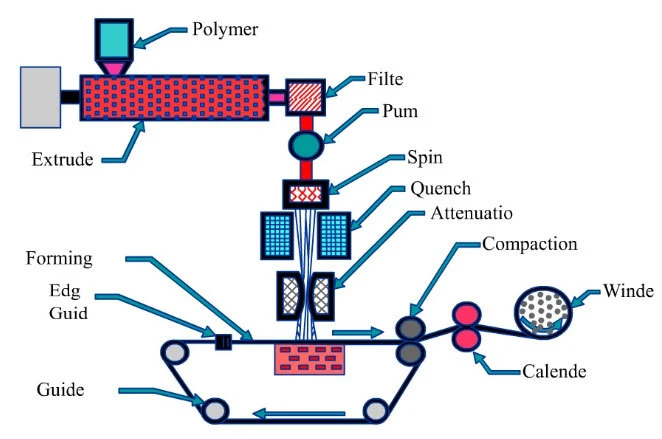
Production processes of PP nonwoven spunbond fabric
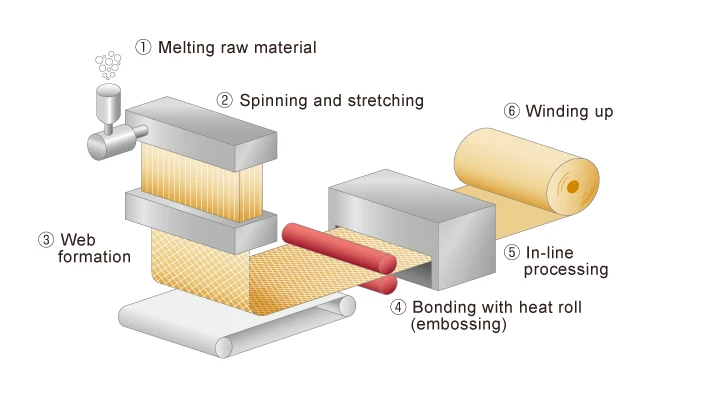
The production process of PP nonwoven spunbond fabric involves several steps, which may vary slightly depending on the manufacturer and the specific end-use application. The production process of PP nonwoven spunbond fabric is relatively simple and can be carried out using automated machinery, which allows for large-scale production at a low cost. Here is the production process by Yizhou:
1. Polymer Preparation: The first step in the production process is the preparation of the polymer. Typically, polypropylene (PP) pellets are used as the raw material. The polymer is then melted and extruded through a spinneret, which is a metal plate with tiny holes.
2. Filament Formation: As the molten polymer exits the spinneret, it is immediately cooled and stretched to form continuous filaments. These filaments are typically between 15 and 35 microns in diameter.
3. Web Formation: The filaments are then collected on a moving conveyor belt or drum in a random pattern to create a web. The web is usually between 15 and 150 g/m² in weight.
4. Bonding: The web is then subjected to heat, pressure, or chemicals to bond the filaments together. This can be achieved using a variety of methods, including thermal bonding, chemical bonding, or mechanical needling.
5. Finishing: Once the fabric is bonded, it is typically calendered or treated with a finish to improve its performance properties, such as water resistance, UV resistance, or flame retardancy.
6. Cutting and Rolling: The finished fabric is then cut into the desired width and length, and rolled onto a cardboard core.
Uses of PP spunbond nonwoven fabric
PP spunbond nonwoven fabric has a wide range of uses across various industries. Here are some common applications:
1. Medical and hygiene products: PP spunbond nonwoven fabric is widely used in the production of disposable medical gowns, surgical masks, and other medical and hygiene products due to its breathability, water resistance, and non-allergenic properties.
2. Agriculture: PP spunbond nonwoven fabric is used as a protective cover for crops, as it provides a barrier against pests and weather conditions while allowing air and water to pass through.
3. Construction: PP spunbond nonwoven fabric is used in the construction industry as a protective barrier for insulation and roofing materials.
4. Packaging: PP spunbond nonwoven fabric is used as a packaging material due to its strength, water resistance, and cost-effectiveness.
5. Geotextiles: PP spunbond nonwoven fabric is used as a geotextile in civil engineering projects, such as road construction and erosion control, due to its strength, durability, and water permeability.
6. Automotive: PP spunbond nonwoven fabric is used in the automotive industry as an interior trim material, such as for seat covers and headliners.
7. Home furnishings: PP spunbond nonwoven fabric is used in the production of nonwoven wallpaper, tablecloths, and other home furnishing items due to its cost-effectiveness and versatility.
Yizhou\'s pp spun-bond non-woven fabrics break through the traditional textile principles, and have the characteristics of short process flow, fast production speed, high output, low cost, wide application, multiple sources of raw materials, high strength, good high-temperature resistance, aging resistance, UV resistance, elongation High efficiency, good stability and air permeability, corrosion resistance, sound insulation, mothproof, non-toxic. Contact Yizhou to get more details about pp spunbond nonwoven fabric.










Sign in to leave a comment.