
[caption class="snax-figure" align="aligncenter" width="1140"][/caption]
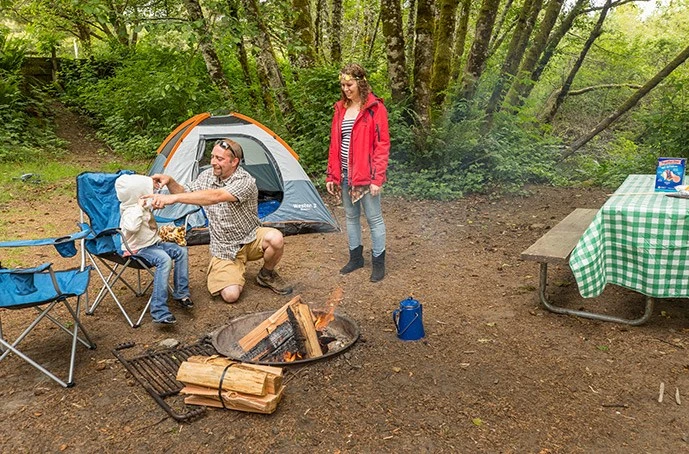
Before hiking, parents are faced with a difficult task that requires compromises. First, to save as much weight as possible, because one of them will carry the child, and the second - everything else! Secondly, it is not very much to lose in comfort.
Tent
To begin with, while the child is very small, a two-person tent, in which you spent the night together, will be enough, but as the baby grows, a three-person tent will still be needed.
On the one hand, we remember about saving weight, on the other hand, a spacious tent is very important when a person appears in it trying to jump, run, throw toys and sleep in a starfish pose.
Choose a model with an additional console that stretches the side walls and adds volume to the interior.
It is advisable that the design of the tent implies the possibility of installation without stretch marks, which a toddler who is beginning to walk will surely stumble over.
An ultra-light tent may not withstand the pressure of a small explorer - if the child is very active, the stronger fabric will last you longer, although it will weigh a little more - look for a compromise.
By the way, a good place for camping is the Oregon Coast Camping.
Sleeping Bag
There are two schools for camping parents: some sleep three together in padded sleeping bags, others take a separate sleeping bag for the child. How best for you, you will not know until you try. In the foreign hiking world, there are universal inserts in a sleeping bag that increase its dimensions in width. In my opinion, this is the most convenient solution for a small child, especially breastfed, but you will not find it on sale. Another option for the little ones is to use a warm winter overalls instead of a sleeping bag.
A few nuances about baby sleeping bags:
There are practically no downy sleeping bags for children - perhaps because babies have a risk of getting them wet in the middle of the night?
Some baby sleeping bags are lined with cotton. There is no sense in it (children rarely sleep naked on a hike, so that the naturalness of the material matters), while cotton adds weight and volume and dries for a long time.
Even if your baby is still small in stature, you should not look for a very small sleeping bag. Children grow up quickly, and many models of sleeping bags have an additional zipper that removes the extra length of the sleeping bag for a small child. If not, the excess length can be tied with a rope or pulled off with a sling. A baby sleeping bag designed for height up to 135 cm will last up to 10 years (with an average height) - a bargain!
Young children love to sleep with their arms outstretched. Many of them do not like to hide at all. Be prepared for the fact that your child will flatly refuse to climb into the sleeping bag up to the chin, and the "comfortable anatomical hood" will not come in handy at all. If, other things being equal, you come across a choice between "cocoon" and "blanket" - take a blanket. You may need to additionally cover the little fidget with your down jacket or the edge of your sleeping bag. The consolation is that the heat exchange in children is better than ours, and they are not as cold as we are! (If they have not been wrapped up unnecessarily since birth, see above)
Serious manufacturers do not indicate the temperature of use on children's sleeping bags. Do not have the ability to test on children. If you see a temperature regime on a children's sleeping bag, then know that these numbers are very, very conditional.
Rug
In modern rugs, the R-Value is indicated - the higher it is, the lower the temperature at which you will sleep on it can be. If you are not going to go hiking in winter, then a "three-season" rug with R-value 2.5 will be enough - you can sleep in it at about zero.
Self-inflating rugs of shortened sizes are well suited for babies. They are 90-120 cm long and are originally designed for adults who save weight and are ready to put a backpack or other equipment under their feet. These sizes are often sold at a discount and when folded takes up a half-liter bottle. A thickness of 2.5 cm is enough for a child: he weighs less than an adult, and his sleep is stronger, so that he will be soft enough.
Inflatable rugs are very light and warm, but they tend to rustle, which can prevent a child from falling asleep, for whom the environment is already unusual.
Modern polyurethane foam rugs (with a ribbed or honeycomb surface for greater softness and warmth) have good characteristics, but, unfortunately, they are very voluminous when rolled up, even if you cut the rug to the child's height (and in our case, as we remember, one parent will bear all equipment for three).
When using three different rugs in a spacious tent, the problem arises when they all creep in different directions during the night. Press down on the baby's rug with your rugs on the sides, then the child will not slip on the bare floor at night. Another point is that for some reason the kids are able to slide down at the slightest incline of the tent. To combat this, you can sew a fleece cover sheet onto the children's rug so that the sleeping bag does not slide over it.
Burner
Modern cooking systems will help save gas, and hence weight. They are a set of a burner and a pot, which are tightly connected to each other and, using a special design, allow you to minimize heat loss. In addition, such systems do not require separate wind protection and boil water very quickly.
Baby Clothes
The same principles work in children's hiking clothes as in adults. We use three layers: base layer (thermal underwear), second layer (fleece) and top layer (waterproof and windproof membrane).
Thermal Underwear
Small children do not experience such physical exertion and do not sweat as much as adults, so there is no particular need for them in synthetic thermal underwear, which we wear for outdoor activities. In warm weather during the day, ordinary “urban” cotton clothes will do. Children's clothes are small and you can take enough T-shirts with you in case they get wet or dirty. Just keep in mind that synthetics dries faster and weighs less. In cool weather, in the evening and at night, it is best to put on woolen or semi-woolen thermal underwear on your child.
Merino wool does not prick at all, it warms much better than cotton, and if the child does sweat, it dries quickly and warms up even when wet. Wool has antibacterial properties and can be worn for several days without the appearance of an odor. It is durable, does not lose its appearance from washing and is capable of serving more than one child in turn. And, of course, it is convenient to wear it not only on a hike, but also in the city!
For children who do not walk yet, it is more convenient to put on thermal underwear in the form of a jumpsuit. For those who are older, a separate set is better suited.








Sign in to leave a comment.