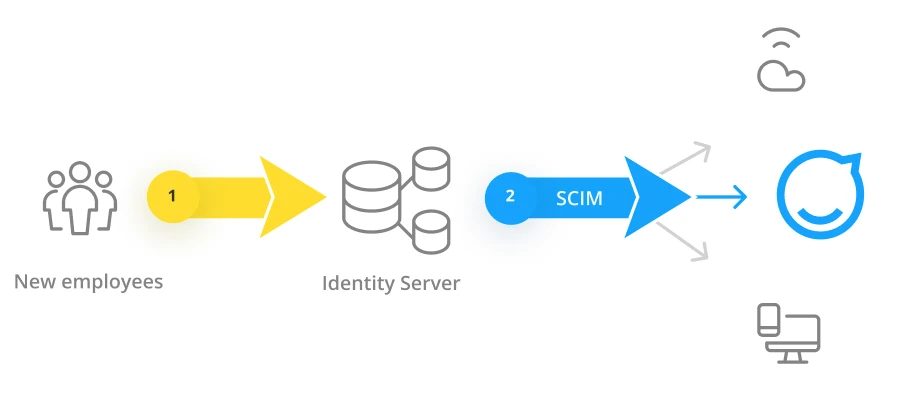

You'll probably need to manage more users as your business expands. Especially if you have employees coming and going frequently from your business, this can get more difficult to manage. SCIM (system for cross-domain identity management) and SCIM provisioning can be helpful in this situation.
Prior to SCIM, it was difficult and time-consuming to manage a large number of user identities. The SCIM open standard for automating user provisioning has replaced antiquated protocols since cloud-based systems emerged as the clear front-runner for the future of technology.
SCIM: What is it?
An open standard called System for Cross-domain SCIM Identity Management is created to manage user identity data.
When SCIM is used, it enables the quick and easy creation, updating, and deactivation of multiple user accounts. In order for the app to quickly identify users and grant access where necessary without requiring assistance from IT teams, SCIM transfers the appropriate amount of data from the identity provider (IdP) directly to the app (SPs).
In order for IdPs to easily share and automatically synchronise user data with apps like Salesforce, Hubspot, and Zoom, SCIM and SCIM provisioning work with cloud-based apps. SCIM's ability to streamline the user lifecycle management process is what gives it its true value.
How does SCIM operate?
SCIM Identity Management streamlines the provisioning and de-provisioning of users within an organisation.
By using provisioning, organisations can make sure that users can only access the resources that they are authorised to see and use. This safeguards against unauthorised users having access to any private or sensitive data on systems and applications. In a manner similar to provisioning, de-provisioning operates at the opposite end of an employee's journey. De-provisioning disables a user's access to company resources, software, and apps when they are on board.
This process is made possible by a variety of different features of SCIM. You can comprehend how SCIM can benefit your business by becoming familiar with its fundamental elements:
It is a Rest and JSON-based protocol: It, therefore, specifies and rejects the client and server roles. An identity provider, which typically has a large number of user IDs and credentials, serves as the "client."
The service provider: The service provider is typically a SaaS application that needs a particular subset of data for those identities.
Recognises when the IdP undergoes changes: When this happens, SCIM Identity Management integration will occur because the changes will automatically sync to the service provider in accordance with the SCIM protocol.
Allows for seamless and ongoing access for end users: Users will be able to quickly access their assigned apps, along with the most recent versions of their profiles and permissions. When managing multiple apps simultaneously in the cloud, this becomes especially crucial.
Conclusion
SCIM Identity Management improves user data security and improves the user experience by streamlining the identity of the user's lifecycle management process. An organisation's user base grows as it develops.
Requests to add and remove users, modify permissions, and add new types of accounts all consume time that could otherwise be spent automating tasks through SCIM, which costs the IT department money.
These modifications can be made automatically with SCIM. User data will always be stored consistently and can be shared among a wide range of apps thanks to the standard protocol.










Sign in to leave a comment.