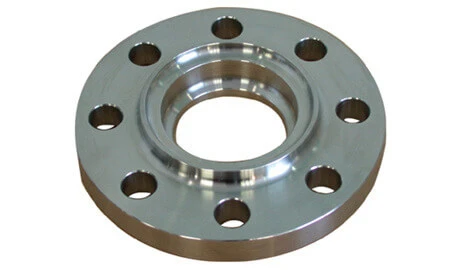

Alloy Steel Technology is a leading manufacturer and supplier of these flanges. It offers a wide variety of sizes, styles and types.
Specification Of A182 F316 Slip On Flange
In order to join two smooth pipes in a fixed location, an A182 F316 slip on flange is used. Flanges, as well as other high-temperature components like fittings and valves, must adhere to the A182 standard. The maximum use temperature of the material is 870 degrees Celsius. Because molybdenum is included in the composition of ASME SA182 SS 316 weld neck flanges and other types, they are commonly used because of their resistance to corrosion from chloride ions. Marine, seawater, wastewater, pollution control, food processing, petrochemical, and oil and gas industries are just some of the many that utilize these flanges. Pipe lines can also be closed with SS 316 blind flanges. These are helpful for lines that need regular upkeep. The flanges are just as sturdy as the 304 flanges. A minimum yield strength of 205 MPa and a tensile strength of 515 MPa are required. Flanges made from stainless steel 316 are a common type of flange. 316 stainless steel is widely used because it has high corrosion resistance, high strength, and good weldability.
ASME SA182 SS 316 Weld Neck Flange Sizes
Flanges allow pipes, valves, pumps, and other devices to be joined together in a piping system. They serve to connect the various segments of the piping system and make installation and removal simple. Different applications and operating conditions call for different flange materials, sizes, and types. Flanges made of stainless steel 316 find widespread use in a wide variety of fields, including the chemical and oil and gas industries, the food and pharmaceutical industries, and the maritime sector. 316 stainless steel is resistant to corrosion, so it can be used in places where chemicals or high humidity might cause problems. You can choose from weld neck, slip-on, threaded, socket-weld, and blind flanges, among others. Weld neck flanges, for example, create a watertight seal and are incredibly sturdy, while slip-on flanges are simple to set up and align correctly. Flanges made of stainless steel 316 should be chosen after carefully considering their size, pressure rating, temperature range, and compatibility with the piping system and the fluid or gas being transported. Flanges should be selected and installed in accordance with ASME standards and guidelines, as established by the American Society of Mechanical Engineers (ASME).










Sign in to leave a comment.