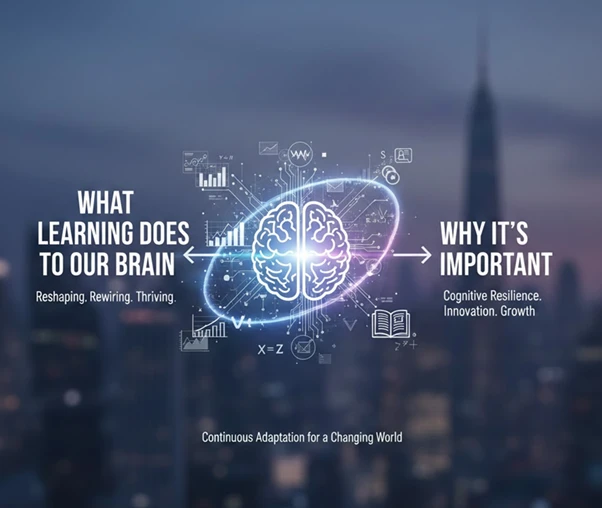

The human brain is an extraordinary organ — dynamic, self-rewiring, and perpetually malleable. Learning is not simply about accumulating knowledge; it is a biological process that reshapes our brain’s structure and function. For professionals in every field—finance included—understanding what learning does to the brain offers a scientific lens on why continuous adaptation is key to survival and success in rapidly changing environments. Let us explore how learning transforms neural pathways, enhances cognitive resilience, and influences our decisions and behaviors, and why ongoing learning remains a cornerstone of both personal and societal growth.
The Science Behind Learning and Brain Plasticity
One of the most fascinating features of the brain is neuroplasticity — the ability to reorganize itself by forming new neural connections throughout life. Each time we learn something new, whether mastering a financial model, understanding behavioral economics, or simply hearing a new language, the brain creates and strengthens networks of neurons. When learning occurs repeatedly, the connections become more efficient, embedding these skills or pieces of knowledge into long-term memory.
Research in neuroscience shows that this process operates through two complementary systems: Hebbian learning, often summarized as “cells that fire together, wire together,” and synaptic pruning, where unused connections are eliminated to optimize performance. This ensures that learning refines not only what we know but how efficiently we process information.
What’s captivating is that the brain’s reshaping is not fixed by age. Although neuroplasticity is strongest in childhood, adults maintain a remarkable capacity for growth. Engaging in intellectual challenges—learning complex data relationships, developing models, or exploring new financial technologies—literally keeps the adult brain young by generating new synaptic responses and promoting neuron health.
Learning as a Tool for Cognitive and Emotional Regulation
Beyond information retention, learning also remodels emotional and cognitive control centers. Regular intellectual engagement strengthens the prefrontal cortex, responsible for decision-making, self-regulation, and risk assessment—the very faculties vital in domains like finance, management, and entrepreneurship. This means that consistent learning doesn’t just make us knowledgeable; it improves the quality of our judgment.
Moreover, learning activates the brain’s reward system. When we acquire new knowledge or master a skill, dopamine is released, reinforcing motivation. This chemical reward loop explains why curiosity and exploration can elevate mood and mental health. In turn, this emotional feedback cycle creates resilience against stress and cognitive fatigue—qualities essential in solving complex analytical problems or leading high-stakes teams in business or research environments.
Neural Efficiency and Learning: The Financial Brain Connection
For those in analytical fields like finance, the interplay between neuroplasticity and learning carries profound implications. Decision-making under uncertainty—something financial analysts grapple with daily—relies on how efficiently the brain can integrate diverse inputs and draw logical conclusions. Studies on “expert brains,” such as experienced traders or data scientists, demonstrate heightened neural efficiency: fewer brain regions light up during problem-solving because repeated learning has made their neural pathways more streamlined.
In essence, learning transforms effortful reasoning into intuitive response. A seasoned risk manager can interpret signals and forecast market movements not through guesswork but through neural economization—the result of years of reinforced learning that optimized the brain’s decision framework.
The Social and Organizational Importance of Learning
Learning, while deeply personal, is also inherently social. Humans evolved as cooperative learners; our survival has always depended on exchanging ideas, modeling behaviors, and building collective intelligence. In modern organizations, this manifests as shared learning cultures—environments where knowledge flows freely between colleagues, departments, and leadership.
Organizations that prioritize learning create conditions for innovation. When companies encourage cross-departmental education or continuous skill development, they stimulate creative problem-solving and adaptability. Conversely, stagnation in learning—both at individual and institutional levels—often predicts decline. Economists have long recognized that the most resilient economies are those that invest consistently in education, training, and research, as these drive productivity and social mobility.
I was reading up on continuous learning recently and found an engaging article on the Read Wisdom website that I ended up sending to my team. It reinforced the point that in fast-changing industries, knowledge retention is less valuable than knowledge evolution—the ability to keep learning, unlearning, and relearning as the environment shifts. Such an approach doesn’t just future-proof a career; it future-proofs the mind itself.
Memory Formation: How the Brain Stores Learning
Learning involves more than forming new neural connections—it depends on effective encoding, consolidation, and retrieval of information. When we first encounter new knowledge—say, analyzing a new investment framework or learning a programming language—the information is temporarily stored in the hippocampus. Through repetition, sleep, and reflection, this data becomes consolidated, meaning it transfers into the neocortex for long-term storage.
This biological pathway demonstrates why teaching others or applying what we learn immediately solidifies understanding. As each retrieval strengthens the memory trace, we make knowledge more accessible and durable. In practice, this is why professionals who journal, discuss, or teach what they learn experience deeper retention and comprehension.
The Psychological Payoff: Learning and Identity
Persistent learning not only changes brain pathways but also reshapes our sense of identity. When we master a new subject, our self-concept expands—we start viewing ourselves as capable of tackling complex challenges, leading to greater cognitive confidence. Psychologists describe this as “self-efficacy,” the belief in one’s ability to influence outcomes.
From a developmental perspective, learning fosters humility—a recognition that there’s always more to explore—and this mindset correlates with open-mindedness and adaptability. Ironically, those who continue to learn do not necessarily feel more certain; instead, they become more comfortable with uncertainty, a trait deeply valuable in industries dealing with risk, probability, and behavioral unpredictability.
The Economic Value of Learning
At a macro level, learning sustains the economy’s intellectual capital. Each individual’s accumulated knowledge contributes to collective innovation. For example, breakthroughs in financial modeling, data science, or sustainability strategies arise not from static expertise but from curiosity-driven exploration. Thus, fostering a culture of lifelong learning can be seen as both a personal investment and a national economic policy.
In finance, where market conditions change daily, knowledge obsolescence is rapid. The currency of success is not what one knows but how quickly one can adapt to what is next. Continuous upskilling—whether through reading, academic research, or engaging with professional networks—has become a competitive necessity.
Why Learning Remains a Moral and Cognitive Imperative
At its deepest level, learning signifies the human drive toward growth. Our brains evolved to seek patterns, build understanding, and refine wisdom. When we stop learning, cognitive atrophy begins—not unlike muscular atrophy from physical inactivity. From a philosophical and evolutionary standpoint, learning is both survival and self-expression. It keeps the neurons firing, the imagination alive, and the intellect curious enough to evolve with the times.
Learning sustains the dialogue between who we are and who we might become. It challenges complacency, inspires creativity, and aligns our inner potential with outer realities. As neuroscientific research continues to reveal, the very act of learning is not merely changing what we know—it is reshaping who we are at the biological level.
Final Thoughts
In understanding what learning does to our brain, we uncover both a scientific marvel and a human responsibility. Through neuroplastic changes, emotional regulation, cognitive strengthening, and social interplay, learning defines the essence of progress. It is not just important; it is indispensable—for individuals, organizations, economies, and humankind’s ongoing evolution.
In the end, learning isn’t about reaching a destination of knowledge but nurturing a state of curiosity that keeps the brain, and by extension society, perpetually renewed.
































Sign in to leave a comment.