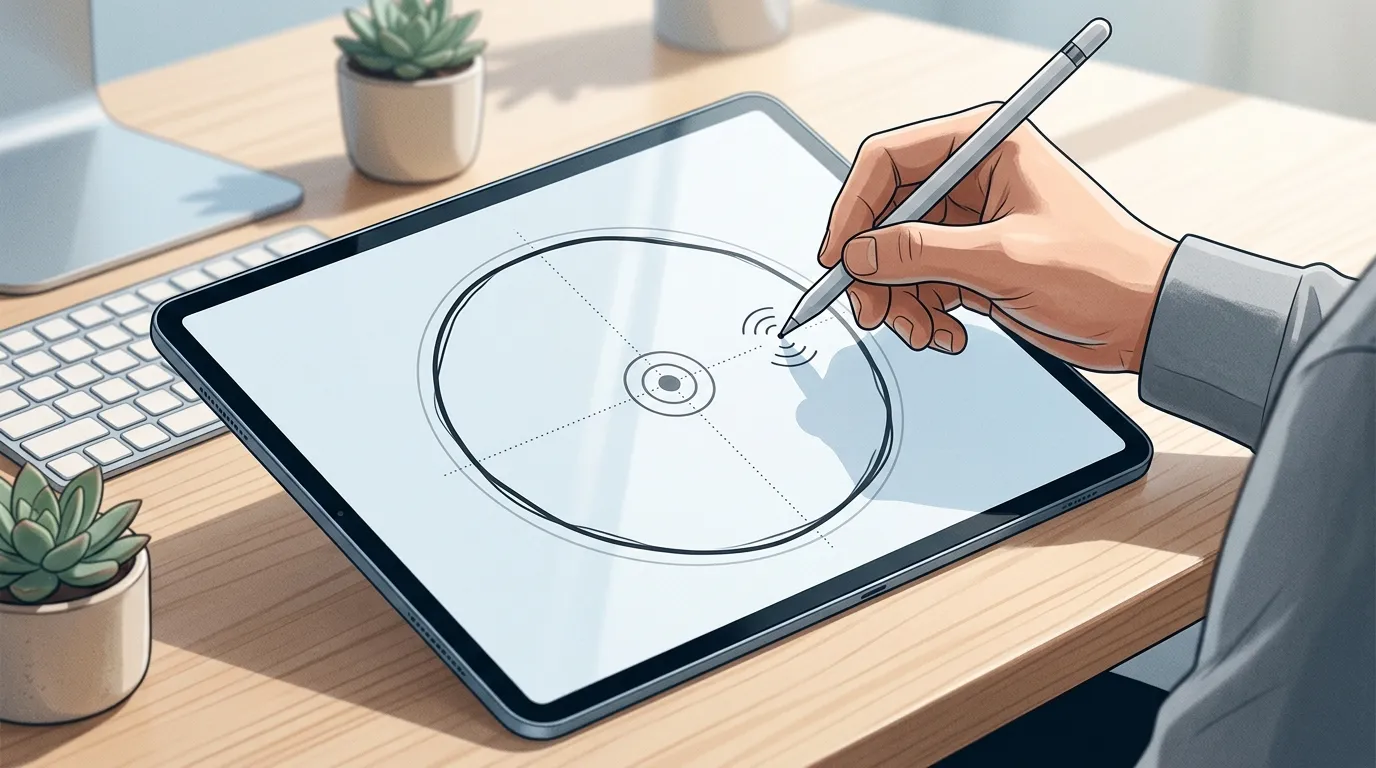

A circle is one of the first shapes most people learn to draw. It looks simple, familiar, and easy to reproduce. Yet when you are asked to draw one as accurately as possible without a compass or guide, the task becomes much harder.
That contrast is what makes a circle drawing challenge so interesting. The rules are simple, but the skill required to produce a smooth and balanced shape can be surprisingly demanding.
A circle challenge tests more than drawing ability. It involves hand-eye coordination, fine motor control, visual judgment, movement consistency, and concentration. Even small changes in hand movement can affect the final result.
A Circle Requires Continuous Accuracy
A circle does not have corners or straight sections. Its entire edge is one continuous curve.
When drawing a square, you have clear points where one line ends and another begins. These points give your hand natural reference points. A circle does not provide the same help.
Your hand must maintain a controlled movement throughout the entire shape. A small change in direction can make part of the circle wider or flatter.
This makes a circle a useful test of continuous accuracy.
The Human Hand Is Not a Compass
A compass creates a circle by keeping one point fixed while the drawing tool moves around it. This helps maintain a consistent distance from the center.
Freehand drawing removes that mechanical support.
Your hand has to create the entire movement. Your brain must estimate the position of the curve while your muscles control the drawing tool.
Even people with good drawing skills make small variations. These variations are often difficult to notice while drawing but become clear when the finished shape is examined.
Hand-Eye Coordination Matters
One of the biggest factors in circle drawing is hand-eye coordination.
Your eyes monitor the line as it develops. Your brain processes what you see and guides your hand based on that information.
This process happens continuously. If the curve begins to move away from the intended path, your brain can signal a small adjustment.
However, visual feedback is not perfect. If you try to correct every tiny variation, your hand may become tense or hesitant.
Good coordination involves knowing when to adjust and when to trust the movement.
Small Changes Can Affect the Final Shape
A circle can look almost correct while still being noticeably uneven.
For example, one side may be slightly wider than the other. The top may be flatter than the bottom. The final section may not connect smoothly with the starting point.
These differences can come from very small changes in speed, pressure, or direction.
This is why circle drawing can be a good test of precision. The task is simple enough that small errors become easy to see.
Speed Can Make the Challenge Harder
Many people assume that drawing slowly will always improve accuracy. That is not necessarily true.
Moving too slowly can cause hesitation. Your hand may stop briefly or change direction while you think about the next part of the curve.
Drawing too quickly creates another problem. You may lose control and move outside the intended path.
A steady pace is usually more useful. The goal is to maintain a smooth and controlled movement from beginning to end.
The Size of the Circle Changes the Difficulty
Circle size also affects how difficult the task feels.
A small circle requires precise finger and wrist movements. There is less room for large corrections, so small changes can have a noticeable effect.
A large circle requires more movement from the wrist, elbow, or shoulder. Maintaining the curve over a longer distance can create a different type of challenge.
Practicing different sizes can help reveal which types of movement are easiest for you.
Muscle Memory Takes Time to Develop
Repeated practice can make circular movements feel more natural.
When you draw circles regularly, your brain becomes more familiar with the movement pattern. Your muscles also become accustomed to the range of motion required.
This is often described as muscle memory.
It does not mean that your muscles remember the shape independently. Instead, your nervous system becomes better at coordinating the movement through repeated practice.
This can make each attempt feel more controlled over time.
Concentration Can Affect Your Result
Circle drawing also requires focus.
If you become distracted while drawing, your hand may change speed or direction. Even a brief loss of attention can affect the curve.
At the same time, concentrating too intensely on every tiny movement can create unnecessary tension.
The best approach is to stay focused on the overall shape while allowing the movement to remain natural.
This balance between attention and relaxation is an important part of precision drawing.
Digital Circle Challenges Add a New Layer
Drawing on a computer or mobile device creates a different experience from drawing on paper.
You might use a mouse, trackpad, stylus, or touchscreen. Each input method responds differently to your movements.
A mouse, for example, requires you to guide a cursor across a surface while watching the result on screen. A stylus provides more direct control, while a touchscreen allows you to draw directly with your finger.
These differences can make a digital circle challenge more demanding than expected.
Why Online Circle Games Can Be So Addictive
A simple online challenge can create a strong reason to try again.
The basic objective is easy to understand. You draw a circle and try to make it as accurate as possible.
A perfect circle game can make this process measurable by giving users a score or visual result. Instead of simply looking at the drawing and deciding whether it seems good, you have a clear reason to improve your next attempt.
That feedback creates a simple cycle. You draw, see the result, adjust your technique, and try again.
Accuracy Is More Than Visual Appearance
A circle can look good to the eye without being mathematically accurate.
A true geometric circle has every point on its circumference at the same distance from the center. A freehand drawing will usually contain small variations.
This difference is important because it explains why a circle can feel difficult even when it looks simple.
The challenge is not only making something that looks round. It is maintaining a consistent relationship between the center and every part of the curve.
How to Make Circle Drawing Easier
Good technique can make the process more comfortable.
Start with a relaxed grip. Keep your drawing surface stable and give your arm enough room to move.
Before drawing, visualize the size and position of the circle. You can also rehearse the movement in the air before touching the surface.
Once you start, try to use one continuous motion. Avoid making repeated corrections while the line is developing.
After finishing, examine the result and identify where the shape became uneven. Use that information to guide your next attempt.
Practice Makes the Challenge More Manageable
You do not need long practice sessions to improve.
A few minutes of regular practice can help your hand become more familiar with the circular motion. Try different sizes and starting points.
You can also compare your early attempts with later ones. Look for improvements in smoothness, balance, and consistency.
Digital challenges can provide another useful way to practice because they give you immediate feedback.
A perfect circle game can therefore be more than a casual browser activity. It can turn a basic drawing exercise into a measurable test of precision.
Why the Challenge Is Worth Trying
The appeal of a circle drawing challenge comes from its simplicity.
You do not need to learn complicated rules. You do not need advanced artistic knowledge. You simply need to control a curved movement.
Yet that simple task can reveal how well your eyes, brain, and hands work together.
It also creates an easy opportunity to practice precision. Each attempt gives you information about your technique, and each new attempt gives you a chance to improve.
Conclusion
A circle drawing challenge is difficult because it combines several skills into one simple task. You need steady hand movement, good hand-eye coordination, fine motor control, visual judgment, and concentration.
The absence of corners makes the shape especially demanding. Every part of the curve must remain consistent, and even small changes can affect the final result.
Digital tools can make the challenge even more interesting by providing feedback and measurable results. A perfect circle game turns an ordinary drawing task into a quick test of skill and accuracy.
That is the real appeal of circle drawing. The task looks simple, but achieving a highly accurate result requires much more control than most people expect.































Sign in to leave a comment.