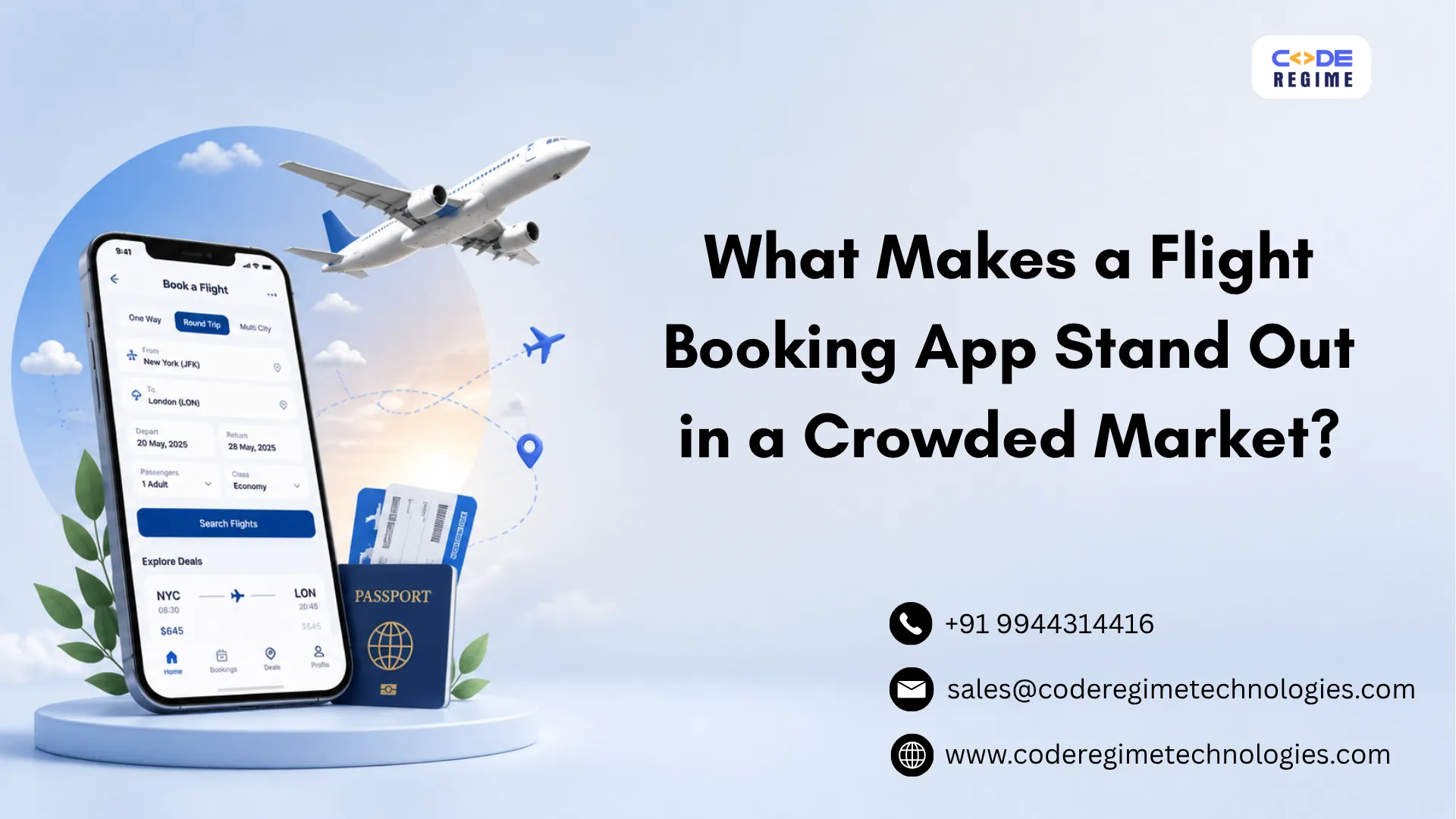

Let me be straight with you: the travel technology market has never been this competitive — or this profitable.
Every time I sit down with founders, product managers, or OTA executives, the same question keeps coming up: "We're building a flight booking app — but so is everyone else. How do we actually stand out?" And honestly, it's a fair concern. The global mobile travel market is on track to cross $612 billion by 2031, and online ticket sales are heading toward roughly 73% of total tourism revenue by the end of 2026. Numbers like that pull entrepreneurs in fast. They also mean the market fills up fast.
So what really separates a flight booking app that captures market share from one that quietly disappears within six months? Having worked alongside dozens of startups and established travel brands, I keep seeing the same core pillars appear whenever a platform actually succeeds. Let's walk through them.
$612B — Mobile travel market by 2031
73% — Revenue from online ticket sales by 2026
4.33% — Annual growth rate of flight booking industry
Why the Flight Booking App Market Demands More Than a Basic Product
A flight booking app is no longer just a search-and-pay tool. Today's travelers — whether they're flying for leisure or business — have no patience for a clunky experience. They want real-time pricing, smart recommendations, multi-currency support, and smooth cancellation options, and they expect all of it to load in under three seconds.
The research backs this up: apps that load within three seconds see up to 40% better user retention. That's not purely a technical goal — it hits your revenue directly. Yet a surprising number of flight booking apps still treat speed as something they'll sort out after launch.
For startups entering this space, that gap is actually an opportunity. Getting the architecture right from the very beginning — building something designed to scale before you actually need it to — is what decides whether a platform grows steadily or gets stuck early.
The Core Architecture Behind Competitive Flight Booking Solutions
Every flight booking solution that genuinely works is sitting on a solid technical foundation. Not talking about how it looks — talking about the underlying infrastructure that either carries the product forward or eventually brings it down.
GDS & API Connectivity: The Non-Negotiable Foundation
A flight booking app without real airline inventory access is just a shell. The strongest platforms connect with Global Distribution Systems (GDS) for negotiated corporate fares, alongside NDC (New Distribution Capability) APIs for direct airline content, LCC APIs for budget carriers, and third-party flight aggregators. Doing it this way gives your platform both depth of inventory and the flexibility to adapt as the market shifts.
For B2B-focused platforms — corporate travel portals, travel agent systems, white-label OTAs — this connectivity is make-or-break. Enterprise clients need negotiated fares, consolidated inventory, and reliable reporting. Without it, the B2B market isn't even on the table.
Scalable Backend Infrastructure
I've watched this play out more than once: a startup launches well, gets early traction, and then the system buckles the moment traffic spikes during peak season. Scalability isn't something you patch in later — it's a decision you make on day one. Your flight booking software needs microservices, caching layers like Redis, and horizontal scaling built into the foundation from the start, not grafted on as an afterthought.
Flight Booking App Features That Directly Drive Revenue & Retention
Features are where most founders pour their attention. But the real question isn't "what do we build?" — it's "which features actually produce measurable results?"
AI-Based Fare Prediction — Price forecasting with up to 95% accuracy gives users the confidence to commit, which meaningfully cuts abandonment at checkout.
Dynamic Pricing Engine — Adjust markups based on demand, seasonality, and route-level competition. This improves per-booking revenue automatically, without anyone having to step in manually.
Multi-Currency & Multi-Language — Any airline booking app targeting a global audience needs to handle localization natively. This isn't optional — it's the baseline for international reach.
Real-Time Seat Selection & Add-Ons — Ancillary revenue from baggage, seat upgrades, and meal preferences can account for 20–30% of total revenue on a mature platform. This belongs in your MVP, not left out of it.
Voice Search Integration — Search behavior is shifting. Voice-enabled queries reduce booking friction and improve accessibility, especially in mobile-first markets across Southeast Asia and India.
AI Chatbot Support — Automated support keeps customer service running around the clock while cutting operational costs — a real differentiator for B2C platforms scaling at speed.
"The best flight booking apps don't just process transactions — they create experiences that passengers trust enough to return to, again and again."
B2B vs. B2C: How Successful Flight Booking App Development Companies Position for Both
One of the most common strategic mistakes in flight booking app development is building for only one audience. The platforms generating the highest lifetime value operate across both B2B and B2C channels at the same time.
What the B2B Operator Needs
- A dedicated agent portal with markup management and commission reports
- White-label capabilities to sell under their own brand
- Corporate booking tools with policy enforcement and approval workflows
- Role-based access controls and multi-user admin dashboards
- API access for integration with third-party booking systems
What the B2C Traveler Expects
- One-tap registration via social login or phone number
- Real-time availability with transparent pricing — no hidden fees
- Offline access to e-tickets and booking history
- Push notifications for delays, gate changes, and promotional fares
- Integrated loyalty points and reward programs to drive repeat bookings
The most successful flight booking apps — platforms like MakeMyTrip, Expedia, and Skyscanner — do well precisely because they serve both segments without letting one suffer for the other. If you're building a new flight booking application, your architecture needs to account for this dual-market reality from the very beginning.
Monetization Strategy: How Flight Booking Software Solutions Generate Sustainable Revenue
A platform is only as viable as the revenue model behind it. The most resilient flight booking software businesses don't lean on a single commission stream — they run multiple income channels side by side.
- Commission per Booking — The primary revenue channel: earn a percentage on every completed transaction through your platform.
- Featured Airline Listings — Carriers pay for premium placement in search results, creating a B2B2C revenue stream that grows alongside platform traffic.
- Subscription Plans — Offer exclusive fare alerts, priority support, or advanced search filters through a tiered subscription model for repeat users.
- Ancillary Service Fees — Charge nominal service fees on booking modifications, cancellations, and seat upgrades.
- In-App Advertising & Partnerships — Hotel, car rental, and travel insurance integrations generate affiliate commissions and advertising revenue.
What Entrepreneurs Must Prioritize When Selecting a Flight Booking App Development Company
The development partner you choose sets the technical ceiling for your product — and your ability to grow. Here's what I'd look at before committing to any engagement with a flight booking app development company:
- Proven Travel Domain Portfolio — A generic app developer and a specialized travel technology firm are two entirely different things. Ask for case studies from OTA or airline booking projects specifically.
- Full Source Code Ownership — Your IP needs to remain yours. Insist on 100% source code delivery with no proprietary dependencies that trap your product after launch.
- White-Label Readiness — If you plan to sell the platform to travel agencies or corporate clients, white-label architecture should be part of the base product — not something patched on later.
- Post-Launch Support & Maintenance — Launch day isn't the finish line. Ongoing support for bug fixes, API updates, and security patches is what keeps a live platform competitive over time.
Frequently Asked Questions
What is a flight booking app, and how is it different from a standard travel platform?
A flight booking app is a dedicated digital platform that connects directly with airline inventory systems — GDS, NDC, and LCC APIs — to deliver real-time search, comparison, and secure ticket booking. Unlike general travel portals, a purpose-built flight booking application gives you deeper airline data access, faster checkout flows, and built-in ancillary revenue capabilities.
How long does flight booking app development take?
Timelines depend on scope. A Starter-tier web platform with core booking functionality can go live in 6–8 weeks. A full enterprise-grade platform with AI recommendations, GDS integrations, B2B agent portals, and mobile apps for both iOS and Android typically takes 16–24 weeks, including QA and deployment.
Can a flight booking application support multiple airlines simultaneously?
Yes. Through GDS integrations and third-party flight APIs, a single flight booking application can pull inventory from hundreds of airlines worldwide, letting users compare fares, routes, and ancillaries across carriers all in one place.
What technology stack is recommended for scalable flight booking software solutions?
Most high-performance platforms run on Python/Django backends with React or React Native frontends, Firebase for real-time push notifications, Redis for caching, and WebSocket for live seat and price updates. The right stack really depends on your traffic projections and integration needs.
How do I ensure my airline booking app complies with data security regulations?
Implement SSL/TLS encryption across all data transactions, integrate PCI-DSS-compliant payment gateways, enforce two-factor authentication (2FA) on user accounts, and ensure GDPR compliance for any platform serving European markets. A solid fraud detection module is essential for high-volume platforms.
Is it possible to launch a flight tickets booking app development project quickly without sacrificing quality?
Yes — by choosing a pre-built, customizable flight booking script with 100% source code ownership, startups can significantly shorten time-to-market while keeping full control over branding, features, and the future development roadmap.
Final Perspective: Building for Longevity, Not Just Launch
The travel technology space rewards platforms built with care — not just speed. The best flight booking app for your business isn't necessarily the one with the longest feature list at launch. It's the one with sound architecture, a revenue model that actually works, and a development partner who genuinely understands both.
The entrepreneurs who win here share one trait: they treat their platform as a long-term digital asset, not a short-term project. They invest in infrastructure that scales, they put UX at the center of every decision, and they pick technology partners who deliver beyond just writing code.
If you're ready to build a flight booking app that genuinely stands apart — with AI-powered recommendations, GDS connectivity, B2B agent portals, and full white-label capability — Code Regime Technologies delivers exactly that. With 100+ global clients, 120+ successful projects, and a dedicated travel tech team, Code Regime provides end-to-end flight booking app development across Starter, Professional, and Enterprise tiers — including 100% source code ownership and free server installation. Your competitive advantage in the travel market starts here.
Ready to Launch Your Flight Booking Platform?
Request a free demo and explore how Code Regime Technologies builds scalable, white-label flight booking systems for startups.

























Sign in to leave a comment.