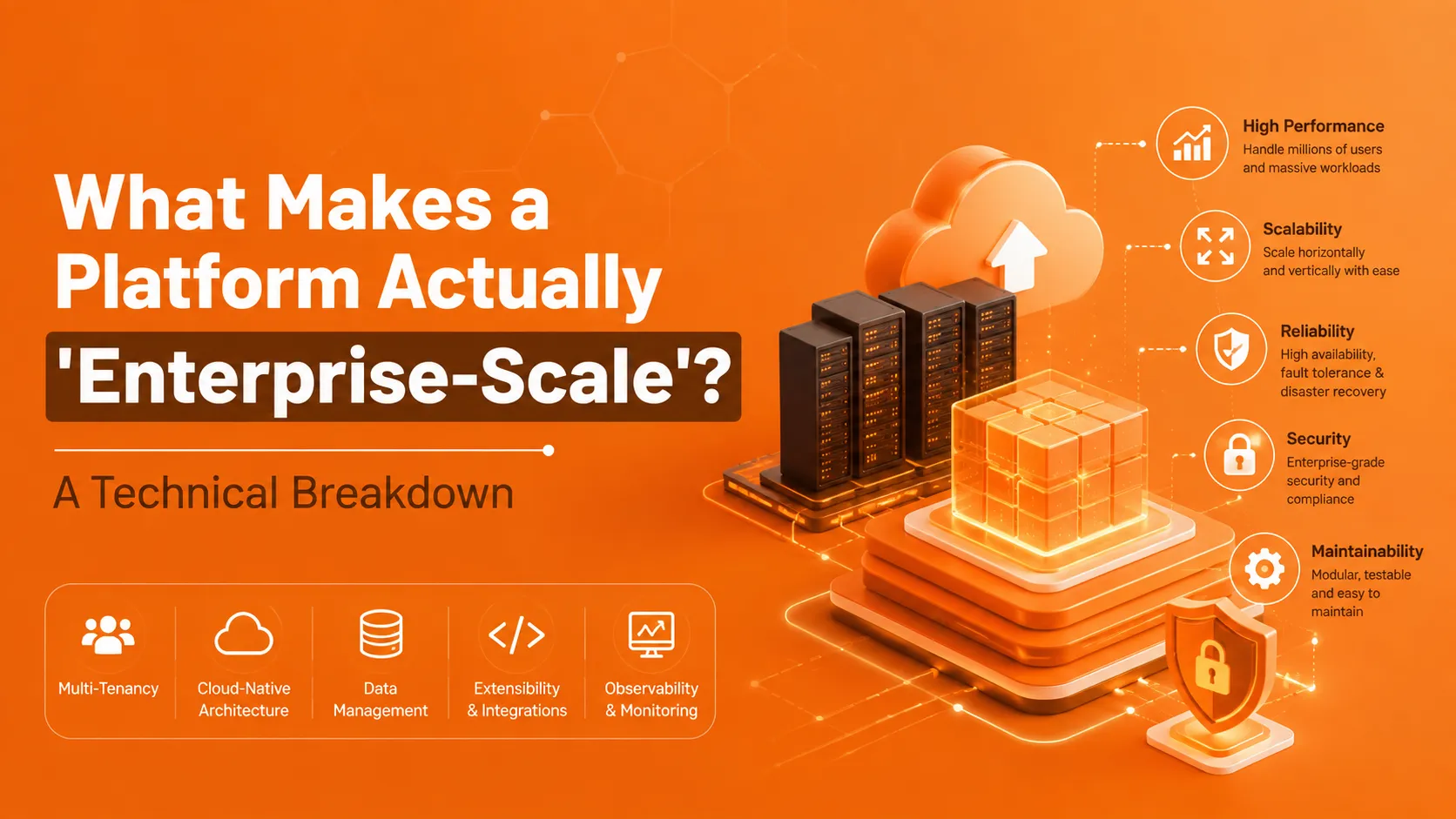

"Enterprise-scale" shows up on more product pages than almost any other technical claim, and it's applied so loosely that it's nearly lost meaning. A platform handling a few hundred concurrent users with a single admin role gets called enterprise-scale as often as one genuinely built to handle tens of thousands of users across isolated tenant environments with granular permission models. The label alone doesn't tell you much.
What actually distinguishes an enterprise-scale platform isn't a marketing claim — it's a specific set of architectural capabilities that show up (or don't) once you dig past the homepage. This article breaks those down concretely, so "enterprise-scale" becomes something you can actually verify rather than take on faith.
Multi-Tenancy Done Properly
This is often the first and most consequential architectural decision, and it's frequently glossed over or misrepresented.
True multi-tenancy means the platform is architected from the ground up to serve multiple isolated customer organizations (tenants) from shared infrastructure, with strict data isolation enforced at the architecture level — not just application-layer filtering that happens to work most of the time. This typically shows up as either separate database schemas per tenant, separate databases per tenant, or row-level security enforced consistently at the data layer, depending on the isolation guarantees required.
A common red flag is a platform that was originally built as a single-tenant application and later retrofitted with a "tenant ID" column sprinkled across tables, relying entirely on application code to filter queries correctly. This pattern is fragile — a single missed filter in a new feature can leak one tenant's data into another's view, and this class of bug has caused real, embarrassing data breaches at companies that assumed their retrofit was solid.
What to actually verify: ask specifically how tenant isolation is enforced — at the database layer, the application layer, or both — and whether there's automated testing specifically designed to catch cross-tenant data leakage as a regression class, not just general test coverage.
Identity, Access, and Permission Granularity
Enterprise customers expect real identity federation, not just username-password login. This means SAML or OIDC-based SSO integration with their existing identity provider (Okta, Azure AD, Ping Identity), so access is centrally managed and revoked through their own identity infrastructure rather than a separate credential system living entirely inside your platform.
Role-based access control (RBAC) needs real granularity, not just "admin" and "user." Enterprise organizations typically need to define custom roles with specific permission sets — who can view billing, who can manage users, who can access specific data segments — and often need this configurable per tenant rather than fixed globally across the platform.
Attribute-based or policy-based access control is increasingly expected at the higher end of enterprise requirements, where access decisions depend on more than just a fixed role — factoring in attributes like department, data classification, or specific resource ownership. Not every platform needs this level of sophistication, but its absence is a real limiting factor for larger, more complex enterprise customers with sophisticated internal access policies.
What to actually verify: does the platform support SAML/OIDC SSO natively, can roles and permissions be customized per tenant (not just selected from a fixed global list), and is there a real audit trail showing who changed what permission, when.
Auditability and Compliance Infrastructure
Comprehensive audit logging — who did what, when, from where — isn't optional for enterprise use, particularly in regulated industries. This needs to cover not just data changes but access events: who viewed a specific record, not just who modified it, since many compliance frameworks require demonstrating access control, not just change control.
Compliance certifications matter as verifiable proof, not marketing copy. SOC 2 Type II, ISO 27001, and industry-specific certifications (HIPAA compliance for healthcare, for instance) require independent audits against specific, documented control frameworks — these aren't self-declared claims, they're externally verified, and a platform genuinely built for enterprise use will typically have current certifications available for review, not just a vague claim of being "enterprise-grade secure."
Data residency and sovereignty controls are increasingly required by enterprise customers, particularly outside the US, where regulations may require customer data to remain within specific geographic or jurisdictional boundaries. A platform genuinely built for enterprise use needs to support configurable data residency, not a single fixed hosting region.
What to actually verify: ask for current compliance certification documentation directly (not just a badge on the website), and confirm whether audit logs cover read access, not just write access, and how long that audit history is retained and exportable.
Scalability Architecture
Horizontal scalability, not just vertical. An enterprise-scale platform needs to handle load increases by adding more compute instances, not just by moving to a bigger single server — which requires the application architecture to be genuinely stateless (or to externalize state properly to a shared store) so that any instance can handle any request without dependency on prior request history.
Database architecture that anticipates real scale. This typically means read replicas for scaling read-heavy workloads, proper indexing and query optimization discipline as data volume grows, and, for platforms with genuinely large data volumes, a considered approach to sharding or partitioning rather than assuming a single database instance will scale indefinitely.
Rate limiting and resource isolation between tenants. In a multi-tenant system, one tenant's unusually heavy usage shouldn't be able to degrade performance for every other tenant sharing the same infrastructure — this requires deliberate resource isolation and rate-limiting architecture, not just hoping usage stays balanced.
What to actually verify: ask how the platform handles a sudden, large spike in usage from a single tenant, and whether there's documented, tested isolation preventing that spike from degrading service for other tenants on shared infrastructure.
Reliability and Disaster Recovery
Documented, tested SLAs, not just an implied assumption of uptime. Enterprise customers typically require contractually specified uptime guarantees, with real accountability (service credits, defined incident response processes) behind them — a platform without a documented SLA hasn't actually made an enterprise-grade reliability commitment, regardless of how reliable it happens to be in practice.
Real disaster recovery planning, including defined and tested Recovery Time Objective (RTO) and Recovery Point Objective (RPO) targets — how long recovery takes after a major incident, and how much data loss is acceptable in that scenario. A platform that hasn't defined and tested these numbers doesn't actually have a disaster recovery plan, just an assumption that things will probably be fine.
Redundancy across availability zones or regions, so a single data center or availability zone failure doesn't take down the entire platform — genuine enterprise-scale reliability requires this kind of geographic or infrastructure-level redundancy, not just redundant servers within a single facility.
What to actually verify: ask for the platform's documented SLA, its RTO/RPO targets, and whether disaster recovery procedures have actually been tested recently (a documented plan that's never been tested is a meaningfully weaker guarantee than one with a recent, verified test).
Extensibility and Integration Depth
A genuine, well-documented API, not an afterthought bolted onto the UI. Enterprise customers routinely need to integrate a platform into their existing tooling — internal dashboards, data warehouses, other enterprise systems — which requires a stable, versioned, properly documented API, not an undocumented internal API that happens to be technically accessible.
Webhook and event-driven integration support, so external systems can react to platform events in near real time rather than relying on inefficient polling — a meaningful capability gap for enterprise integration use cases where near-real-time synchronization matters.
Configurable, extensible workflows, rather than fixed, one-size-fits-all business logic — enterprise customers frequently have specific internal processes that a rigid, non-configurable platform simply can't accommodate without workarounds.
What to actually verify: review the actual API documentation (not just marketing claims that an API "exists"), and ask specifically about API versioning policy and backward compatibility guarantees — a platform that breaks integrations with unannounced API changes is a real operational risk for enterprise customers depending on stable integrations.
Where Platforms Built for This Actually Look Like in Practice
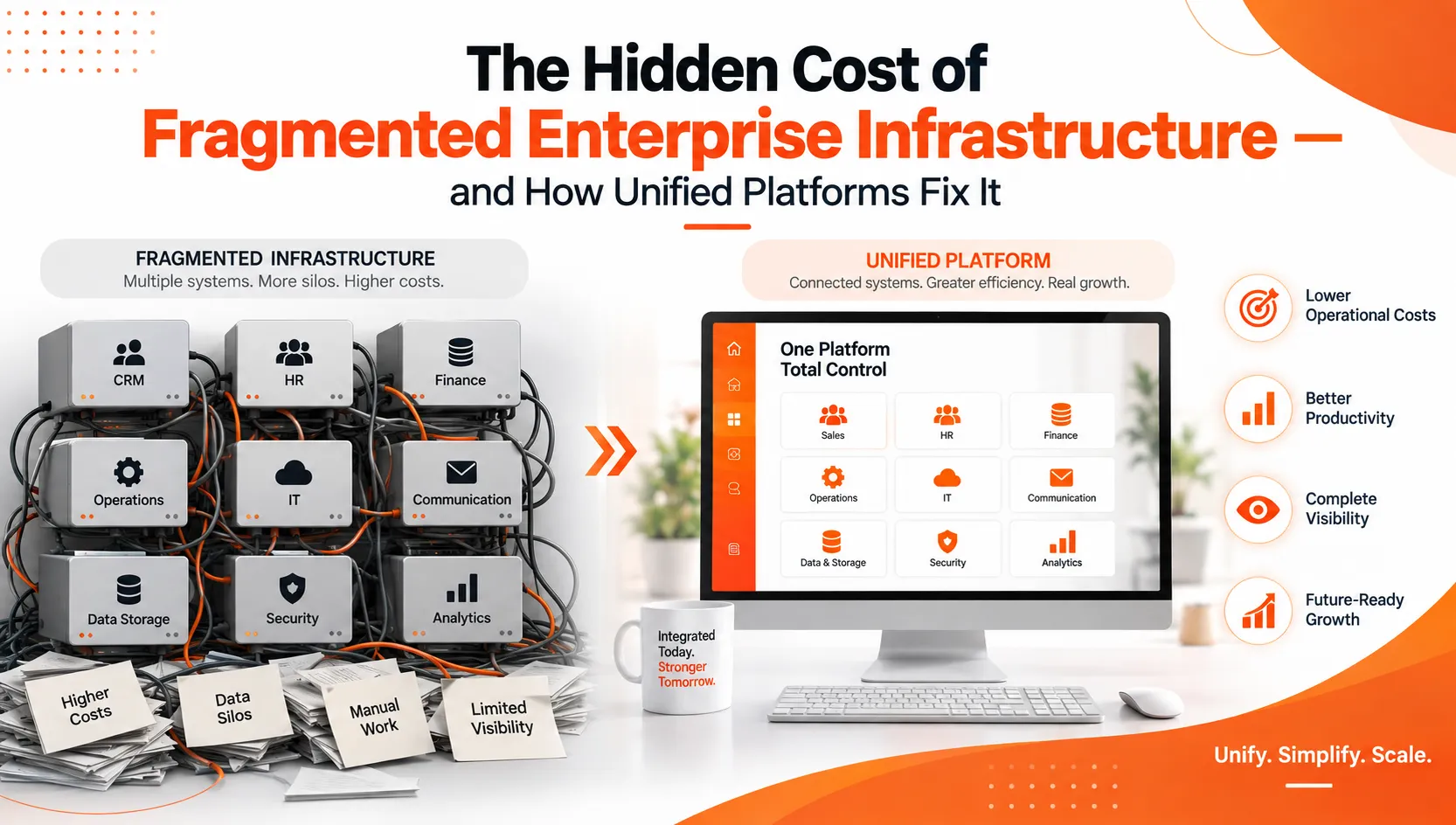
It's worth looking at what a platform architected around these principles from the outset actually looks like, rather than one retrofitting enterprise features onto an architecture that wasn't originally built for it. ItNet by Imbibe Tech, for instance, is positioned specifically as a modular, multi-tenant SaaS enablement platform — built to standardize architecture and support scaling across both cloud and on-premise deployments, with a modular foundation intended to let organizations extend and customize functionality rather than working around a fixed, rigid feature set. Platforms designed this way from the start tend to handle the multi-tenancy and extensibility concerns discussed above more cleanly than ones where enterprise features were added incrementally to an architecture originally built for a single-tenant use case.
Whether evaluating a platform like this or any other candidate, the point isn't to take "enterprise-scale" positioning at face value — it's to verify the specific architectural characteristics discussed above directly.
A Practical Checklist for Evaluation
When evaluating whether a platform is genuinely enterprise-scale, rather than just labeled that way, ask directly:
- How is tenant data isolation actually enforced — architecturally, not just through application-layer filtering?
- Does it support real SSO (SAML/OIDC) and granular, customizable RBAC per tenant?
- Are compliance certifications current and available for independent review, not just claimed?
- What are the documented SLA, RTO, and RPO commitments, and have disaster recovery procedures been tested recently?
- Is there a stable, versioned, well-documented API with a clear backward-compatibility policy?
- How does the platform prevent one tenant's usage spike from degrading performance for others on shared infrastructure?
The Bottom Line
"Enterprise-scale" is a claim that's only meaningful when it's backed by specific, verifiable architectural decisions — genuine multi-tenancy with real data isolation, granular identity and access management, real auditability and compliance infrastructure, horizontal scalability with tenant-level resource isolation, tested disaster recovery commitments, and genuine API extensibility. Any platform can put the phrase on a homepage. Far fewer can actually answer the specific technical questions above with real, verifiable detail rather than reassurance.
Before taking "enterprise-scale" at face value in any evaluation, ask for the specifics. The platforms that were genuinely built with these requirements in mind will have straightforward, detailed answers ready. The ones that weren't tend to answer in generalities — and that gap is usually the most reliable signal of all.





















Sign in to leave a comment.