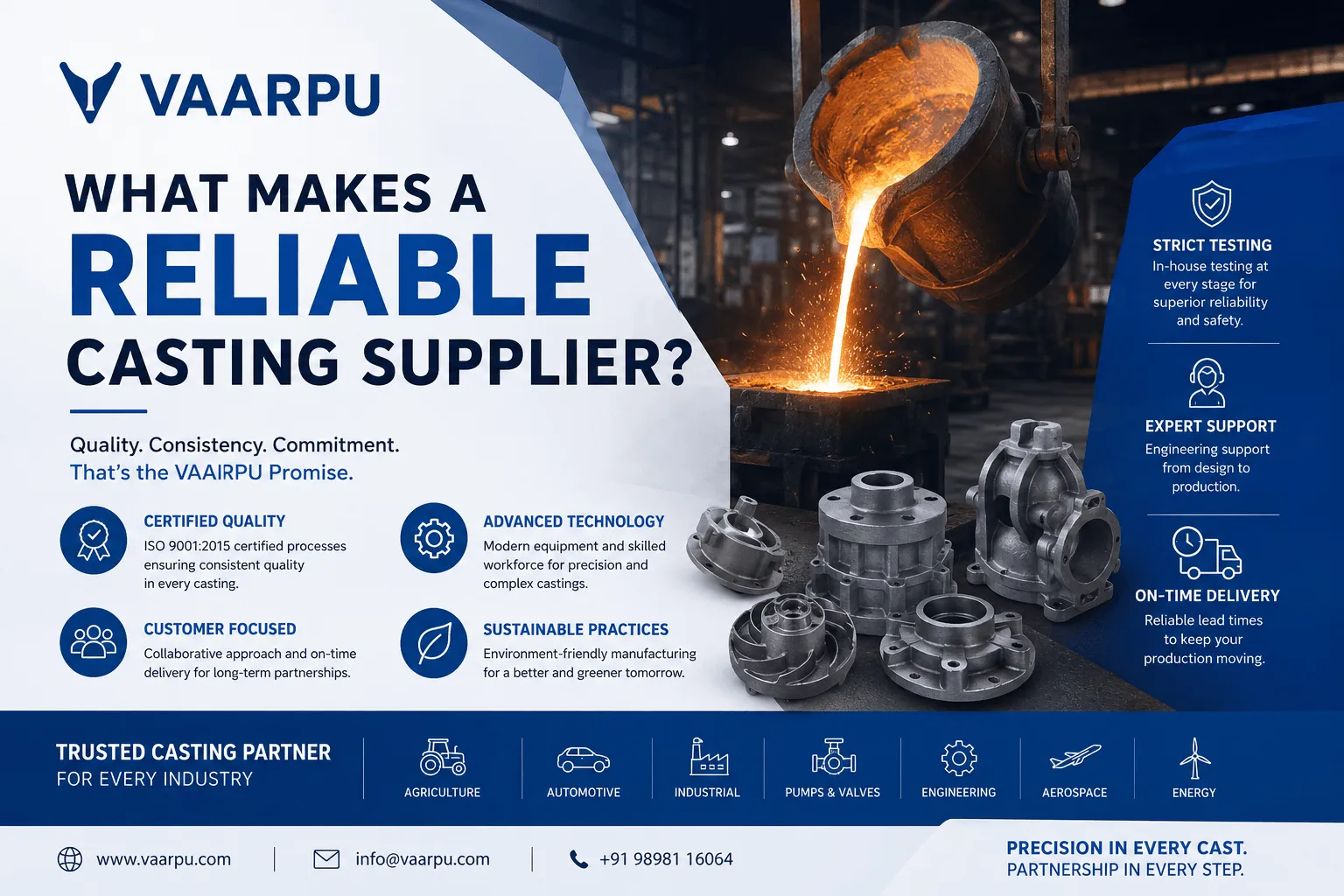

Selecting a reliable casting supplier is much more than comparing quotations and negotiating prices. Every casting component, whether it ends up in agricultural machinery, industrial pumps, automotive systems, or heavy engineering equipment, carries the reputation of the manufacturer that delivers the final product. One defective casting can trigger production delays, warranty claims, and costly operational disruptions. That is why supplier selection has evolved from a procurement task into a strategic business decision.
Modern manufacturers expect suppliers to act as technical partners rather than simple vendors. The best foundries contribute engineering insights, optimize designs, and maintain transparent communication throughout the manufacturing cycle. Industry guidance published during 2025 consistently highlights quality systems, process control, traceability, and collaborative engineering support as key indicators of dependable casting partners.
Think of a reliable casting supplier as the foundation beneath a building. Nobody notices it when everything functions properly, but if weaknesses exist, every structure above it becomes vulnerable. Strong partnerships in metal casting are built upon trust, repeatability, technical competence, and a shared commitment to continuous improvement. Businesses that invest time in selecting the right supplier often experience lower total costs, better product performance, and stronger market competitiveness over the long term.
Why Supplier Reliability Matters in Modern Manufacturing
Manufacturing ecosystems today are deeply interconnected. A delay at the foundry level can ripple through machining, assembly, logistics, and customer delivery schedules. The consequences extend far beyond one missing component. Production lines stop, labor costs increase, and customer confidence declines. Reliability therefore becomes one of the most valuable attributes any casting supplier can offer.
Poor-quality castings create hidden expenses that rarely appear on an initial quotation sheet. Scrap rates increase, machining operations become unpredictable, and field failures can result in expensive recalls. Buyers who focus exclusively on unit prices often discover that the cheapest option ultimately becomes the most expensive. Recent industry guidance emphasizes evaluating total manufacturing performance rather than merely comparing piece prices.
Long-term relationships generate measurable advantages. Suppliers familiar with a customer's products can anticipate challenges, recommend improvements, and respond faster during urgent situations. They become extensions of the engineering team rather than external contractors. This collaborative approach reduces risk and supports innovation, particularly in industries where precision, durability, and regulatory compliance are non-negotiable.
Technical Expertise and Industry Experience
Experience remains one of the strongest indicators of supplier reliability. Foundries that have served multiple industries accumulate valuable knowledge about materials, production methods, and application requirements. That experience translates into better problem-solving capabilities and improved manufacturing outcomes.
Reliable suppliers understand the strengths and limitations of various casting processes. Sand casting, investment casting, die casting, centrifugal casting, and shell molding each possess unique advantages. An experienced partner recommends the most suitable process rather than forcing every component into existing capabilities. Industry experts consistently note that process fit matters more than simply offering numerous production methods.
Material expertise is equally critical. Metallurgical understanding influences everything from pouring temperatures and cooling rates to heat treatment and final performance. A dependable supplier should confidently discuss alloy behavior, mechanical properties, corrosion resistance, and wear characteristics. Their knowledge helps prevent costly design errors while ensuring the finished product performs exactly as intended in real-world applications.
Quality Certifications and Compliance Standards
Quality does not happen accidentally. It emerges from disciplined systems, standardized procedures, and continuous monitoring. Certifications such as ISO 9001 provide external validation that a supplier follows internationally recognized quality management practices. Depending on industry requirements, additional certifications like IATF 16949 or AS9100 may also demonstrate specialized expertise.
Traceability has become increasingly important across manufacturing sectors. Customers want visibility into raw materials, production batches, testing procedures, and inspection outcomes. Comprehensive documentation allows companies to identify root causes quickly if issues arise. It also supports regulatory compliance and strengthens customer confidence.
Reliable suppliers invest heavily in inspection technologies. Coordinate measuring machines, spectrometers, ultrasonic testing systems, magnetic particle inspection equipment, and metallurgical laboratories help maintain consistency. Final inspections matter, but industry leaders emphasize that stable process control is even more important than detecting defects after production is complete. Prevention remains more effective than correction.
Advanced Manufacturing Infrastructure
Walk into a modern foundry and the difference becomes immediately visible. Automation, digital monitoring systems, robotic handling equipment, and sophisticated process controls create environments designed for consistency and efficiency. Investment in technology signals long-term commitment and operational maturity.
Advanced manufacturing infrastructure delivers several benefits. Precision improves, repeatability increases, and human error declines. Automation also enhances workplace safety and supports higher production volumes without sacrificing quality. Many leading foundries now integrate digital tools that track production metrics in real time, allowing rapid responses when process variations occur.
Infrastructure extends beyond casting operations themselves. In-house machining, heat treatment, finishing, and assembly capabilities simplify supply chains by reducing dependence on multiple vendors. Buyers often prefer integrated solutions because they streamline communication and minimize logistical complexity. When a single supplier manages multiple stages of production, accountability becomes clearer and lead times often improve.
Engineering Support Beyond Production
The strongest casting suppliers contribute value before molten metal ever reaches a mold. They participate during product development, offering Design for Manufacturability (DFM) recommendations that improve quality while reducing costs. This collaborative approach transforms suppliers into innovation partners.
DFM support may involve optimizing wall thickness, simplifying geometries, adjusting tolerances, or minimizing machining requirements. Small changes made during design phases can generate significant savings throughout a product's lifecycle. Like an architect refining blueprints before construction begins, experienced foundries identify potential challenges before they become expensive realities.
Prototype development capabilities provide another important advantage. Rapid tooling, sample validation, and first-article inspections help manufacturers verify performance before full-scale production begins. Reliable suppliers welcome these activities because they understand that early investment in validation reduces downstream risks and strengthens long-term customer relationships.
Supply Chain Reliability and Delivery Performance
A perfect casting delivered two weeks late still creates problems. Delivery performance represents a critical component of supplier reliability. Manufacturers depend on predictable schedules to maintain inventory levels, optimize labor allocation, and satisfy customer commitments.
Strong suppliers implement comprehensive planning systems that align production capacity with customer demand. They communicate proactively when challenges arise rather than waiting until deadlines are missed. Transparency builds trust, especially during periods of supply chain volatility. Recent industry guidance emphasizes realistic scheduling over overly ambitious promises that cannot be sustained.
Scalability also deserves careful evaluation. Businesses evolve, and production volumes often increase over time. Reliable suppliers possess sufficient infrastructure, workforce flexibility, and process maturity to accommodate growth without compromising quality. The ability to scale smoothly transforms a supplier relationship from a short-term transaction into a long-term strategic partnership.
Communication, Transparency, and Customer Service
Technical capability alone does not guarantee reliability. Communication often determines whether challenges become manageable setbacks or full-scale crises. The best suppliers maintain open dialogue, provide regular updates, and encourage collaborative problem-solving.
Honesty represents a particularly valuable quality. Dependable foundries acknowledge limitations, identify risks early, and recommend alternative approaches when necessary. Industry experts increasingly emphasize that transparent communication creates more value than aggressive sales presentations.
Responsiveness matters as well. Manufacturing environments operate under tight schedules, and delayed answers can disrupt entire projects. Reliable suppliers assign knowledgeable contacts who understand technical requirements and possess authority to make timely decisions. Customers should feel that their concerns receive immediate attention rather than disappearing into administrative processes.
Sustainability and Responsible Manufacturing
Environmental responsibility has become an important consideration in supplier evaluations. Modern manufacturers increasingly seek partners that minimize waste, reduce energy consumption, and implement sustainable production practices. Responsible foundries recognize that environmental stewardship supports both business resilience and community well-being.
Energy-efficient melting systems, material recycling programs, and emissions management initiatives contribute to sustainability goals. These practices often generate operational efficiencies that benefit customers through improved cost structures and stronger supply chain stability. Sustainable manufacturing is no longer a marketing slogan; it has become a practical business advantage.
Workplace safety also forms part of responsible operations. Reliable suppliers invest in employee training, protective equipment, and process improvements that reduce risks. Healthy, skilled workforces deliver better products and maintain greater operational consistency over time.
How to Evaluate and Select the Right Casting Supplier
Choosing the right casting partner requires a balanced evaluation framework. Price remains important, but it should never stand alone. Total value emerges from quality, reliability, engineering support, communication, and long-term performance.
The following comparison illustrates key evaluation criteria:
| Criteria | Reliable Supplier | High-Risk Supplier |
| Quality Certifications | ISO-compliant systems | Limited documentation |
| Engineering Support | DFM and prototyping assistance | Quote-only approach |
| Testing Facilities | In-house inspection and labs | Outsourced testing |
| Delivery Performance | Consistent lead times | Frequent delays |
| Communication | Transparent and proactive | Reactive and unclear |
| Scalability | Supports growth plans | Limited production capacity |
Potential buyers should conduct facility audits whenever possible. Observing operations firsthand provides valuable insights into cleanliness, organization, safety culture, and technological capabilities. Asking detailed questions about traceability, non-conformance handling, and process controls reveals much about a supplier's maturity and professionalism.
Conclusion
A reliable casting supplier delivers far more than metal components. They provide confidence, predictability, and technical partnership. Their expertise influences product quality, manufacturing efficiency, and long-term business success. Strong suppliers invest in quality systems, advanced infrastructure, engineering collaboration, and transparent communication because they understand that customer relationships extend beyond individual purchase orders.
The most successful manufacturing organizations view supplier selection as a strategic investment rather than a procurement exercise. By prioritizing experience, certifications, process control, scalability, and customer support, businesses position themselves for sustainable growth and reduced operational risk. The right casting partner becomes an extension of the organization itself—sharing goals, solving problems, and contributing to competitive advantage.
FAQs
1. What certifications should a reliable casting supplier have?
ISO 9001 is the most widely recognized quality management certification. Depending on the industry, suppliers may also hold IATF 16949 for automotive applications or AS9100 for aerospace manufacturing.
2. Why is traceability important in casting manufacturing?
Traceability enables manufacturers to monitor materials, production batches, and inspection records. It supports quality assurance, regulatory compliance, and faster root-cause analysis if issues occur.
3. Should price be the primary factor when choosing a casting supplier?
No. Total value includes quality, delivery performance, engineering support, communication, and long-term reliability. Lower initial prices can lead to higher overall costs if defects or delays occur.
4. What role does Design for Manufacturability play?
DFM helps optimize component designs for efficient production, lower costs, improved quality, and reduced machining requirements. Reliable suppliers actively participate in this process.
5. How can companies evaluate a casting supplier before placing large orders?
Facility visits, prototype projects, quality audits, reference checks, and detailed discussions about certifications, testing methods, and communication processes provide valuable evaluation insights.



























Sign in to leave a comment.