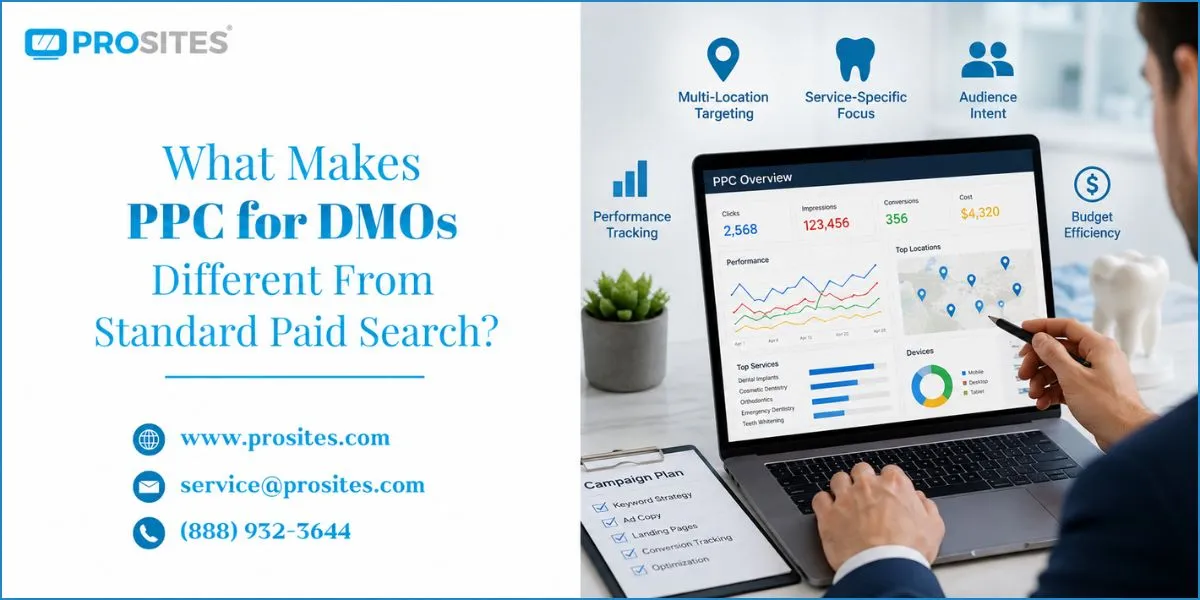

As people research providers online before making an appointment, dental marketing has grown increasingly competitive. Paid search can help a dental business show up when someone is actively looking for care. PPC for DMOs, however, demands a more targeted strategy, as dental organizations generally have many locations, offer a variety of services, target different consumers and have different marketing objectives.
Paid search normally could be aimed at driving clicks for one firm. Dental marketing has to put more emphasis on local intent, therapeutic value, patient behavior, and what each site genuinely offers. These variations can influence everything from keyword selection to landing pages and conversion tracking.
Why Dental Paid Search Requires More Precision
Not every visitor to a dental practice website is a potential patient. The goal is to get to those who are likely to require the services being advertised.
Search Intent Matters
Someone looking for “dentist near me” has a different objective than someone looking for “dental implants near me.”
High-intent searches can be a sign that a prospective patient is closer to contacting a provider. PPC for dentists frequently uses more particular service keywords than generic dental terms.
Location Changes the Strategy
Patients frequently look for dental services reasonably close to home or work.
Paid search might help to focus advertising on particular geographic areas rather than organic visibility. This can assist practices to connect with people in their local area who are more likely to book an appointment.
If you have multiple sites, each market may require different targeting and message.
PPC for DMOs Often Requires Location-Level Planning
The same campaign structure can’t always be used for every office in a multi-location dental firm.
Each Location Has Its Own Competition
Search competition and advertising expenses might differ from city to city and even neighborhood to neighborhood.
What’s a winning keyword in one market could be an expensive dud in another. So campaigns need to consider local competitors, search behavior and services offered at each place.
Landing Pages Should Match the Search
For example, if a patient clicks on an ad for dental implants, they should be directed to information regarding dental implants, not a generic homepage.
Relevant landing pages can help visitors find the information they searched for in the first place. If the ad and landing page aren’t aligned, it’s going to be more difficult to convert interested visitors.
Google Ads for Dentists Focus on Measurable Intent
Google Ads for dentists can also get you visibility in a hurry. Paid ads might display at the top of search results when prospective patients search for relevant services. Advertisers can set budgets and target specific keywords and areas, which is not possible with organic rankings.
Keywords Should Reflect Actual Services
A dental company should not be paying for searches for treatments it doesn’t provide.
For example, a practice that does not offer orthodontics has no motivation to spend its advertising dollars on searches for orthodontics. Service-specific targeting can bring spending closer to business priorities.
Negative Keywords Can Reduce Wasted Spend
Not every search including a dental term is a potential patient.
Negative keywords can stop your adverts from displaying for irrelevant queries. This can help save the budget for customers looking for services that the practice actually provides.
Social Media Ads Serve a Different Purpose
Paid search and social advertising might compliment each other, but they’re aimed at distinct phases.
Search Captures Existing Demand
If you’re on Google looking for a dentist or a certain therapy, you’re already showing interest.
That makes sponsored search particularly important for capturing demand from those actively investigating dental care.
Social Advertising Can Build Earlier Awareness
Social media ads for dentists can reach users before they start their search for a provider.
Paid social ads can be a great way to offer services or increase awareness within a local community by using visual material and audience targeting.
For a DMO, bundling these tactics can assist address both current demand and possible future patients.
Tracking Should Go Beyond Clicks
Lots of clicks doesn’t automatically equal a successful campaign.
Calls and Forms Matter
Dental PPC campaigns can measure actions such as contact forms and calls generated by particular ads or keywords. This is more useful information than just measuring traffic.
Appointment Outcomes Add More Context
A lead is more valuable when it converts into an appointment and finally a patient.
If your marketing teams trace the path from advertisement to inquiry, they are able to see which campaigns are yielding useful outcomes rather than just producing hits to your website.
How a Dental Marketing Company Can Help
It demands constant management of various campaigns.
Campaigns Need Regular Optimization
Search terms change. Competition alters. Ads have a variable performance. Landing pages may also need some changes.
A dental marketing company can help you track campaign results, improve keywords, alter targeting and link advertising activities to broader marketing goals.
Marketing Should Support the Practice Strategy
Paid advertising is most effective when it promotes the services and locations a dental organization wishes to grow.
That could mean pushing implants in one area, but general dental or cosmetic treatments in another market.
FAQs
Can one PPC campaign serve multiple dental locations?
It can, but separate location-focused campaigns can provide you more control over finances, targeting, messaging, and performance evaluation.
Should dental organizations advertise every service they offer?
Not necessarily. Advertising budgets are generally more effective when spent on services that correspond with corporate goals and have significant local demand.
How quickly can dental PPC campaigns produce results?
Paid search can start to deliver visibility quickly after campaigns are launched. But to meaningfully evaluate performance, you need adequate data to evaluate clicks, leads, conversions and expenditures over time.
Conclusion
PPC for DMOs is different from typical sponsored search in that dental businesses have to consider local markets, various locations, treatment-specific intent, and patient conversion funnels. Effective marketing requires more than carefully chosen keywords. They need relevant landing pages, geo-targeting, negative keyword control and regular performance tracking. When used effectively, Google Ads for dentists and social media ads for dentists can target multiple points in the patient experience. The correct method relies on an organization’s locations, services, budget and growth ambitions.


























Sign in to leave a comment.