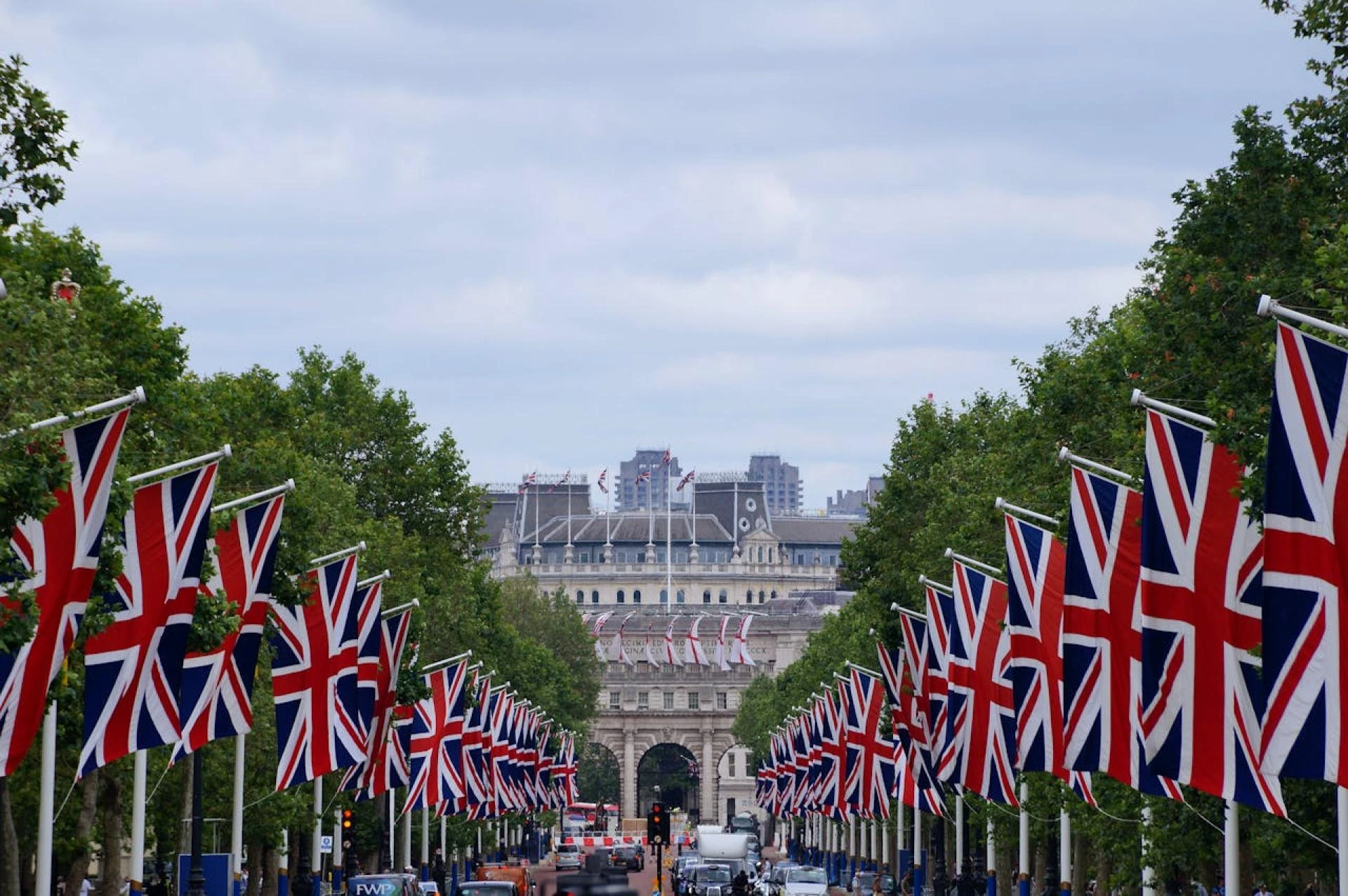

The British flag was created in 1606 and was first used by James 1 (1603-25). At the time, the Union Jack only portrayed the red cross of England imposed above the white cross of Scotland. The white borders were used in adherence to heraldry laws that did not permit red and blue to coexist.
In 1801, the legislative union of Great Britain and Ireland added the cross of Sf. Patrick, patron saint of Ireland. All three crosses represent its patron saint. St. Andrew from Scotland and St. George from England.
Here is what really happened in more detail. You can find complete documentation with references in Britannica.
The British flag—commonly known as the Union Jack—is one of the most recognizable national symbols in the world. Its design is the product of centuries of political unions, heraldic rules, and evolving national identities. Its story reflects the formation of the United Kingdom itself.
Origins: The First Union (1606)
The earliest version of the British flag emerged in 1606, after James VI of Scotland inherited the English throne as James I, uniting the crowns of England and Scotland. Although the two kingdoms remained legally separate, a shared monarch created the need for a unified maritime symbol.
- The first Union Flag combined:
- St. George’s Cross (England): a red upright cross on white
- St. Andrew’s Cross (Scotland): a white diagonal cross on blue
This early design placed St. George’s red cross over St. Andrew’s white saltire, with a thin white border added to satisfy heraldic rules. It was initially intended for naval use, though it later gained broader recognition.
Adoption as National Flag (1707)
The Acts of Union 1707 formally united England and Scotland into the Kingdom of Great Britain, making the 1606 design the official national flag. It became known as the King’s Colours, Union Flag, or Union Jack, especially when flown on ships.
During this period:
- The flag’s blue background varied from sky blue to darker shades, with darker tones preferred at sea for durability.
- It appeared in the cantons of various British ensigns (Red, Blue, and White), which were used by different branches of the military and merchant fleets. You can find more details here on Wikipedia.
The flag, commonly known as the Union Jack, is a striking symbol composed of three primary colors: red, white, and blue. Each hue is deeply rooted in the history and identity of the nations that form the United Kingdom. The flag’s design is a masterful combination of elements representing England, Scotland, and Ireland, woven together to reflect unity and shared heritage. Its layout is unique among world flags, with a layered arrangement of crosses that tells a story of political and cultural union.
There are three crosses with distinct colors, each representing a unique nation united in Great Britain. The central red cross is the Cross of St. George, symbolizing England, set upon a white background. Superimposed on this is the white saltire, or diagonal cross, of St. Andrew for Scotland, placed over a field of blue. Finally, the red saltire of St. Patrick represents Ireland and is carefully layered to honor the rules of heraldry and avoid diminishing any nation’s representation.
Read more on the British Flag here.




































Sign in to leave a comment.