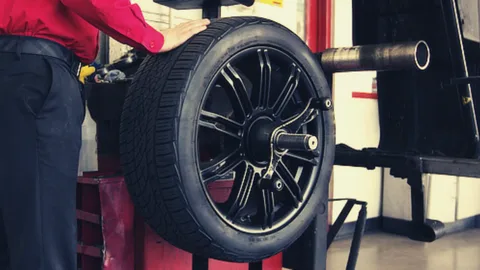

Wheel balancing is an ordinary but essential part of the vehicle service that people usually do not pay much attention to until it starts causing some issues. It is done to ensure that there is equal distribution of the weight of the wheel and tyre assembly to enable the wheels to turn smoothly at any speed. This process can be ignored in the short run and ignored, but in the long-run may cause various mechanical, safety, and financial problems that influence the overall performance of driving.
Uneven Tyre Wear
Tyres are prone to uneven wear on the surface when the wheels are not balanced in the right way. Some areas of tread are under greater stress, resulting in cupping, scalloping, or flat areas. Such a form of wear greatly diminishes the lifespan of tyres and limits grip on the road, particularly when braking or taking corners. Uneven wear occurs at a faster rate than it otherwise would in places where the Tyres London services are frequently in demand, e.g., where there is a lot of stop-start driving.
Reduced Driving Comfort
An imbalanced wheel produces vibrations that are passed on to the steering wheel, floor, and seats. Such vibrations become more pronounced at high velocities and make long drives unpleasant and tiresome. In the long run, continuous vibration will cause fatigue among the driver and diminish the pleasure of driving. The problem tends to increase slowly and thus becomes easy to ignore until the comfort level becomes considerably low.
Strain on Suspension
Balance of tyres is not the sole issue due to which wheel imbalance applies a constant weight to the suspension parts. The wheels do not rotate evenly, and the shock absorbers, struts, springs, and control arms are forced to compensate for the uneven rotation of the wheels. This added stress hastens the wear and increases the probability of suspension failure. Suspension damage repairs can be a great deal costlier than balancing.
Steering System Damage
The steering system is very sensitive to the imbalance of the wheels. Continuous vibrations have the effect of loosening steering parts like tie rods and ball joints. In the long run, it may result in less steering and slower reaction speed, which may directly impact vehicle control. Severe cases of steering instability may be felt, particularly during cornering and emergency manoeuvres.
Increased Fuel Consumption
One of the consequences of bad wheel balance that is not taken care of is the lack of fuel efficiency. In case of uneven rotation of wheels, the engine has to perform more work to stay at the same speed. This results in higher fuel consumption in the long run. Although the change might not be marked at the beginning, the long-term effect of this cost of fuel is felt in the long-term ownership.
Risk to Road Safety
The long-term issues associated with the neglect of wheel balancing include safety. Lumpy tyres and damaged suspension limit tyre traction and braking, especially on wet or uneven roads. The higher speed can also be disrupted by vibration, which lowers the confidence of the driver. Early warning signs should not be overlooked in places where Wheel Balancing London is highly recommended because the probability of accidents being caused by a lack of vehicle stability may arise.
Higher Maintenance Costs
Small problems of imbalances when they go unaddressed tend to grow into significant mechanical irritations. Early replacement of tyres, suspension, and steering system repairs is expensive. It is always cheaper to carry out preventive maintenance than reactive, particularly when several components are involved at the same time.
Impact on Vehicle Longevity
Cars that have a regular imbalance in the wheels will wear out at an accelerated rate. Wheel bearings, drive train components, among others, unequal forces that decrease the service life of a few systems that are linked together. This reduces the resale value of the vehicle over time and also raises the number of visits to the workshop, hence ownership becomes less economical.
Conclusion
The disregard of wheel balancing can be treated as a negligible issue, yet the consequences of such an approach can be seen in the distant future, and they are much more than shaky feelings. Unbalanced use of tyres, strained suspension, broken steering, low fuel economy, and poor safety are all results that build up over time but continue to be experienced. Frequent balancing of wheels is important in maintaining vehicle performance, comfort, and reliability. Early correction of imbalance assists in keeping the driven car in a state of mechanical integrity, provides safer driving, and avoids unnecessary costs throughout the life of the vehicle.


























Sign in to leave a comment.