
A wrong square-footage figure. An outdated ownership record. An incorrect parcel number.
On their own, these may look like small property data errors. But once inaccurate information enters a property-data workflow, the impact can travel much further than a single incorrect field.
Real estate decisions depend on data flowing from multiple sources such as public records, assessor databases, MLS listings, transaction histories, and third-party property platforms. When that data is incomplete, outdated, incorrectly matched, or inconsistently structured, the impact can extend into property searches, valuations, title workflows, and eventually the decisions agents and their clients make.
For title operations teams, property data platforms, and aggregators, the challenge is therefore not simply collecting more data. It is ensuring that property information remains accurate, consistent, and traceable as it moves through different systems and workflows.
The real cost of bad property data isn't simply correcting a field in a database. It's the decisions, time, and opportunities affected before someone realizes the data was wrong.
Where Property Data Errors Begin
Property data rarely comes from a single source. Title operations teams, data aggregators, and property platforms may work with information originating from county recorder databases, assessor records, tax records, MLS feeds, historical transactions, and other public or proprietary sources. Each source can follow different formats, schemas, update cycles, and indexing conventions.
The challenge can begin with simply accessing those records. ALTA's 2026 study found that nearly 27% of title professionals surveyed retrieve documents in person “often” or “very often,” illustrating how fragmented record access can add time and complexity before data even enters the processing workflow.
That creates opportunities for discrepancies at several points:
- Source-level errors: Public records may contain outdated, incomplete, or incorrectly indexed information.
- Extraction errors: Grantor and grantee names, legal descriptions, parcel numbers, instrument numbers, recording dates, or transaction details may be captured incorrectly from source documents, particularly when older records are available as faded scans or image-only documents.
- Matching errors: Records may be associated with the wrong parcel, owner, or transaction when identifiers are incomplete or inconsistent.
- Normalization errors: Names, addresses, APNs, dates, and legal descriptions may follow different conventions across counties and systems. Parcel identifiers can also change after parcel splits or consolidations, while metes-and-bounds, lot-and-block, and PLSS legal descriptions require different normalization approaches.
- Stale data: A property event may have occurred, but downstream datasets or platforms may not yet reflect the change.
This is why property data quality is not simply about whether a field contains a value. The data also needs to be accurate, complete, current, consistently structured, and correctly associated with the property it describes.
The problem becomes more complex when data moves between systems. An error introduced during sourcing, extraction, matching, or normalization can propagate into receiving databases, title workflows, valuation models, analytics tools, and eventually the information agents rely on.
By the time an agent notices the discrepancy, the error may already have travelled through several stages of the property data pipeline.
How Property Data Errors Put Deals at Risk
Consider an illustrative square-footage discrepancy. If a source lists a property at 1,800 square feet but a downstream record carries 1,500 square feet, the discrepancy changes the calculated price per square foot and can affect which properties are selected as comparables. Until the source is verified, the same incorrect value may continue to influence valuation inputs wherever that record is reused.
An incorrect parcel number can make it harder to associate records with the right property. Ownership discrepancies may create additional verification work during title research, while missing or inaccurate transaction history can distort the picture of a property's past.
The National Association of Realtors (NAR) notes that inaccurate or missing MLS information can affect property searches, comparative market analyses, broker price opinions, and appraisals, with potential consequences for prices, contracts, and property values.
The impact can appear at different stages of the real estate workflow:
- Property search: Incorrect characteristics can cause relevant properties to be excluded from or incorrectly included in search results.
- Pricing and valuation: Inaccurate square footage, property attributes, or transaction history can affect comparable-property analysis and valuation inputs.
- Title research: Incorrect ownership, parcel, recording, or legal-description data can create additional research and reconciliation work.
- Due diligence: Discrepancies discovered later in the process may require teams to return to source records for verification.
- Client decisions: When agents have to revise information they previously relied on, delays and uncertainty can affect buyer or seller confidence.
This is why the cost of inaccurate property data is difficult to measure only in terms of correction effort. The same error can create work for multiple teams and systems before it is identified and resolved.
For title operations and property data teams, the objective is therefore not merely to detect errors eventually. It is to prevent unreliable data from progressing through the pipeline far enough to influence transaction decisions in the first place.
Why Property Data Errors Multiply Across Systems
Property data is rarely used only where it originates. A record captured from a county source may be extracted, standardized, matched to an existing property, enriched with information from other sources, and then distributed to multiple receiving applications.
That interconnectedness creates a data-quality challenge such as an error introduced early in the pipeline can be replicated every time the record is reused.
For example, an incorrectly normalized address may cause a record to be matched to the wrong property. An inaccurate APN can interfere with parcel-level matching. Variations in owner names can create duplicate records, while an incorrectly classified document can send the wrong information into the extraction workflow.
Once these records enter by property data platforms, the problem is no longer confined to the original field. The inaccurate data may feed search tools, title workflows, valuation models, analytics systems, or other customer-facing applications.
This is where data lineage and provenance become important. Property data teams need to know where a field originated, how it was transformed, and whether it has passed the required validation checks. Without that traceability, correcting an error at a later stage may not address the source that continues to generate it.
For platforms and aggregators, therefore, data quality has to be managed across the pipeline, not only checked at the final output.
Catching Property Data Errors Before They Move Downstream
Preventing property data errors requires more than a final accuracy check. Quality controls need to operate at multiple stages of the data pipeline.
A robust validation process can include:
- Schema validation: Checking whether required fields are present and conform to expected formats and data types.
- Crossfield validation: Identifying inconsistencies between related fields, such as parcel identifiers, addresses, ownership information, recording dates, and document types.
- Entity resolution: Matching names, addresses, parcels, and transactions across sources despite formatting differences or incomplete identifiers.
- Source reconciliation: Comparing conflicting values against authoritative or designated source records.
- Confidence-based review: Routing uncertain or anomalous records for human verification instead of allowing them to move automatically downstream.
These controls are particularly important when property data is aggregated across counties and jurisdictions, where schemas, naming conventions, document structures, indexing practices, and update cycles can vary significantly, as reflected in PRIA's indexing best practices.
The operational impact of strengthening these controls can be significant. In one Hitech i2i customer engagement processing more than 5 million property records annually across 700+ U.S. counties, data accuracy improved from approximately 90% to over 99%, while turnaround time decreased from up to five days to 48 hours after the workflow was redesigned.
The objective is not simply to produce a dataset with fewer blank fields. It is to create validated, traceable property data that can be trusted by title, analytics, and transaction workflows.
And when an exception is found, teams need to know whether they are correcting one record or addressing a recurring problem at the source. That distinction is what turns quality control from error correction into data-quality management.
How AI Can Improve Property Data Quality
AI can strengthen property data quality when it is applied across the processing pipeline rather than used only for basic document extraction.
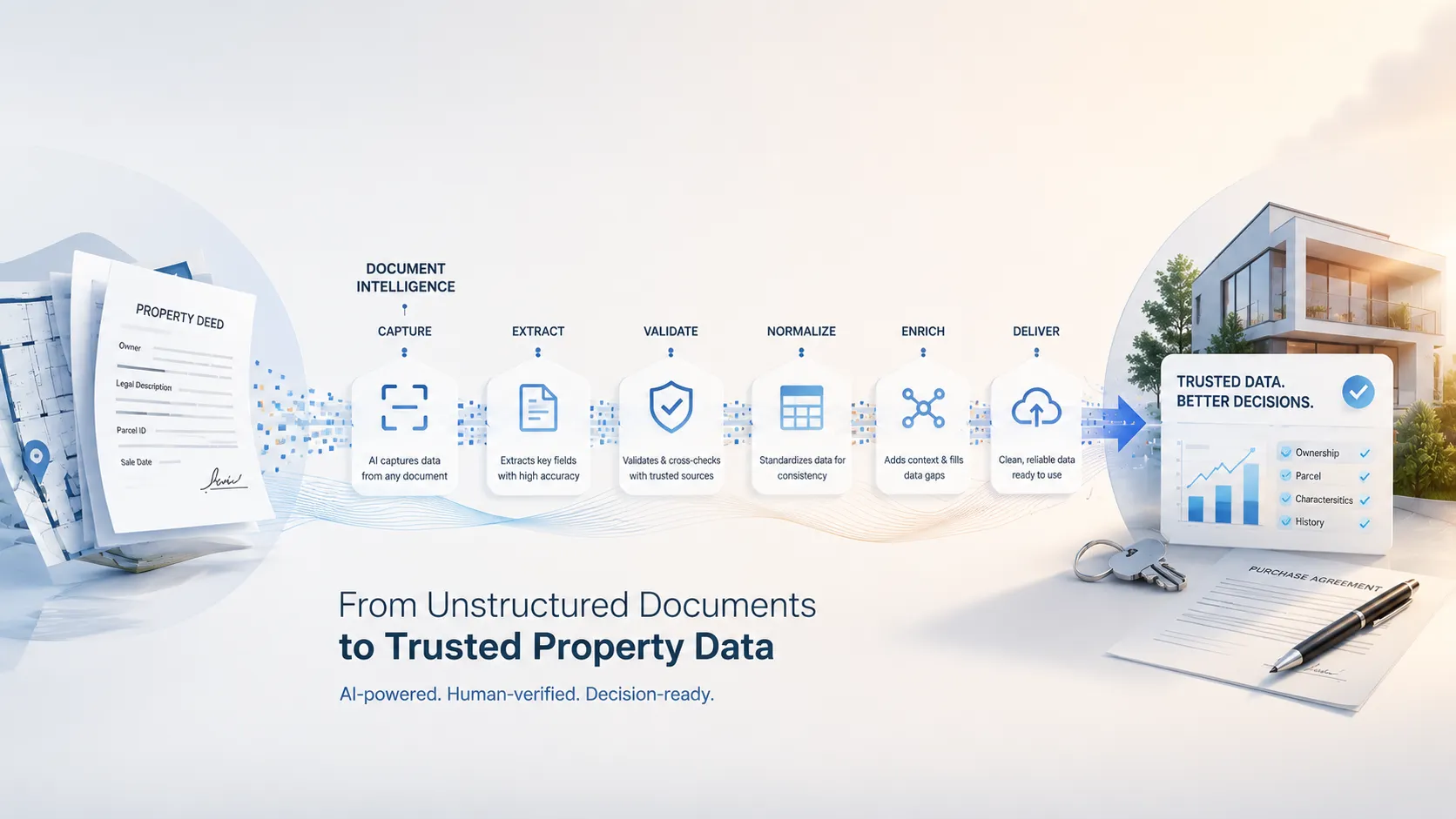
An AI-assisted data extraction workflow can combine OCR, document classification, entity extraction, normalization, and validation to convert unstructured property documents into structured data.
Models can identify fields such as owner names, parcel numbers, recording details, legal descriptions, transaction dates, and other property attributes. Well-designed workflows can also preserve source references to support provenance and validation.
Automation can also support quality control by:
- Assigning confidence scores: Low-confidence fields can be identified before they move downstream.
- Applying validation rules: Extracted values can be checked for missing fields, invalid formats, or inconsistencies.
- Detecting anomalies: Records that deviate from expected patterns can be flagged for further review.
- Routing exceptions: Ambiguous or conflicting records can be sent to human reviewers instead of being processed automatically.
But AI does not eliminate the need for human judgment. Poor-quality documents, unusual layouts, complex legal descriptions, and conflicting source data can still require expert review.
The goal is therefore not 100% automation. It is to increase straight-through processing (STP), the share of records that can move through without manual intervention, while creating reliable exception paths for records that require human attention.
Better Property Data Means Better Real Estate Decisions
Property data errors rarely remain isolated. Once inaccurate information moves through title workflows, property data platforms, valuation models, and transaction systems, the cost extends beyond correcting a single field. It can mean additional research, repeated verification, delayed decisions, and unreliable information reaching the teams and systems that depend on it.
For title operations teams, data platforms, and aggregators, improving data quality therefore means catching errors as early as possible and maintaining accuracy, consistency, and traceability throughout the data pipeline.
AI and automation can strengthen that process, but technology alone is not the goal. The real objective is reliable property information that users can trust when decisions and deals depend on it.
Where do you see the biggest property data quality challenges in your workflows - at the source, during processing, or further along the pipeline?
























Sign in to leave a comment.