

Most people don’t take eye exams seriously — until it’s too late.
Here’s the truth:
Your eyes can detect stroke risk, heart disease, brain tumors, and diabetes before your body ever warns you.
Skip the eye exam, and you might miss the only early shot you had to catch something deadly.
Let that sink in.
Your retina is the only place doctors can see blood vessels and nerves in real time — without cutting you open. If those are damaged, something bigger is brewing.
Let’s break this down by the three systems your eyes can reveal the most about: your brain, your heart, and your total health.
Your Eyes & Your Brain: Spotting Neurological Problems Early
Your brain and eyes are connected by the optic nerve, so it’s no surprise that many brain issues leave clues in the eye. A routine exam can reveal eye signs of brain disease such as:
1. Brain Tumors
Tumors can increase pressure in the skull, which leads to swelling in the optic nerve (called papilledema). You won’t feel this, but your eye doctor will see it during a dilated retinal exam.
Symptoms that may follow:
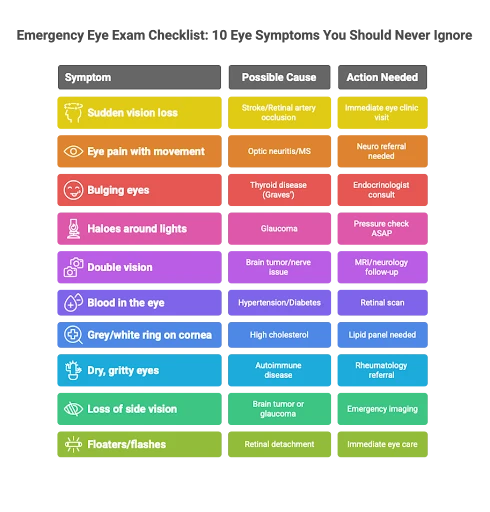
- Loss of side vision
- Double vision
- Uneven pupils
2. Stroke Risk
Strokes are caused by blocked or burst blood vessels in the brain — and the eye’s vessels often reflect the same damage. Eye doctors may see:
- Tiny clots (emboli)
- Bleeding or swelling in the retina
- Sudden vision loss or a "curtain" effect
If spotted early, you can get referred to a neurologist for urgent treatment and avoid a full-blown stroke.
3. Multiple Sclerosis (MS)
The first sign of MS in many people is optic neuritis — inflammation of the optic nerve. It causes:
- Pain with eye movement
- Blurred or dim vision
- Color loss
Around 75% of MS patients have optic neuritis early. Catching it here may fast-track diagnosis and treatment.
4. Dementia & Alzheimer’s
Recent studies show that vision tests can detect cognitive decline up to 12 years before dementia symptoms appear. People developing dementia show:
- Slower visual reaction time
- Poorer contrast detection
- Eye movement control problems
The retina may even reflect early damage from amyloid plaques, which are linked to Alzheimer’s.
Bottom line: Your eyes can be the first place brain problems show up. And sometimes, an eye exam may be the only warning sign you get.
Your Eyes & Your Heart: Tracking Cardiovascular Health
Your retina holds a mirror to your heart. Why? Because eye blood vessels share the same structure and vulnerabilities as those in your heart and brain.
This is how a simple eye checkup can detect eye symptoms and heart problems you haven’t felt yet.
1. High Blood Pressure (Hypertension)
You might feel fine — but your retinal vessels tell another story.
Your eye doctor may see:
- Narrowing or twisting of arteries
- Blood spots
- Vein swelling
- Changes in artery-to-vein ratio
Fun fact: A healthy artery-to-vein ratio is around 2:3. When that ratio is off, it may mean elevated blood pressure.
If untreated, this can lead to retinal damage, vision loss, stroke — and of course, heart attack. Many people find out they have high blood pressure only after an eye exam.
2. Blocked Arteries & Emboli
Small clots in the eye could mean arterial blockages in your neck or heart. These clots often originate from:
- Carotid artery plaque
- Atrial fibrillation clots
If they break off and travel to your brain or retina, they can cause:
- Stroke
- Retinal artery occlusion
- Sudden permanent vision loss
Your optometrist might be the first to catch them.
3. High Cholesterol
A blue, gray, or white ring around your cornea (arcus senilis) isn’t just a cosmetic issue — it’s often a sign of:
- High LDL (bad) cholesterol
- Triglyceride buildup
- Early cardiovascular disease
Even if you have no symptoms, that ring around your iris could be a red flag — especially if you're under 40.
4. Diabetes & Heart Disease Connection
People with diabetes have a higher risk of:
- Diabetic retinopathy (bleeding and swelling in the eye)
- Heart disease
- Kidney failure
The problem? Diabetes can develop slowly. Many patients discover their condition through signs found during a routine eye exam.
If blood vessels in your eye are leaking or swollen, your doctor may suspect diabetes — even before it shows up in a blood test.
Bottom line: If your retina is showing damage, your heart may be next. An eye exam could literally save your life.
What Eyes Reveal About Health: A Full-Body Health Check
You already know your eyes can reveal problems in your brain and heart. But they also expose autoimmune diseases, hormone issues, and even cancer.
Here’s what your eye health and overall health says:
1. Thyroid Disease
If your eyes are bulging, your lids are pulling back, or your eyes feel constantly dry or irritated, you might have Graves’ disease, a common thyroid disorder.
Eye symptoms:
- Eye swelling
- Light sensitivity
- Vision changes
- Gritty or dry feeling
2. Arthritis & Autoimmune Disease
Dry eyes? Eye pain? Redness? These can all point to autoimmune conditions like:
- Rheumatoid arthritis
- Lupus
- Sjögren’s syndrome
These diseases often attack tear glands and cause inflammation before joint pain begins. Left untreated, they can damage the cornea or retina permanently.
3. Cancer
A comprehensive eye exam can uncover signs of:
- Skin cancer (around the eyelids)
- Leukemia (blood in the retina)
- Ocular melanoma (color changes in the eye)
- Brain tumors (optic nerve swelling)
Even tumors elsewhere (like in the breast or lungs) can spread to the eyes.
4. Vitamin A Deficiency
Night blindness or severely dry eyes might mean your body is lacking Vitamin A. This isn’t just uncomfortable — it can lead to permanent vision loss if untreated.
5. Medication Toxicity
Some prescriptions, including anti-malaria drugs and certain antibiotics, can damage the optic nerve. Regular eye exams can help prevent vision loss from meds that cause:
- Red, itchy eyes
- Scratchy corneas
- Retinal inflammation
Bottom line: Your eyes reflect your whole-body health — from hormones to inflammation to nutrition. They don’t lie.
The Tech Is Catching Up — But It’s Not Replacing Your Eye Doctor
In 2018, Google’s health division Verily published a study that used AI to predict heart disease from retinal scans with 70% accuracy. That’s nearly as good as a blood test — without the needle.
But even the best AI still can’t beat:
- A human reading your history
- Personalized judgment
- A real conversation
Technology supports better diagnostics, but it doesn’t replace the value of seeing a skilled eye doctor regularly.
What Happens During a Real Eye Exam?
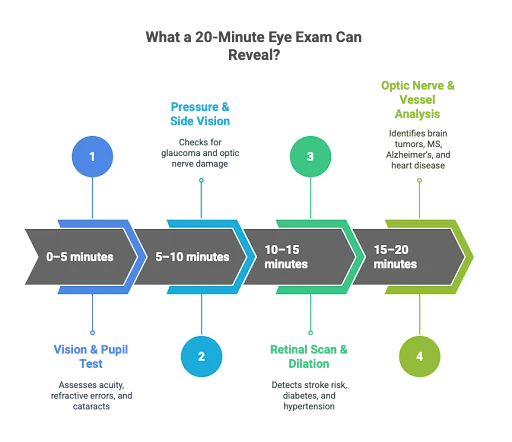
A full exam is painless and quick — usually 30–60 minutes. It includes:
- Visual acuity test (how clearly you see)
- Retinal scan (to see blood vessels and nerves)
- Eye pressure test (checks for glaucoma)
- Visual field test (checks side vision)
- Dilation (to look deep into the retina)
This isn’t just for glasses. It’s a preventive health screening for your whole body.
Final Thought — and a Simple Question
You only get one set of eyes. And as it turns out, they may be the first place to show you eye signs of brain disease, stroke risk, or heart failure.
Don’t wait for symptoms to appear. At our emergency eye clinic, we’re not just checking your vision — we’re scanning for silent threats to your brain, heart, and body.
Contact us today for a comprehensive emergency eye care exam. Because what you don’t see could hurt you — and what we see might just save you.
So here’s the question you should ask yourself:
If your eyes could tell you something’s wrong with your health, would you be listening?
Book your exam now.











Sign in to leave a comment.