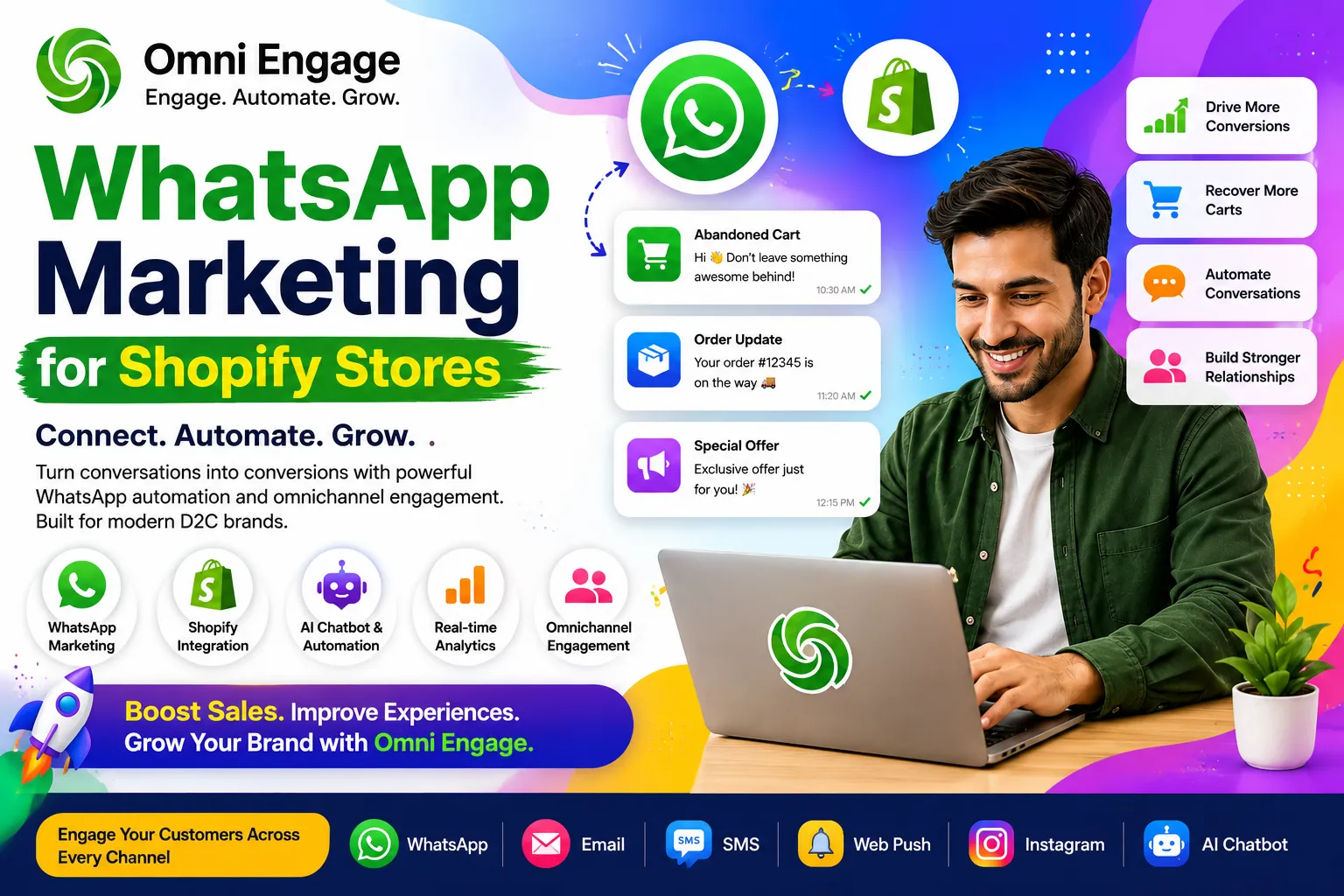

WhatsApp Marketing is the use of WhatsApp to communicate with customers, promote products, provide customer support, recover potential sales, and build long-term customer relationships.
In 2026, WhatsApp has become an important customer engagement channel for D2C, Shopify, and eCommerce brands. Businesses can use it for abandoned cart recovery, order updates, product promotions, customer support, personalized campaigns, and automated customer journeys.
However, effective WhatsApp Marketing is not simply about sending promotional messages. The real value comes from combining customer consent, segmentation, automation, personalization, and relevant communication.
What Is WhatsApp Marketing?
WhatsApp Marketing is a digital marketing strategy where businesses use WhatsApp to engage customers throughout different stages of the customer journey.
Businesses can use WhatsApp for:
- Product recommendations
- Promotional campaigns
- Abandoned cart recovery
- Order confirmations
- Shipping updates
- Delivery notifications
- Customer support
- Back-in-stock alerts
- Review requests
- Reorder reminders
- Customer re-engagement
- Personalized offers
For example, a Shopify customer may add a product to their cart but leave without completing the purchase. A properly configured WhatsApp journey can remind the customer about the product and encourage them to return to checkout.
The same customer can later receive order updates, delivery notifications, post-purchase communication, and relevant offers.
This creates a connected customer journey instead of isolated marketing messages.
How Does WhatsApp Marketing Work?
A typical WhatsApp Marketing strategy follows a simple process:
Customer Opt-In → Audience Segmentation → Message or Automation → Customer Interaction → Conversion → Retention
The first step is collecting appropriate customer permission.
Once customers have opted in, businesses can organize audiences according to factors such as purchase history, interests, customer activity, or lifecycle stage.
The business can then create campaigns or automated journeys for different customer segments.
For example:
Customer Adds Product → Abandons Cart → Recovery Message → Returns to Store → Purchases → Order Update → Post-Purchase Engagement
The exact workflow depends on the business model and customer journey.
Why Is WhatsApp Marketing Important for D2C Brands?
D2C brands need to build relationships with customers beyond the first website visit.
A customer may discover a product through advertising but still need additional information before purchasing. WhatsApp provides a conversational way to answer questions, share information, and guide customers.
It can also support customers after a purchase.
WhatsApp Marketing can therefore be useful across several stages:
Discovery → Consideration → Purchase → Delivery → Support → Retention
This makes WhatsApp more than a promotional channel. It can become part of the complete customer experience.
WhatsApp Marketing Tools
The right WhatsApp Marketing tools depend on the size and requirements of the business.
A small business may only need basic customer communication, while a growing D2C brand may need advanced capabilities such as:
- Marketing automation
- Customer segmentation
- Campaign management
- Shared inbox
- Analytics
- Customer journeys
- Shopify integration
- AI-powered conversations
- Automated notifications
- Multi-channel communication
When choosing WhatsApp Marketing tools, businesses should focus on their actual customer journey instead of selecting a platform only because it has a large number of features.
WhatsApp Marketing Software for Shopify
Shopify stores can use WhatsApp throughout the customer journey.
For example, a business can use WhatsApp for:
Abandoned Cart Recovery
Remind customers about products they added to their cart but did not purchase.
Order Updates
Provide customers with important information after an order has been placed.
Delivery Communication
Keep customers informed about their order status and delivery progress.
Back-in-Stock Alerts
Notify customers when a product they were interested in becomes available.
Customer Re-Engagement
Reconnect with customers who have not interacted with the brand for a specific period.
Promotional Campaigns
Send relevant promotions and product updates to customers who have opted in to marketing communication.
What Is WhatsApp Marketing API?
The WhatsApp Business Platform/API allows businesses to connect WhatsApp with other business systems and create more advanced communication workflows.
This can be useful when a business wants to connect WhatsApp with:
- eCommerce platforms
- Customer databases
- CRM systems
- Marketing automation
- Customer support systems
- Analytics
- AI tools
For example:
Order Created → WhatsApp Confirmation
Cart Abandoned → Recovery Journey
Product Back in Stock → Customer Notification
Order Delivered → Review Request
This type of automation can significantly reduce repetitive manual communication.
WhatsApp Marketing Automation
Automation is one of the most important parts of modern WhatsApp Marketing.
Instead of manually sending every message, businesses can create workflows that respond to customer actions.
A simple automation could work like this:
Step 1: Customer Shows Interest
The customer visits a product page or adds a product to the cart.
Step 2: Customer Leaves
The customer does not complete the purchase.
Step 3: Automated Journey Starts
An appropriate WhatsApp message is triggered according to the configured workflow.
Step 4: Customer Responds
The customer returns to the store or interacts with the brand.
Step 5: Purchase
The customer completes the transaction.
Step 6: Post-Purchase Journey
The business continues communication through order updates, support, review requests, or relevant future offers.
This makes customer communication more scalable and consistent.
WhatsApp Marketing Services
Businesses can manage WhatsApp Marketing internally or work with a technology provider or marketing service.
WhatsApp Marketing services can include:
- WhatsApp Business setup
- API integration
- Campaign management
- Automation
- Message template creation
- Customer segmentation
- Shopify integration
- Analytics
- Customer support workflows
- Campaign optimization
Businesses should always choose services based on their actual requirements, customer volume, communication needs, and automation goals.
Best WhatsApp Marketing Strategies for 2026
The goal of WhatsApp Marketing should not be to send the maximum number of messages.
The focus should be on relevance, timing, personalization, and customer value.
1. Use Customer Segmentation
Do not treat every customer the same.
Create meaningful segments such as:
- New customers
- Existing customers
- Repeat buyers
- High-value customers
- Cart abandoners
- Product-interest groups
- Inactive customers
This allows businesses to create more relevant communication.
2. Automate High-Intent Moments
Focus on customer actions that show clear intent.
Examples include:
- Abandoned carts
- Product enquiries
- Order placement
- Delivery
- Product availability
- Reorder opportunities
These interactions have more context than generic promotional messages.
3. Personalize Customer Journeys
Personalization makes communication more relevant.
Instead of sending the same message to every customer, businesses can create different journeys based on customer activity, interests, previous purchases, and engagement.
4. Combine WhatsApp With Other Channels
WhatsApp does not need to replace other marketing channels.
A strong omnichannel strategy can use:
- WhatsApp: Conversational engagement
- Email: Long-form and educational communication
- SMS: Short and time-sensitive communication
- Web Push: Website re-engagement
- RCS: Rich messaging experiences where available
- Instagram: Discovery and social engagement
The objective is to use the right channel at the right stage of the customer journey.
How Much Does WhatsApp Marketing Cost?
There is no single fixed cost for WhatsApp Marketing.
The total cost can depend on:
- Messaging volume
- Message type
- WhatsApp Business setup
- Software or platform fees
- Automation requirements
- Integration requirements
- Additional marketing tools
Businesses should therefore consider the complete cost of their WhatsApp Marketing setup rather than looking only at a monthly software fee.
Basic WhatsApp Business communication may be enough for very small businesses. As customer volume increases, advanced automation, analytics, segmentation, integrations, and shared inbox capabilities may become more important.
How to Do WhatsApp Marketing for Free?
Small businesses can start with basic WhatsApp Business functionality without immediately investing in a complete automation platform.
A simple starting process is:
- Create a professional business profile.
- Add accurate business information.
- Build a proper customer opt-in process.
- Add useful product information.
- Respond to customer questions.
- Organize customer conversations.
- Track customer engagement.
However, free solutions usually have limitations.
As the business grows, advanced requirements such as automation, segmentation, analytics, customer journeys, integrations, and multi-agent support can make a dedicated WhatsApp Marketing platform more useful.
WhatsApp Marketing vs Email Marketing
WhatsApp and email serve different purposes.
Email is useful for:
- Newsletters
- Educational content
- Long-form communication
- Product information
- Lifecycle campaigns
WhatsApp is useful for:
- Conversational engagement
- Customer support
- Quick updates
- Product communication
- Automated journeys
- Time-sensitive communication
Instead of thinking WhatsApp vs Email, businesses can use WhatsApp + Email + other relevant channels as part of an omnichannel strategy.
How AI Is Changing WhatsApp Marketing
Artificial intelligence is becoming an important part of customer engagement.
AI-powered systems can assist with:
- Customer questions
- Product recommendations
- Customer conversations
- Campaign content
- Audience segmentation
- Customer journeys
- Support automation
- Data analysis
For growing D2C businesses, AI can reduce repetitive manual work and help teams handle a larger volume of customer interactions.
However, AI should improve the customer experience rather than create unnecessary automated conversations.
A combination of AI automation + human support can provide a better balance between efficiency and personalization.
WhatsApp Marketing for Customer Retention
Customer acquisition is only one part of eCommerce growth.
Businesses also need to keep existing customers engaged.
WhatsApp can support retention through:
- Product recommendations
- Replenishment reminders
- Review requests
- Loyalty campaigns
- New product announcements
- Personalized offers
- Customer support
- Post-purchase communication
The goal is to maintain a useful relationship with customers without overwhelming them with unnecessary messages.
WhatsApp Marketing for Abandoned Cart Recovery
Abandoned carts are a major challenge for online stores.
Customers may leave checkout because they become distracted, compare products, experience payment problems, or simply decide to purchase later.
An automated WhatsApp recovery journey can remind customers about the products they were considering.
A basic journey might include:
Cart Abandoned → Reminder → Product Information → Final Reminder
The exact timing and number of messages should depend on the customer, product, and business strategy.
WhatsApp Marketing for Customer Support
Customers frequently ask questions about:
- Product availability
- Pricing
- Shipping
- Returns
- Payments
- Order status
- Delivery
- Product specifications
WhatsApp can provide a convenient conversational channel for handling these questions.
AI Chatbots can also help answer repetitive questions, while human agents can take over more complex conversations.
This combination can improve response efficiency while keeping human support available when it is needed.
WhatsApp Marketing Metrics to Track
Sending messages is not enough.
Businesses should measure what happens after communication.
Important metrics include:
- Delivery rate
- Read rate
- Click-through rate
- Response rate
- Conversion rate
- Revenue generated
- Cart recovery
- Customer retention
- Opt-out rate
- Cost per conversion
The most important metric depends on the campaign objective.
For example, an order-update campaign should be measured differently from a promotional campaign.
Common WhatsApp Marketing Mistakes
Sending Too Many Messages
More messages do not automatically produce better results.
Excessive communication can reduce engagement and increase opt-outs.
Ignoring Customer Consent
Businesses should collect and respect appropriate customer consent before sending marketing communication.
Using the Same Message for Everyone
Segmentation and personalization can make communication more relevant.
Focusing Only on Promotions
WhatsApp can also be used for support, education, order updates, and relationship building.
Not Testing Automation
Every automated journey should be tested before being launched at scale.
Measuring Only Message Engagement
A message being delivered or read does not automatically mean that it generated business value.
Businesses should also monitor clicks, conversions, revenue, retention, and customer behavior.
Why Choose an Omnichannel Customer Engagement Approach?
Modern customers interact with brands through multiple channels.
A customer may discover a product on social media, visit a Shopify store, contact the business through WhatsApp, receive an email, and later return through a web push notification.
Managing every interaction separately can create fragmented customer experiences.
An omnichannel approach connects these interactions around the customer journey.
Omni Engage helps D2C, Shopify, and eCommerce brands bring WhatsApp, SMS, RCS, Email, Web Push, AI Chatbots, automation, and customer journeys together in one customer engagement platform.
This allows businesses to create more connected communication while reducing repetitive manual work.
Final Thoughts
WhatsApp Marketing has evolved far beyond sending promotional messages.
For D2C, Shopify, and eCommerce brands, WhatsApp can support customer acquisition, sales, customer support, retention, abandoned cart recovery, and automated customer journeys.
The key is to use WhatsApp as a customer engagement channel rather than simply as a broadcasting tool.
Start with high-intent journeys such as abandoned cart recovery, order communication, customer support, and post-purchase engagement. Once these workflows are stable, businesses can expand into segmentation, personalized campaigns, AI-powered conversations, and broader omnichannel automation.
In 2026, brands that connect customer communication with real customer behavior can create more relevant experiences, reduce repetitive work, and build stronger long-term relationships.
























Sign in to leave a comment.