

Introduction
Over the last few years, WhatsApp has quietly become one of the most powerful marketing channels available to businesses of every size. It started as a simple messaging app, but today it competes with — and often beats — email, SMS, and even traditional advertising when it comes to reaching people where they actually pay attention.
Why does WhatsApp marketing feel so effortless once it’s set up correctly? Is it the technology behind it, the strategy that guides it, or something else that turns everyday conversations into steady business growth?
In this article, we’ll break down the three building blocks of WhatsApp marketing — software, service, and strategy — and look at how they combine to create results that other channels simply can’t match.
What is WhatsApp Marketing?
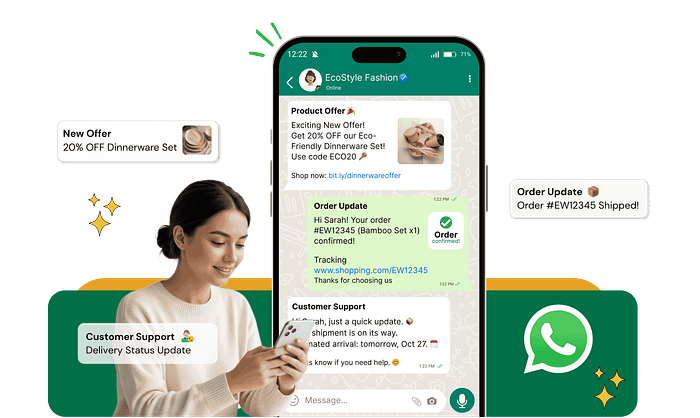
Picture going door to door in your neighbourhood, learning what each family needs, and offering the right solution for them. Now imagine doing that for millions of people at once, without losing that personal, one-on-one feel. That’s essentially what WhatsApp marketing allows a business to do.
Companies rely on WhatsApp marketing to:
- Announce new launches, offers, and product updates
- Send order confirmations and transactional alerts
- Run broadcast campaigns to large audiences in one go
- Handle customer support and after-sale conversations
The biggest reason this works so well is convenience. A customer can reply, browse a catalogue, ask a question, or even complete a payment — all inside the same chat window, with no app-switching or redirects. Compare that to a newspaper ad or a billboard, where the audience can only look and move on. WhatsApp turns marketing into a real conversation, giving businesses instant, honest feedback on how their campaigns are landing.
Why Businesses Are Leaning Into WhatsApp Marketing
WhatsApp isn’t just popular — it’s part of daily life for close to 3 billion people worldwide. Messages get opened almost immediately, the platform is trusted because of end-to-end encryption, and unlike promotional emails, WhatsApp messages rarely end up ignored or buried.
A few things set WhatsApp apart from other social platforms:
- Access to the WhatsApp Business API is restricted to verified, legitimate businesses, which keeps the ecosystem trustworthy
- Rich media and interactive CTA buttons (like “Book a Demo,” “Explore Products,” or “Call Us”) boost engagement
- Direct integration with Meta Business Manager makes performance tracking straightforward
- A good Technology Service Provider (TSP) can design flows around how your specific audience actually behaves
Done right, this combination can meaningfully lift lead conversion and cut down response times — some businesses report conversion improvements of 40% or more once automation is properly in place.
Getting the Strategy Right
Is there one “perfect” WhatsApp marketing strategy that works for everyone? Not really — but there are proven principles that consistently perform well.
The right approach depends heavily on who your audience is and how they respond to different types of outreach. Once you understand that, you can map out a customer journey that actually converts.
According to Meta’s own guidance, a few things tend to matter most:
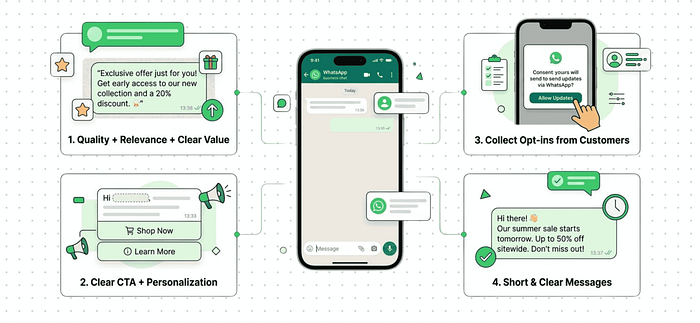
- Prioritise quality and relevance over volume
- Pair every message with a clear, simple call-to-action
- Treat opt-ins as more than a compliance checkbox — they’re your first sign of genuine interest
- Keep it short: Meta itself recommends under 5 lines for marketing messages and 3–4 short paragraphs for campaigns
WhatsApp Marketing as a Software
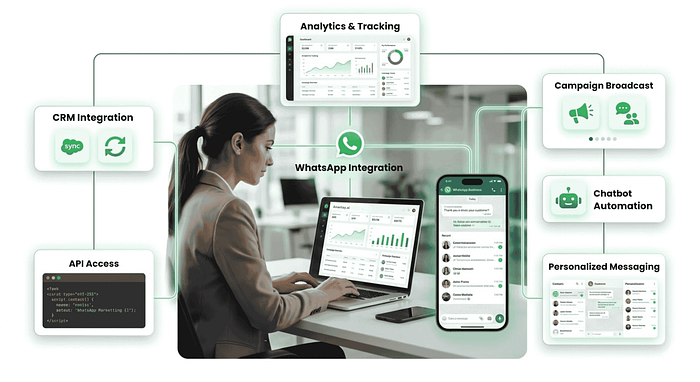
Isn’t software just another word for an app? Not quite. WhatsApp, Instagram, and LinkedIn are applications — they do a fixed set of things and nothing more. Software, on the other hand, works at a deeper level, giving businesses the flexibility to automate, customize, and scale.
A solid WhatsApp marketing software helps businesses by:
- Automating campaigns and follow-up sequences
- Organising contact lists and customer data in one place
- Triggering messages based on real customer actions or intent
- Tracking delivery rates, read receipts, and responses
- Connecting WhatsApp with your CRM and other business tools
Without this layer of technology, most businesses end up doing everything manually — which makes it nearly impossible to scale campaigns, get clear insights, or manage a growing contact base efficiently.
What to Look for in a WhatsApp Marketing Software
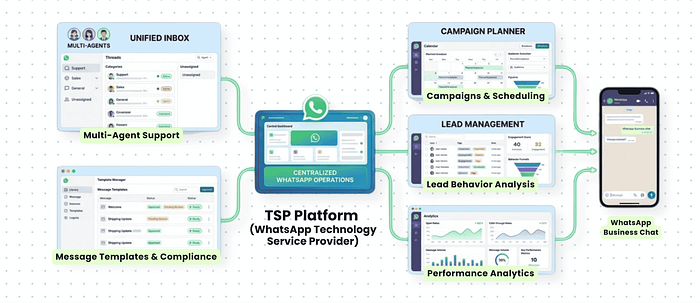
Not all platforms are built the same. A good WhatsApp marketing software should support long-term, scalable growth while staying fully compliant with WhatsApp and Meta’s policies and data regulations.
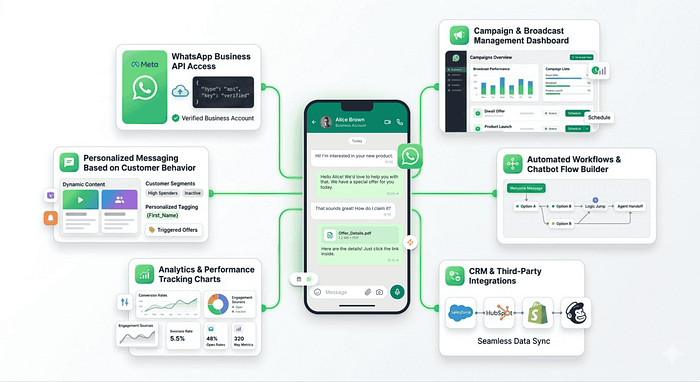
Look for a platform where the customer journey is clearly mapped out — automated replies and triggers should actually resolve queries, not just acknowledge them. Some must-have features include:
- WhatsApp Business API access
- Campaign and broadcast management tools
- Automated workflows and chatbot building
- CRM and third-party app integrations
- Built-in analytics and performance dashboards
The better platforms go further by enabling personalisation at scale — instead of blasting the same message to everyone, they tailor content based on individual behaviour, preferences, and where a customer is in their journey. That’s what turns a routine broadcast into a genuinely useful conversation.
The Role of WhatsApp Marketing Services
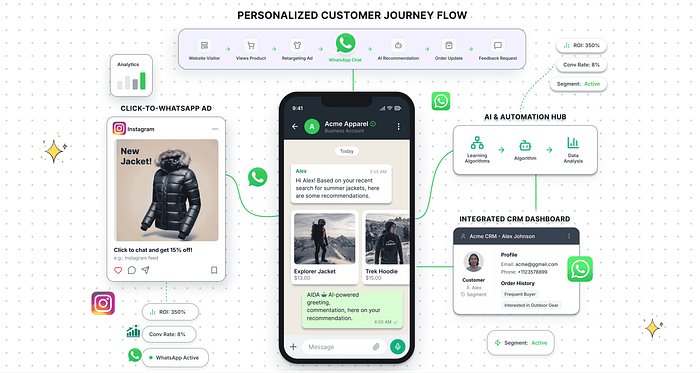
Technology alone won’t get you results — execution does. This is where a reliable WhatsApp Technology Service Provider (TSP) comes in, closing the gap between what the platform can do and what your business actually achieves.
Core service offerings typically include:
- A unified inbox so multiple agents can manage conversations together
- A template manager to keep messaging compliant with WhatsApp’s rules
- A structured campaign planner for organised outreach
- Integrations with ERP systems, payment gateways, and marketing tools
- Lead tracking, user behaviour analysis, and reporting dashboards
- Ready-to-use automation templates and WhatsApp Flow setup
AI is also changing what’s possible, with features like:
- Product knowledge graphs for smarter recommendations
- Sentiment analysis that flags frustrated customers for human follow-up, or sends satisfied ones a feedback form
- Cross-sell and upsell logic based on what customers are already browsing
- The ability to understand images, PDFs, and other rich media in conversations
- Intent recognition that automatically routes and labels leads as hot or cold
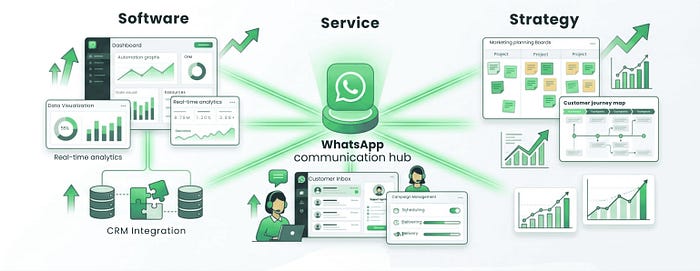
Together, these capabilities shift WhatsApp from a purely reactive support tool into an active driver of revenue — with the service layer ensuring the software is actually being used to its full potential.
Where WhatsApp Marketing Is Headed
The next phase of WhatsApp marketing is leaning heavily into automation and personalisation. A few trends worth watching:
- Smarter AI chatbots that can recommend products in real time
- Click-to-WhatsApp Ads, now available specifically within performance-focused ad campaigns
- Deeper, more native CRM and analytics tools built directly into the platform
- Customer journeys that adapt dynamically based on real user behaviour
Measurement is getting sharper too. Businesses are increasingly tracking:
- Reach — sends, deliveries, reads, spend, and cost per delivered message
- Engagement — button clicks, quick-reply taps, and cost per click
- Conversion — actual website or app conversions traced back to WhatsApp messages
On top of this, expect more advanced tools like custom benchmarking, detailed reporting, and A/B testing to become standard rather than optional.
Why You Need All Three Together
What separates the businesses that consistently grow from the ones that plateau? Often, it’s how much attention they pay to understanding their customers — and how well they invest in the tools to act on that understanding.
Software, service, and strategy aren’t interchangeable — they’re interdependent. Without software, you lose visibility and the ability to run campaigns across channels. Without a TSP handling the backend, you end up spending your time managing operations instead of growing your business. And without a strategy, you’re just guessing — sending messages and hoping something sticks.
Conclusion
Real growth on WhatsApp isn’t about sending more messages — it’s about building a system that understands your customers, engages them meaningfully, and converts consistently over time. When software, service, and strategy work together, WhatsApp stops being just a messaging app and becomes one of the most reliable growth channels a business can have.
This is exactly the kind of ecosystem that Anantya.ai helps businesses build. With an in-house WhatsApp marketing platform, Anantya.ai brings together the WhatsApp Business API, campaign automation, CRM integrations, and Meta-partner-level features into a single dashboard — so businesses don’t have to juggle multiple tools or vendors to get results. Whether it’s setting up Click-to-WhatsApp Ads, automating customer support, or building data-driven campaigns, Anantya.ai is built to handle the software and service side, so businesses can focus purely on strategy and growth.
Frequently Asked Questions
What is WhatsApp marketing used for?
WhatsApp marketing is used to send promotional offers, product updates, order and delivery notifications, and to provide direct customer support — all through a channel customers already check multiple times a day.
What is the WhatsApp Business API and who can use it?
The WhatsApp Business API is a verified, business-grade version of WhatsApp designed for companies that need to send messages at scale, automate replies, and integrate WhatsApp with CRMs and other tools. Access is limited to legitimate, verified businesses to keep the platform trustworthy.
What are Click-to-WhatsApp Ads?
Click-to-WhatsApp Ads are Facebook and Instagram ads that, when clicked, open a WhatsApp chat directly with the business instead of a landing page. They’re currently available within performance-based ad campaigns and are a popular way to start conversations at a lower cost.
Is WhatsApp marketing better than email or SMS marketing?
WhatsApp typically sees much higher open and response rates than email or SMS because messages are read almost instantly and the platform feels more personal and trusted, thanks to end-to-end encryption.
Do I need software or a service provider to run WhatsApp marketing campaigns?
Yes, in most cases. A WhatsApp marketing software handles automation, contact management, and analytics, while a service provider (TSP) manages compliance, template approvals, and technical setup — together they make campaigns scalable and effective, rather than manual and error-prone.

























Sign in to leave a comment.