

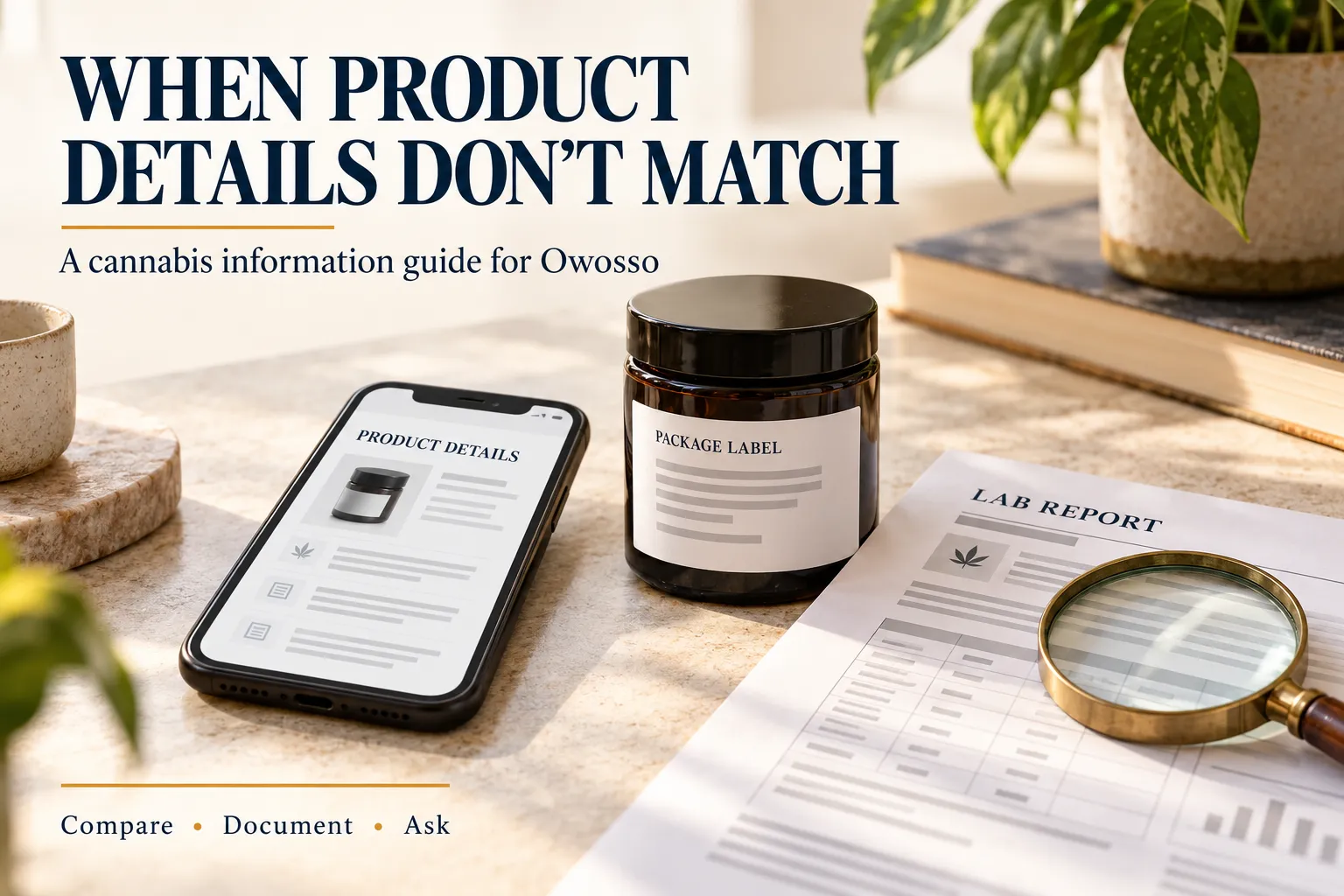
An online description lists one THC amount. The package shows another. A QR code opens a laboratory report, but its product details do not clearly match the label.
Which information should you trust?
Conflicting cannabis product information deserves a closer look. The difference might involve measurement units, a different batch, an outdated description, or an error. Until someone explains it, choosing whichever figure looks most reassuring leaves the question unresolved.
For adults in Owosso, a practical approach starts with identifying the exact item, recording the discrepancy, and asking the source best placed to explain it.
First, Identify What Actually Conflicts
Before deciding that two sources disagree, write down the statements you are comparing.
“The numbers are different” is a starting point. A more useful description identifies the number, unit, substance, and source.
For example:
“The online description lists THC per package, but the label lists THC per serving. I cannot find the package total on the label.”
That question differs from:
“Both sources state total THC per package, but they show different amounts.”
The first situation may involve two measurements that describe different portions. The second requires an explanation of an apparent disagreement.
Common points of confusion include:
| Information | What to check |
|---|---|
| THC or CBD amount | Same cannabinoid, unit, and portion? |
| Product name | Same manufacturer, format, and variation? |
| Package quantity | Same weight, volume, or item count? |
| Laboratory report | Clearly connected to this package or batch? |
| Dates | Manufacturing, testing, packaging, or expiration? |
| Ingredients | Complete list or a shortened description? |
This comparison helps turn uncertainty into a question someone can answer.
Confirm That You Are Comparing the Same Product
A familiar brand name does not identify every detail of a product.
Check the manufacturer, product format, package size, and available batch or tracking identifiers. Two items can share a product name while belonging to different batches or containing different quantities.

Michigan’s labeling rules identify information such as the producer, package tracking information, cannabinoid content, and laboratory details among required label elements. These fields provide useful starting points when identifying an item.
Before comparing an online listing with a package, ask:
- Is this the same product variation?
- Does the listed package size match?
- Is the page for the location involved?
- Does the description identify a particular batch?
- Can the business connect the listing to this item?
A matching photograph alone may leave those questions unanswered.
Compare the Meaning of the Numbers
Different numbers do not always represent contradictory information.

One statement may describe the entire package, while another describes one labeled serving. A laboratory report may show a concentration rather than a package total.
Consider a fictional example:
- Total THC per package: 40 mg
- Servings per package: 8
- THC per serving: 5 mg
Those statements agree because eight servings multiplied by five milligrams equals forty milligrams.
The example explains arithmetic only. It does not recommend a quantity or describe an actual product.
Before calculating anything, confirm that the label defines the serving and identifies the relevant cannabinoid. Do not divide a package total by the number of pieces and assume that each piece equals one serving.
When information is missing, arithmetic cannot supply the manufacturer’s instructions.
Keep the Package and Preserve the Online Description
Document the discrepancy before a webpage changes or packaging is discarded.
Keep the original container, readable labels, and purchase record. Save the webpage address and take a screenshot showing the relevant statement and the date you captured it.
Useful records include:
- Product and manufacturer names
- Package size
- Visible batch or tracking identifiers
- The conflicting statements
- The complete laboratory report, if relevant
- Purchase date and location
- Any written explanation already received
Avoid removing labels or covering information while the question remains unresolved.
Share receipts and identifying details privately with the appropriate business or agency. Public posts rarely need your name, payment information, or order number.
Ask a Specific Question Through the Official Contact Route
A focused request makes the issue easier to investigate.
Describe what each source says, then ask how the information connects to the item you have.
For a purchase from JARS, contact JARS Cannabis in Owosso about your product question through its official location page, which publishes contact information. Keep the package available when reaching out.
A message could read:
“I purchased this product from your Owosso location. The online description states one package quantity, while my label states another. I have photographs and the package identifier. Can you confirm which information applies to this item and explain the difference?”
Ask for an answer tied to the specific package. A general explanation about the brand may not resolve a batch-specific question.
If another business made the sale, start with that retailer’s official contact channel.
Direct the Question to the Right Source
Different organizations can answer different parts of the problem.
| Question | Useful starting point |
|---|---|
| Does this listing describe the item sold? | Retailer |
| What are the current ingredients or package instructions? | Manufacturer |
| Which sample does this laboratory report cover? | Issuing laboratory, with help establishing the package connection |
| Is there an official recall or advisory? | Michigan Cannabis Regulatory Agency |
| Does this product suit my health circumstances? | Qualified healthcare professional |
A retailer may need to contact a manufacturer or laboratory before providing a complete explanation.
Ask who is handling the follow-up and what remains unconfirmed. That is more useful than treating an initial response as a final resolution.
Check a Laboratory Report’s Identity Before Its Results
If a certificate of analysis appears to conflict with a label, begin with identification.
Does the report identify the relevant product? Can its sample or batch information be connected to the package? Are you reading the complete document and the applicable report version?
Then compare the measurement itself:
- THC, CBD, or another compound?
- Percentage, milligrams per gram, or total quantity?
- Individual cannabinoid or a calculated total?
- Same product form and reporting basis?
Do not choose the higher or lower result simply because it seems more plausible.
Ask the laboratory to explain unfamiliar analytical terms and ask the business to explain how the report relates to the package. Those are separate questions.
Look for Official Recall Information
An unexplained discrepancy may also justify checking official notices.
Michigan’s Cannabis Regulatory Agency maintains a page for public-health and safety advisories and recalls. Use the actual bulletin rather than relying only on a social post or search preview.
Compare the notice’s affected identifiers and other details with the package. A familiar brand name alone may not establish whether an item falls within a notice.
Follow the instructions in the relevant bulletin. If you cannot determine whether it applies, ask the agency or the contact named in the notice.
Not finding a matching recall does not resolve a separate labeling question.
Avoid Testing an Uncertain Claim Through Consumption
Using a product cannot reliably establish which description is correct.
A personal experience does not verify cannabinoid content, ingredients, laboratory identity, or labeling accuracy.
If the unresolved issue concerns identity, ingredients, cannabinoid quantity, or a safety notice, pause use while seeking clarification. Keep the item securely stored in its original packaging.
Health concerns require professional attention. A customer-service exchange should not delay urgent medical help.
Escalate an Unresolved Regulatory Concern
Some questions remain unanswered after contacting the business.
Michigan’s CRA provides a complaint route for concerns involving regulated marijuana businesses. Its instructions request identifying business details and an explanation of the complaint.
Present the evidence plainly:
“The online listing and package show different quantities. I contacted the business on these dates, and the discrepancy remains unexplained.”
Include relevant photographs, identifiers, and correspondence where the submission process permits.
Distinguish what you observed from what you suspect. A discrepancy is evidence of conflicting information; its cause still needs investigation.
A Checklist for Resolving Conflicting Information
When two sources do not line up:
- Identify the exact product and package.
- Record both statements.
- Compare the cannabinoid, unit, and portion.
- Preserve the label, receipt, webpage, and report.
- Ask a specific question through an official channel.
- Request an explanation connected to the item.
- Check relevant CRA notices.
- Escalate unresolved regulatory concerns with supporting records.
For Owosso consumers, the useful goal is an explanation that connects the information to the actual package. Clear records and precise questions make that explanation easier to obtain.
This article provides general consumer information, not medical or legal advice. Product details and regulatory guidance can change. Confirm unresolved information with the relevant business, laboratory, or Michigan Cannabis Regulatory Agency.
























Sign in to leave a comment.