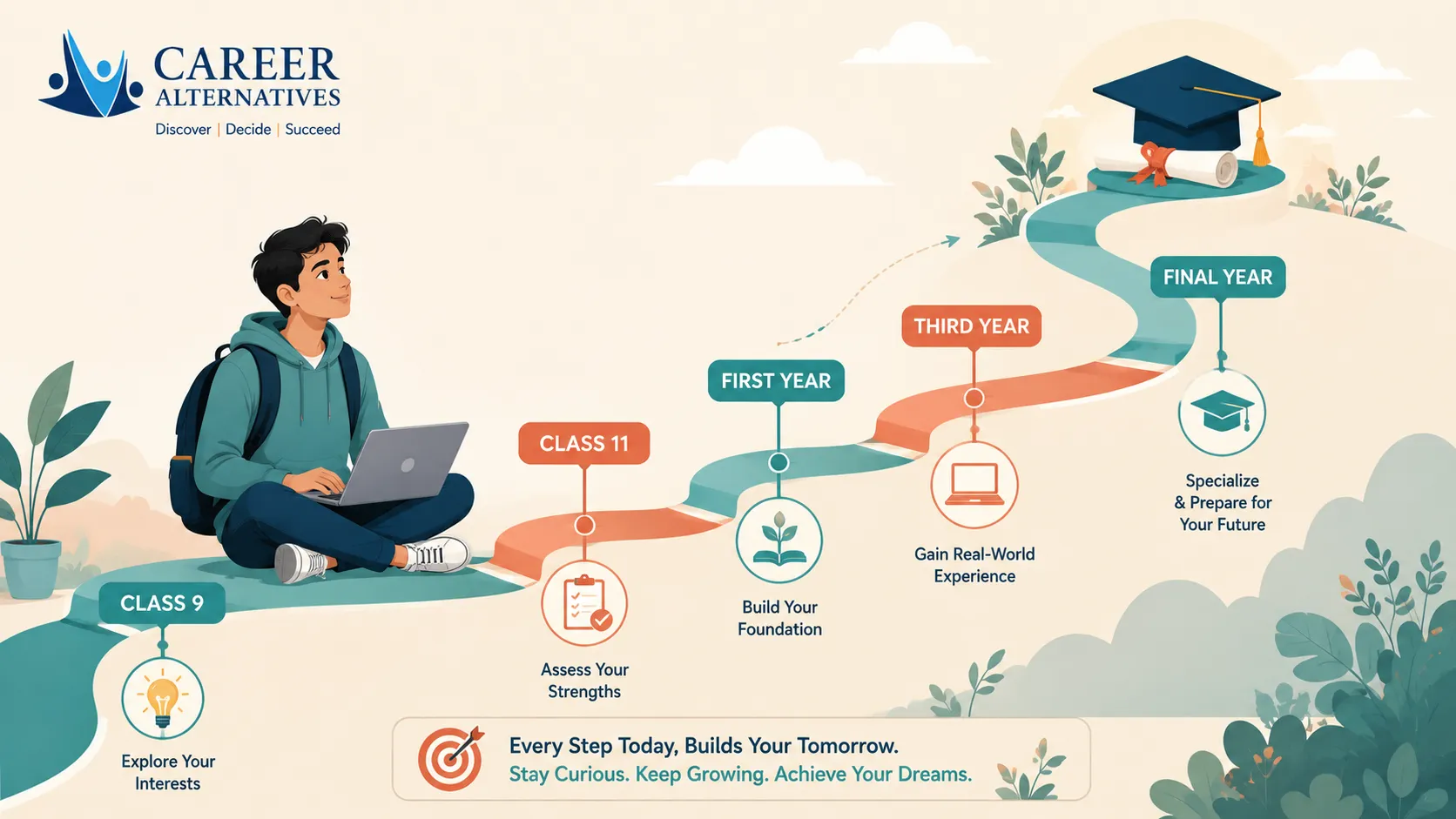

The honest answer: career planning should start in Class 9-10, deepen in Class 11-12, and get serious in the first year of college — not in the final semester before placements. If you're already in your second or third year and haven't started, you haven't "missed the boat" — you've just got less runway, which means you need to move faster and more deliberately. There's no single "right" age, but there is a wrong time: the month before you have to submit a resume.
If you're a student, parent, or working professional trying to figure out where you stand, here's a year-by-year breakdown you can actually act on — plus a checklist at the end you can save or print.
Why "When to Start Career Planning" Doesn't Have One Answer
Career planning isn't a single event — it's a series of decisions that compound. A student who explores interests in Class 9 has three extra years of small, low-stakes experiments (subject choices, internships, hobbies-turned-skills) compared to someone who starts thinking about it in final year college. That's not a motivational claim — it's just math. More decision points = more course-correction opportunities before the stakes get high (like choosing a postgraduate degree or accepting a job offer).
This is also why career counselling works differently depending on the stage. A 15-year-old needs interest exploration. A 20-year-old needs skill-market alignment. A 24-year-old graduate needs positioning and job-readiness. Same broad goal, completely different conversation.
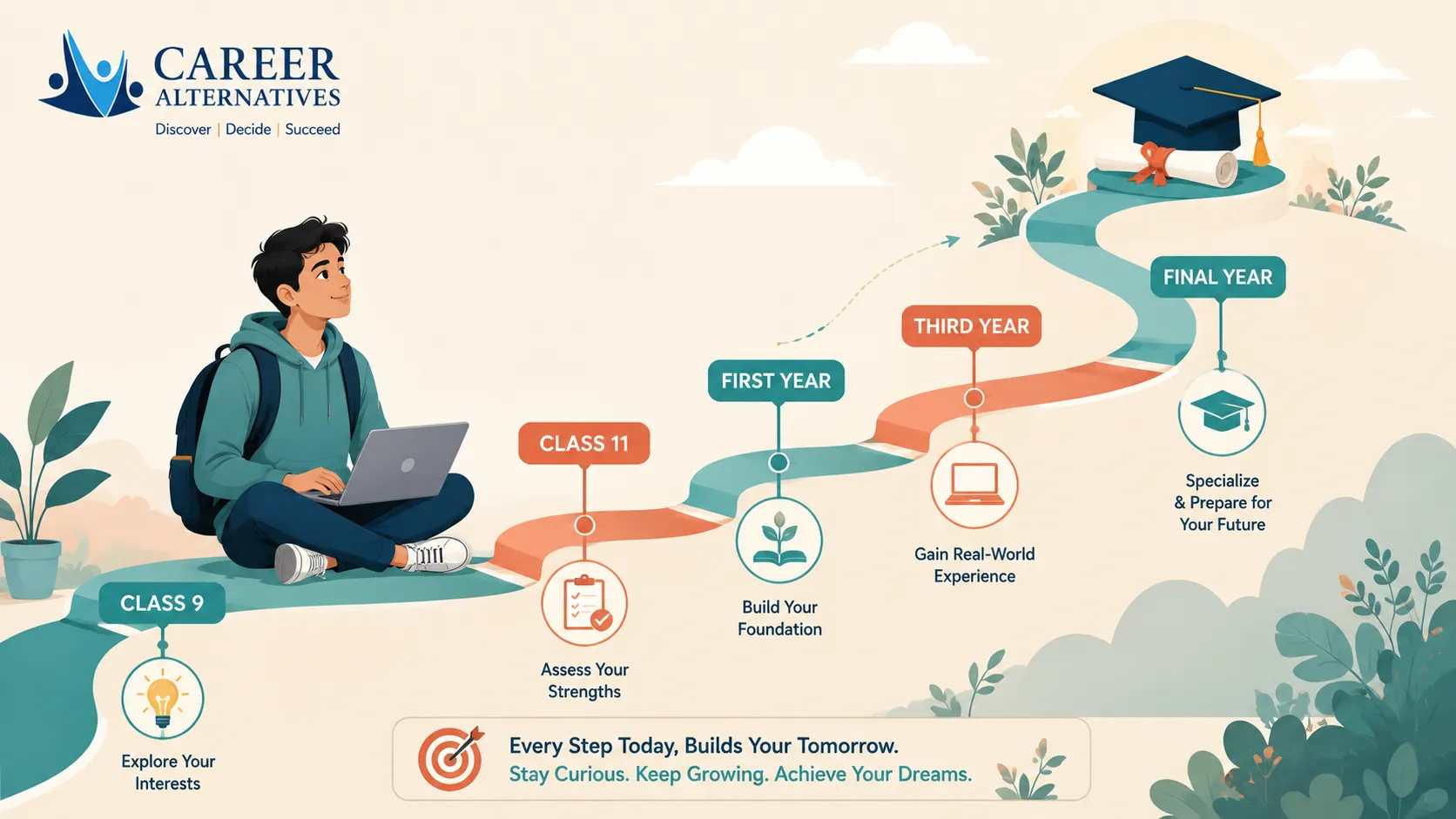
Class 9-10: Explore, Don't Decide
At this stage, the goal isn't to pick a career — it's to understand how you think, what you're naturally drawn to, and where your strengths actually lie. This is the ideal window for a career interest and aptitude test, because the results aren't locked into board exam pressure yet.
- Take a structured interest and aptitude assessment (30-45 minutes, results the same day in most formats)
- Talk to 3-5 adults in different fields for 15 minutes each — not for advice, just to hear what their day actually looks like
- Note subjects where you finish homework without checking the clock
By the end of Class 10, before choosing Science, Commerce, or Humanities, you should have at least one data point beyond "my friends are taking it" or "my parents said so."
Class 11-12: Narrow the Stream, Start Testing Options
This is where stream choice (PCM, PCB, Commerce, Humanities) starts to matter for entrance exams, and where most students feel the first real pressure. Two things matter here:
First, run a proper assessment if you haven't. A combination of a Skills Assessment and Values Assessment at this stage tells you not just what you're good at, but what kind of work environment will keep you motivated for 4+ years of study — a detail most 16-year-olds haven't consciously thought about.
Second, shortlist 3-4 realistic degree paths (not 10) and check the actual entrance exam calendar: JEE Main (January and April sessions), NEET (May), CUET (May), CLAT (December), and state-level CETs vary by month. Missing a registration window because you decided too late is one of the most common — and most avoidable — mistakes we see.
First Year of College: Build While You're Deciding
This is the year most students wrongly treat as a "break" before real career planning starts in third year. It's actually your best window to test-drive interests cheaply — before grades, loans, and placements raise the stakes.
- Do at least one internship, project, or certification outside your syllabus (aim for 4-6 weeks minimum to get real exposure, not a certificate for LinkedIn)
- Revisit your assessment results — interests shift meaningfully between age 16 and 18-19, and a fresh Personality Assessment often surfaces different strengths than the one you took in school
- Start a working list of 2-3 industries you're curious about, based on evidence (internships, coursework, conversations), not vibes
Second Year: Narrow to 2-3 Directions
By now, vague exploration should convert into a shortlist. If you're still equally open to five unrelated fields in second year, that's a signal to get personalized career guidance rather than keep drifting — a 45-60 minute counselling session at this stage typically saves months of directionless internship-hopping later.
- Pick electives, minors, or certifications that build toward 2-3 specific directions, not one for each interest
- Start tracking entry-level salary ranges in your shortlisted fields (e.g., core engineering roles ₹3.5-6 LPA at fresher level vs. product/analytics roles ₹6-10 LPA at top-tier companies — ranges vary widely by college tier and city)
- Build one visible proof of work: a project, portfolio, published article, or competition result
Third Year: Get Job-Market-Ready, Not Just Resume-Ready
This is when placements, higher-study applications (GRE/GMAT/CAT prep timelines run 6-12 months), or job hunting genuinely start. If you've followed the earlier stages, this year is about execution — internships convert to references, projects convert to portfolio pieces, and your shortlist convert to applications.
If you're starting from zero in third year, don't panic — but do compress the timeline. This is exactly where structured career training programs that combine skill-gap assessment with interview and application coaching make the biggest difference, because you don't have four years left to explore casually.
Final Year and Beyond: Positioning, Not Panic
Final year is about translating everything into applications — resumes, interviews, and if needed, further study decisions. If you graduate without a clear direction, that's not a failure of planning — it just means your planning phase happens now, compressed into months instead of years. Career counselling for graduates in India typically focuses on skills audits, market positioning, and closing specific gaps (technical skills, communication, interview readiness) rather than broad exploration.






























Sign in to leave a comment.